
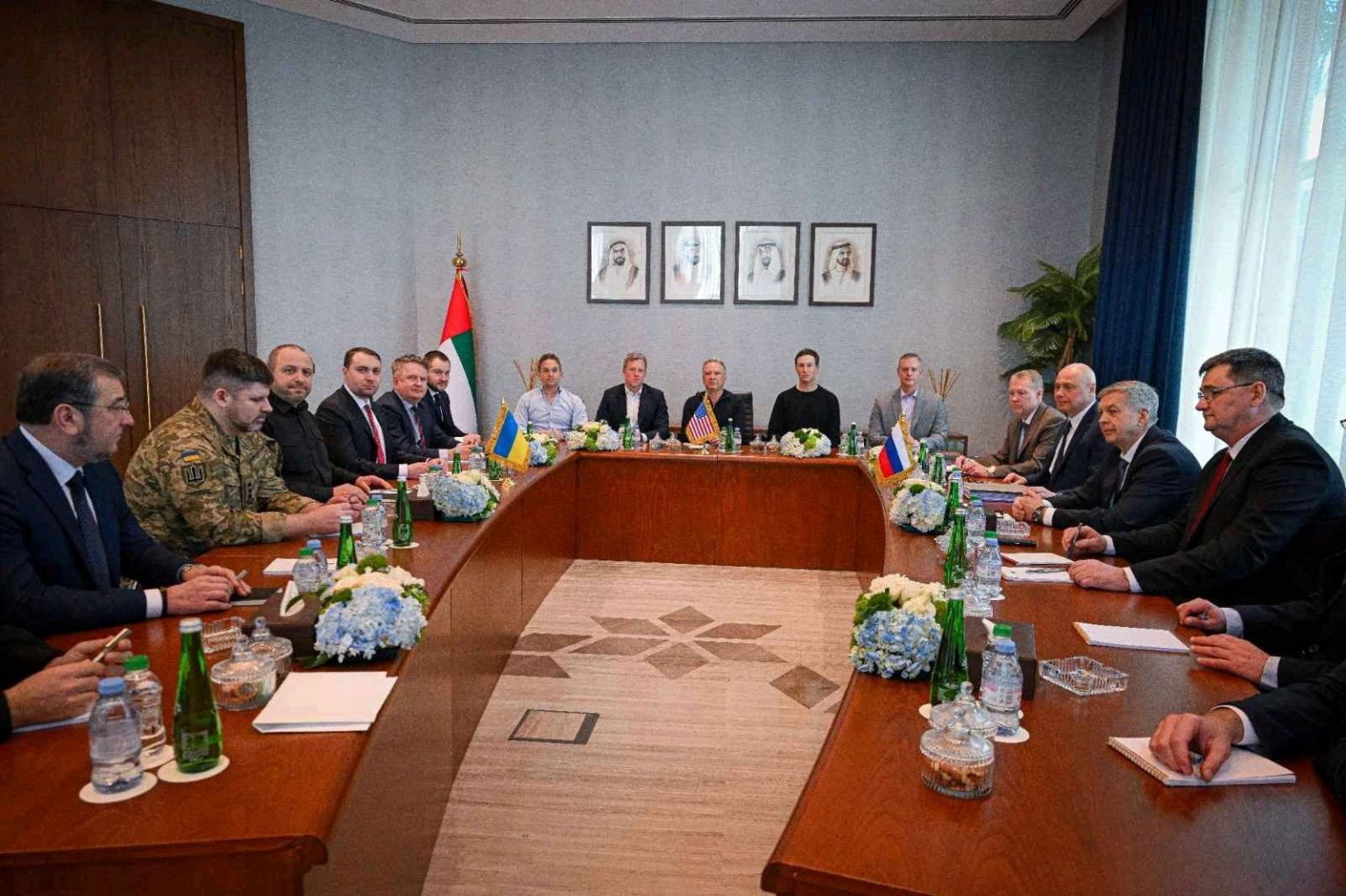
The second round of talks between Russian and Ukrainian delegates began on Wednesday in Abu Dhabi, United Arab Emirates, against the backdrop of nearly four years of European war. The warring parties once again adopted a trilateral format with a US delegation over two days.
The previous talks were hosted by the Emirates on January 23 and 24, marking the first direct meeting between the warring parties since the war began in February 2022. As in the first round, the media expected minimal progress in the discussions on the fundamental issues of the promised ceasefire.
Conflicting demands
The main and, according to Reuters, "most sensitive" issue is Moscow's demands for Ukrainian territorial concessions in the Donetsk region. According to Russia's plans, Kyiv should withdraw its troops from the entire region, which the defending country refuses to do.
Ukrainian President Volodymyr Zelensky has argued that the conflict should be frozen at the current battle line, and in the past he has repeatedly asked for Western support, including the deployment of military units to guard the ceasefire. Russia has rejected this, saying that it would consider Western troops a strategic threat to its territory.
Another pressing issue is the future of the Zaporizhzhia nuclear power plant, which is currently occupied by Russia and for which Ukraine is requesting international control.
At Thursday's meeting, Alexei Likhachev, director of the state nuclear company Rosatom, announced Moscow's position that it is open to "international cooperation" at the Zaporizhzhia nuclear power plant, but that the facility itself "must remain in Russian hands."
Ukrainian Prime Minister Yulia Svyrydenkova said on Telegram on Wednesday that Moscow had carried out 217 attacks on energy infrastructure since the beginning of this year.
Over the past year, President Donald Trump's administration has been pushing both sides to find a compromise as soon as possible that would at least dampen the fighting and stop the bloodshed. However, the demands of Russia and Ukraine seem to be incompatible.
According to Zelensky, Russia used last week's energy truce to "stockpile ammunition," which it then used to shell critical Ukrainian infrastructure—despite the truce being in effect. Tuesday's attack featured a "record number" of ballistic missiles.
Russian troops will continue fighting until Ukraine makes specific "decisions," Kremlin spokesman Dmitry Peskov said before the start of the talks. According to the press secretary, Russia's position on the "root causes" of the war has not changed, "which is known to both Ukrainian and American negotiators."
A subtle change in rhetoric
A few minutes before 11 a.m. on Thursday, negotiations began in a trilateral format—Ukraine, the United States, and Russia—as confirmed by chief Ukrainian negotiator Rustem Umerov on the Telegram platform.
The negotiating teams also met in separate working groups to discuss specific topics, after which they met again to harmonize their positions.
We are working according to clear instructions from President Volodymyr Zelenskyy to achieve a dignified and lasting peace," the former minister wrote on the X network. It is worth noting the change in rhetoric, with the Ukrainian representative speaking not of a "just" peace, but a "dignified" one. Kyiv probably does not expect that potential exchanges of territory would be fair from Ukraine's point of view.
Ukrainian Foreign Ministry spokesman Heorhij Tychyj said at a press conference in Kyiv that the current round of negotiations is focused on military issues. According to him, Ukraine wants to "hear feedback" on the issues discussed at the January meeting.
Before the negotiations, Zelensky met with the delegation—the same as in January—to hold talks with the US on security guarantees in addition to the trilateral negotiations.
"We consider the bilateral document on security guarantees with the United States to be complete and expect further substantial work on documents related to reconstruction and economic development," the Ukrainian leaderannounced.
Exchange of soldiers
The three delegations again agreed mainly on prisoner exchanges. "Delegations from the US, Ukraine, and Russia today agreed to exchange 314 prisoners—the first such exchange in five months," US envoy Steve Witkoff wrote on Twitter.
RIA Novosti subsequently reported that the two sides had exchanged 157 prisoners, with the Ukrainian contingent including three civilians captured in the Kursk region.
The second day of negotiations ended shortly after 1 p.m., with both sides describing them as productive. They agreed to inform their capitals and continue trilateral negotiations in the coming weeks.
Zelensky noted that the next round of talks would likely take place in the United States.
Fighting continues
Against the backdrop of the talks, the Russian Defense Ministry announced that its forces had "liberated" the villages of Staroukrajinka in the Zaporizhzhia region and Stepanivka in the Donetsk region. The information was reported by the state agency TASS.
"As a result of active operations, units of the Southern Group of Forces liberated the village of Stepanivka in the Donetsk People's Republic. Units of the Eastern Group of Forces continued to advance deep into enemy defenses and, as a result of decisive actions, liberated the village of Staroukrajinka in the Zaporizhzhia region," the agency quoted the ministry's statement as saying.
Shortly after the start of the negotiations, the Russians attacked a crowded market in the Donetsk region, using cluster munitions and killing at least seven people, Governor Vadym Filashkin said.
(reuters, sab)