A late but important victory for freedom of expression
The Brussels court declared the ban on the National Conservatism Conference unlawful, thereby sending a clear signal: fundamental rights apply even where political positions are provocative.
Brussels. When, in April 2024, the municipality of Saint-Josse-ten-Noode near Brussels banned a meeting of the National Conservatism Conference (NatCon), it appeared that everything was unfolding according to a familiar European pattern: a politically controversial event, the reflexive invocation of security concerns, fears of protests, and finally an official prohibition. And indeed, the planned event could not take place at first [the conference had to be moved to a different location three times, editor's note]. Everything seemed routine, as it has on many occasions before.
Last week, however, the all-too-familiar scenario took a surprising turn. A Brussels court ruled that the ban on the conference of national conservatives was unlawful.
This is an important decision. It underscores one of the central principles of a democratic state governed by the rule of law. Freedom of expression is not merely guaranteed; it must be actively enabled. In practice, however, that obligation is often overlooked.
The judges pointed out that freedom of expression and assembly are not acts of grace granted by the state when the weather is fine, only to be withdrawn when a storm approaches. According to the ruling, they are rights that state authorities must not only tolerate but also protect and promote.
At first glance, this seems obvious. In practice, however, it is frequently inconvenient: for administrative authorities that avoid conflict, for politicians who mistake peace for order, and for a public that increasingly accepts freedom only where it does not cause disruption.
Democracy thrives on disputes, not consensus
The court’s message that the state must actively support freedom of expression – regardless of whether the views expressed are perceived as controversial – touches on a sensitive issue in the current political climate.
Democracy thrives on debate, not consensus. It is not a space for opinions approved by the media, but a process for the peaceful resolution of contradictions. When such debate is perceived as a danger, democracy begins to misunderstand itself. An open process then becomes a morally curated stage.
The municipality of Saint-Josse-ten-Noode argued precisely on that basis. The mere possibility of counter-demonstrations, disruptions or escalations became the justification for a preventive ban. However, the court in Brussels made clear what is often obscured in political practice: those who argue in that way transfer a veto over fundamental rights to those who threaten most loudly or aggressively – or who simply have the prevailing opinion on their side.
Freedom is then no longer restricted by law, but by the expectation of unrest. That is not prevention, but capitulation.
The decision touches on a key aspect of democratic self-understanding. The state is not the arbiter of a pleasant atmosphere but, in the best-case scenario, the guarantor of fair play. Its role is not to prevent political conflicts, but to enable, regulate and, if necessary, protect them. Where that role is avoided through preventive bans on events, efforts to ensure internal security turn into a form of indirect censorship.
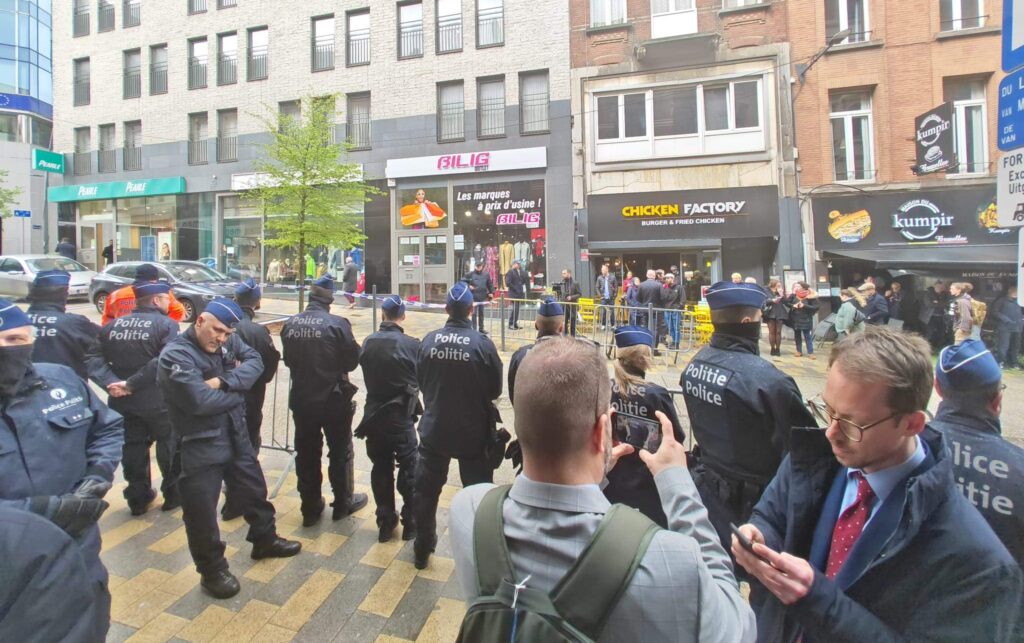
Police outside the building where the National Conservatism Conference was held. Photo: Marek Novák/Inštitút Ladislava Hanusa
Familiar patterns of censorship
This practice is nothing new. Historically, preventing unpopular political actors from expressing themselves has often been the first step towards the gradual decline of democracy. In the Weimar Republic, for example, gatherings not only of extremist but also of merely inconvenient parties were regularly banned or restricted, usually with reference to public order.
However, that was not a sign of strength – quite the contrary. The Weimar Republic ultimately failed not because the state did not crack down hard enough on the Nazis and Communists, but because of its inability to confront extremist positions politically. A state that responds to political challenges through the judiciary delegitimises itself in the long run.
The pattern can also be observed in other European democracies. Whether in post-war France, Spain during the transition, or politically charged Italy in the 1970s, state authorities repeatedly believed that political problems could be solved through administrative intervention. This rarely worked. On the contrary, it often led to radicalisation, martyrdom narratives and an erosion of trust in the neutrality of state institutions.
The modern version of that habit is more subtle. It has abandoned open repression and instead adopts the language of risk management. Prohibitions are imposed not because of content, but because of “circumstances”. Not because of opinion, but because of possible reactions. The result, however, is the same: certain political positions are effectively pushed out of the public sphere without anyone having to admit openly to that step.
Protection from the state, not from opinions
A democratic constitutional state is necessary precisely where opinions are polarised. Fundamental rights are not a reward for political conformity, but an insurance policy against the arbitrariness of the majority.
John Stuart Mill put it soberly and clearly in the nineteenth century: the value of freedom of expression lies not in the protection of recognised truth, but in the tolerance of error. Those who believe they already know which positions are harmful have already closed the democratic process in their own minds. A democratic constitution does not protect the state from its citizens, but citizens from the state.
The Brussels court recalled that simple truth. It did not judge the political merits of the National Conservatism Conference, but the actions of the authorities. It focused on process, not morality – and therein lies its democratic significance. Democracy is not a question of correct content, but of correct rules.
At a time when political camps increasingly view the state as a tool against their opponents, this is an important counterpoint. The idea of marginalising undesirable parties or movements through administrative measures may have a short-term calming effect. In the long run, however, it undermines the pluralism it purports to defend.
A democracy that tolerates only pleasant voices quietly becomes authoritarian – often without even realising it.
To put it more starkly, the Brussels ruling defends republican seriousness against post-political complacency. It reminds us that freedom entails effort: for the police, the administration, politicians and every citizen. Prohibition is the easy way. The democratic way is complex and laborious.
When Emir Kir, the mayor of Saint-Josse-ten-Noode who was responsible for the ban, declared that "the extreme right is not welcome in Brussels," he revealed himself as a democrat who is satisfied only under favourable circumstances and for whom democracy means consensus among people of good intentions – at most disturbed by a little mild criticism.
In a democracy worthy of the name, however, even political extremists have the right to express their views – quite apart from the fact that the National Conservatism Conference is anything but extremist in the political science sense.
By censuring Saint-Josse-ten-Noode, the Brussels court has strengthened democracy. It has defended freedom of expression against its situational relativisation, preserved the right of assembly from preventive erosion, and affirmed pluralism as a constitutive element of an open society.
At a time when many democracies react nervously to dissent, this is more than a legal victory.
It is a reminder that freedom lies not in avoiding conflict, but in enduring it – with trust in the law and respect for the diversity of political belief.
Placeholder For Topreaded Placeholder For Topreaded
Placeholder
Placeholder
Placeholder For Topreaded Placeholder For Topreaded
Placeholder
Placeholder
Placeholder For Topreaded Placeholder For Topreaded
Placeholder
Placeholder
Placeholder For Topreaded Placeholder For Topreaded
Placeholder
Placeholder
Placeholder For Topreaded Placeholder For Topreaded
Here is placeholder for Article excerpt Here is placeholder for Article excerpt Here is placeholder for Article excerpt Here is placeholder for Article excerpt
Here is placeholder for Article excerpt Here is placeholder for Article excerpt Here is placeholder for Article excerpt Here is placeholder for Article excerpt
Here is placeholder for Article excerpt Here is placeholder for Article excerpt Here is placeholder for Article excerpt Here is placeholder for Article excerpt
Welcome to the comments section of the Štandard daily. Please take note of our guidelines, comments are moderated by us. You can contact the moderators at [email protected].
Participate in the discussion
Comments are available to subscribers only. If you'd like to join the discussion, choose a subscription starting at €6.72 per month.
All comments 0
Register
Comments are available to registered users only. If you'd like to join the discussion, register here.