
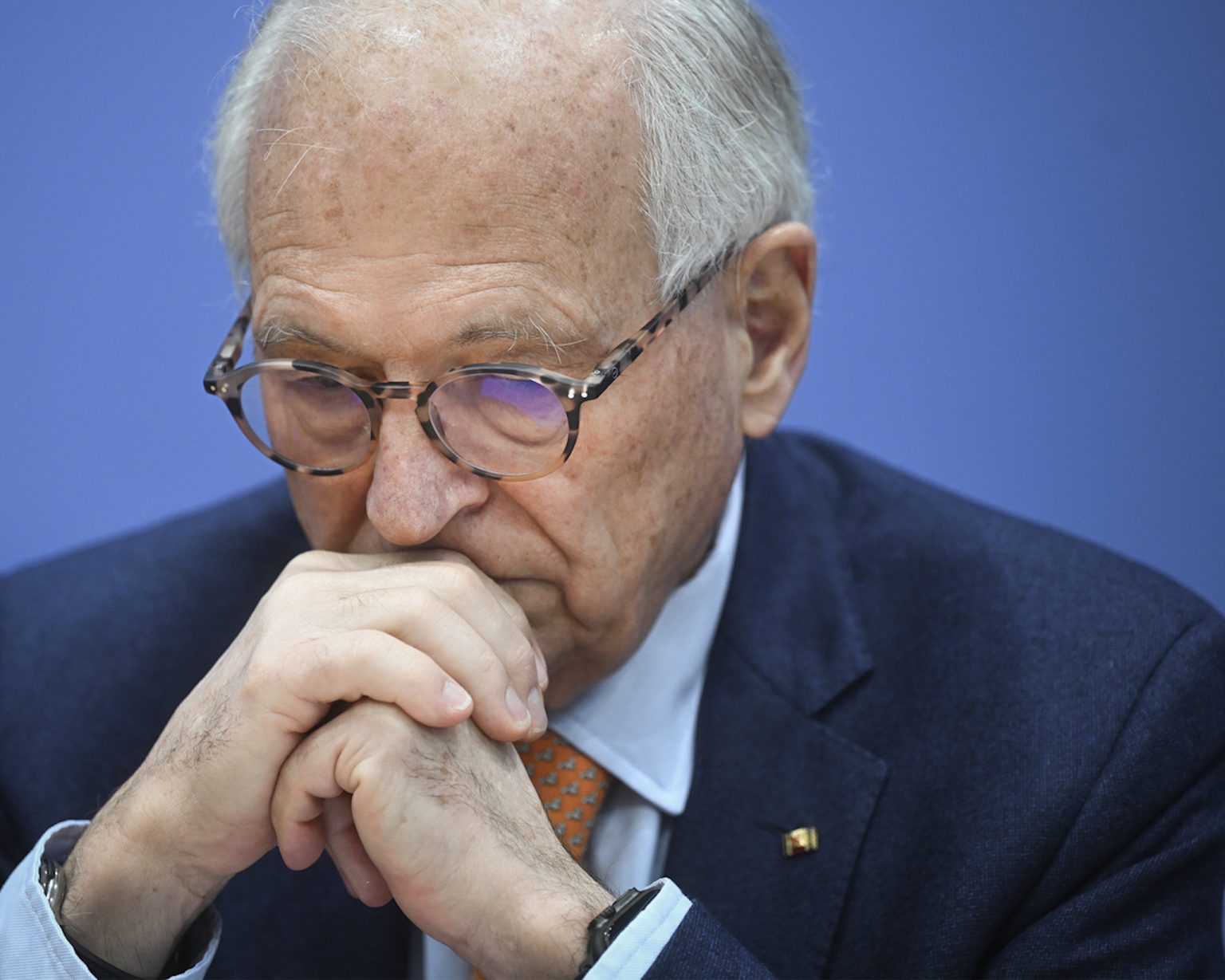
This year, the Munich Security Conference is starting without delay. The security report clearly shows that 2026 is not about fine-tuning, but about fundamental issues. Wolfgang Ischinger, who has long seen the conference as a place where tensions escalate, deliberately programmed the forum for conflict. The title of the report is not a diplomatic description, but a call to arms: Under Destruction.
The conference will take place from February 13 to 15 at the Bayerischer Hof hotel. It will be opened by German Chancellor Friedrich Merz (CDU). More than 60 heads of state and government, numerous foreign and defense ministers, and Ukrainian President Volodymyr Zelensky are expected to attend. Russia remains excluded. Munich will once again be the place where it will be decided whether analysis will be translated into political consequences.
Diagnosis: destruction as a political style
The security report begins with an uncomfortable question: what is the state of the international order after a year of profound upheaval? The answer is depressing. According to the findings, the world has entered a phase of demolition politics. Political actors gain support by promising not reform, but destruction. Gradual change is seen as failure, radical change as liberation.
The report describes this development not as a marginal phenomenon, but as a structural change. According to the report, the driving force behind this is a general disappointment with democratic institutions and a loss of confidence that reforms are even possible. In many societies, only a minority still believes that the policies of their governments will improve the lives of future generations. A sense of political powerlessness is becoming the main source of strength for those who destroy.
The report uses a drastic metaphor to illustrate this. In October 2025, significant parts of the White House were demolished. This process is not interpreted as a construction project, but as a political symbol. Demolition represents a political style that does not want to modernize existing structures. It wants to tear them down so that something completely different can be built.
The report quotes from Donald Trump's inaugural address, in which he declared that America's decline was over. For the authors, this sentence is more than rhetoric. It signifies an effort to end the existing order. The United States, which contributed significantly to the establishment of the post-war international order, now appears to be its most significant dismantler. More than 80 years after its creation, this order is not in crisis, but in a deliberate process of disintegration.
Europe caught between two threats
The report describes a double burden for Europe. The first is Russia. The offensive war against Ukraine destroyed the remnants of the cooperative security architecture after the Cold War. Europe has entered a long-term phase of confrontation. The report emphasizes that this is not just about front lines, but about the systematic expansion of hybrid warfare.
Sabotage, cyberattacks, arson, drone incidents, airspace violations, and disinformation campaigns are described as part of a strategy that deliberately stays below the classic thresholds of war. The aim is to create uncertainty, paralyze decision-making processes, and undermine the political will to support Ukraine. Europe must learn to actively address this gray zone without uncontrollable escalation.
The second burden comes from Washington. The report talks about the gradual withdrawal of the US from its traditional role as the primary guarantor of European security. Fluctuating support for Ukraine and aggressive rhetoric towards allies, for example in relation to Greenland, have significantly increased the sense of uncertainty in Europe. At the same time, it is clear that Europe has not yet completed its transition from security consumer to security provider.
The psychological description of this situation is particularly apt. Europe finds itself between repression and acceptance. On the one hand, European states are trying to keep the US involved at almost any cost. On the other hand, they are only hesitantly moving towards strategic independence, postponing preparations for a future in which US security guarantees will be subject to greater conditions.
Economy, trade, and coercion
The report devotes a separate chapter to the global economy. The authors consider 2025 to be a turning point. The United States has openly begun to use economic pressure to force political and trade concessions. This essentially marks an abandonment of the rules-based trading system that Washington helped to build. At the same time, China continues its market-distorting practices and is intensifying its exploitation of economic bottlenecks, particularly in the case of critical raw materials.
The report notes that global trade is more resilient than originally expected. At the same time, it warns of the long-term costs of fragmentation and uncertainty. These act as an invisible tax on wealth, hampering investment and undermining economic planning. Ironically, these effects also affect the United States itself.
The report also describes conflicting trends. New trade coalitions are emerging around the world that continue to adhere to the principles of the global trading order. At present, it is impossible to answer the question of whether these coalitions will be sufficient to at least partially preserve rules-based trade, or whether the system will completely shift to the law of the strongest.
The American delegation and the memory of Vance
This year, the US delegation in Munich will be led by Secretary of State Marco Rubio. He will be accompanied by more than 50 congressmen from both parties. The unusually broad parliamentary participation is seen as a signal that Washington wants to show its presence despite transatlantic tensions, but also as a manifestation of domestic political divisions that influence US foreign policy.
On the contrary, the participation of US Vice President JD Vance. His speech last year had a lasting impact on the conference. Vance sharply criticized Europe, spoke of internal threats, and accused European governments of shortcomings in the areas of freedom of expression and democratic culture. His speech was perceived by many as a moment of open transatlantic alienation.
The question of whether Vance, the "security bogeyman," will be on stage again this year is one of the most frequently asked questions on the eve of the conference. The sobering answer is: not in person. However, the fundamental debate sparked by his speech continues to influence the conference. The focus is on America's course, the reliability of security guarantees, and the future of the transatlantic partnership—regardless of who is speaking.
Munich as a point of decision
The 2026 Munich Security Conference is thus more than a routine meeting. It is a test of Europe's ability to act. The continent must simultaneously confront Russian aggression, support Ukraine politically, militarily, and economically, and adapt to an America that is tying security guarantees to stricter conditions.
The security report provides a diagnosis with unusual sharpness. Munich will show whether this will result in a strategy. Ischinger's concept remains unchanged: no Sunday speeches, no self-affirmation, but confrontation. The question hanging in the air during the three days from February 13 to 15 is no longer whether the international order is under pressure. The question is whether Europe is prepared to withstand this pressure – and to draw conclusions from it.