
When US Vice President JD Vance spoke at the Munich Security Conference last year, the tension in the room was palpable. Vance did not identify Russia, China, or the Global South as the greatest threat to Europe, but rather internal developments: restrictions on freedom of expression, political approaches to migration, and the marginalization of inconvenient forces.
Many in Germany perceived this as a provocation, and Defense Minister Boris Pistorius sharply rejected comparisons to authoritarian regimes.
Vance's speech left its mark. It signaled a break with the traditional transatlantic division of roles: Washington usually pushed for higher military spending, while its European partners relied on values and the multilateral order. However, Vance did not question Europe's willingness to act, but rather the state of its society and its value foundations.
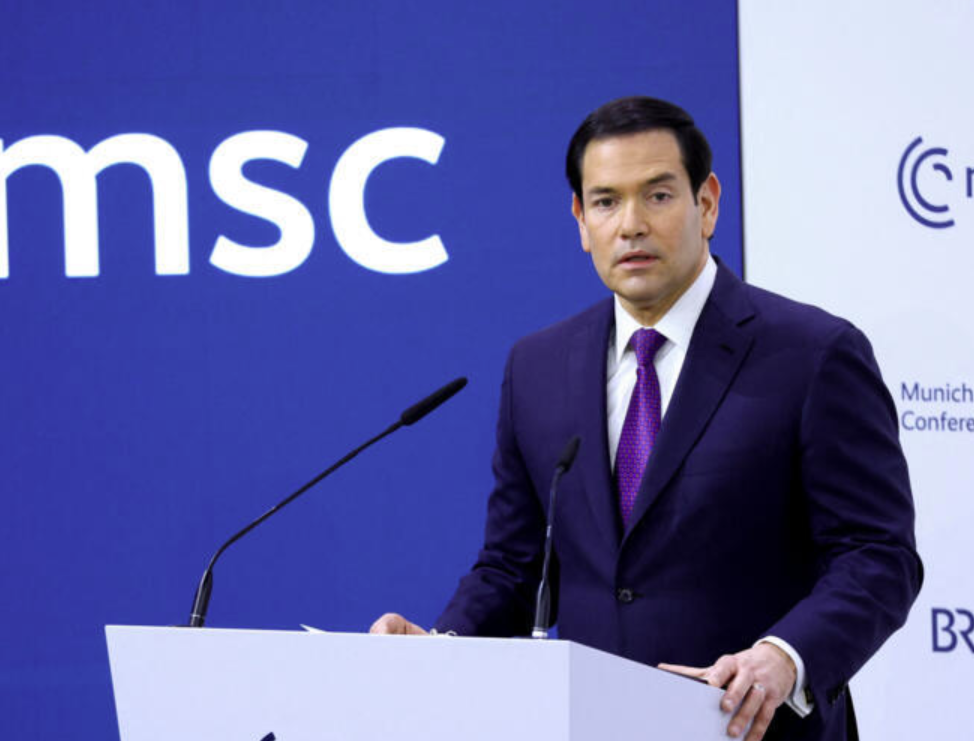
That is why this year's speech by US Secretary of State Marco Rubio in Munich was more than just a routine diplomatic stop. Rubio offered an assessment of the situation and at the same time ideologically followed up on Vance – further escalating the dispute and placing it in a broader historical context.
Unlike Vance, however, he focuses less on day-to-day politics and more on the story of the rise, self-deception, and impending decline of the West.
Rubio does not begin with current conflicts, but with memories. He recalls the division of Germany, a period when Europe was divided between freedom and communism. He talks about the Cuban crisis, a moment when the world stood "on the apocalyptic edge of the abyss," worse than anything humanity had ever experienced before. The outcome was then uncertain and "billions of lives were at stake."
According to Rubio, the West survived this era thanks to its common goals. It knew not only what it was fighting against, but also what it was fighting for. Europe and America built prosperity, the Iron Curtain fell, and Germany was reunified. However, according to Rubio, it was precisely the euphoria of victory that led to a dangerous illusion.
The illusion after victory
Rubio argues that after victory, the West succumbed to self-deception—the belief in "the end of history." It assumed that economic interdependence would replace political power and that trade, markets, and rules-based order would render national interests obsolete. He describes the idea that "economic and trade ties will replace the role of the state" and that a world without borders will emerge in which everyone will become a global citizen.
"And that was not a reasonable assumption," says Rubio. In his view, it ignored the experience of thousands of years of history. The West paid a high price for this illusion.
He is most critical of economic and industrial policy. According to him, the West adopted a "dogmatic ideology of free and unregulated trade," while other countries protected and supported their own businesses. As a result, entire regions lost their industrial core and production moved abroad.
"We transferred our sovereignty elsewhere," Rubio claims, while other countries invested heavily in armaments and used "hard power" to promote their own interests. He does not see deindustrialization as a natural development, but as a political decision with strategic consequences.
He also includes climate policy in this criticism. According to him, the West took measures "to appease the climate cult," while its opponents deliberately used gas, oil, and other resources to strengthen their own economies—and also as a tool of coercion against others.
Rubio is most outspoken on migration. He does not consider the opening of borders to mass migration to be a marginal issue, but a crisis with civilizational dimensions. According to him, it has threatened "the survival of our culture and the future of our nations." Migration, he says, is not just an administrative issue, but a process that changes and destabilizes societies.
The tone is noteworthy. Rubio does not place the responsibility solely on Europe. "We made these mistakes together," he says, and concludes that we have a shared responsibility to rectify the situation.
The West's offer – and ultimatum
Rubio derives the political line of President Donald Trump's administration from this diagnosis. According to him, under Trump's leadership, the United States will decisively embark on the renewal and strengthening of the West "for a future that will be as proud and sovereign as in the past." The key sentence comes early and acts as a strategic turning point: the US is prepared to go down this path alone if necessary.
At the same time, however, he emphasizes that America wants to take this path together with Europe. "It is clear to both the US and Europe that they belong together," he says, recalling the European roots of the United States. According to him, America is part of Western civilization, united by Christian faith, cultural heritage, language, history, and the sacrifices of past generations.
He explains the directness of American demands by saying that the US cares about the future of Europe. If they sometimes disagree, it is precisely for this reason, he says. Europe must survive because its fate is closely linked to that of America.
According to him, national security is not primarily a technical question of budgets or the number of soldiers. The decisive factor is "what we are actually defending." Armies do not fight for abstractions, but "for people, for nations, for our way of life."
We must defend a civilization that has reason to be proud of itself. Rubio lists a cultural canon ranging from the rule of law and universities to Mozart, Dante, Shakespeare, and the Sistine Chapel. According to him, this list is not random: only those who embrace this heritage can shape the economic and political future.
Deindustrialization, he argues, was not inevitable, but the result of a conscious political choice. Migration is not a marginal issue, but an ongoing crisis. Reindustrialization is possible, as is the building of Western supply chains for critical raw materials that will not be vulnerable to blackmail.
Rubio does not reject international cooperation, but he clearly downplays it. The United Nations can produce good results, but it has failed in key conflicts. He mentions Gaza, Ukraine, Iran, and Venezuela, and in each case emphasizes the role of American leadership.
According to him, international law must not serve as a protective shield for those who threaten citizens and undermine global stability.
In conclusion, Rubio summed up his speech with a civilizational challenge. The West is once again at a crossroads. Decline is not a law of nature, but a choice. What is needed are not the weak, but "strong and proud allies" who can defend their heritage. It is not about maintaining a status quo that no longer works, but about a renewed alliance that looks boldly to the future. The conclusion is both programmatic and emotional: America sees its home in the Western world and "will forever remain a child of Europe."
After last year's speech by JD Vance, Rubio's speech brings no appeasement, but further escalation: it offers joint renewal – but at the same time gives Europe an ultimatum to reaffirm its own foundations.
The original text was published on the website of the Austrian sister newspaper Statement.at.