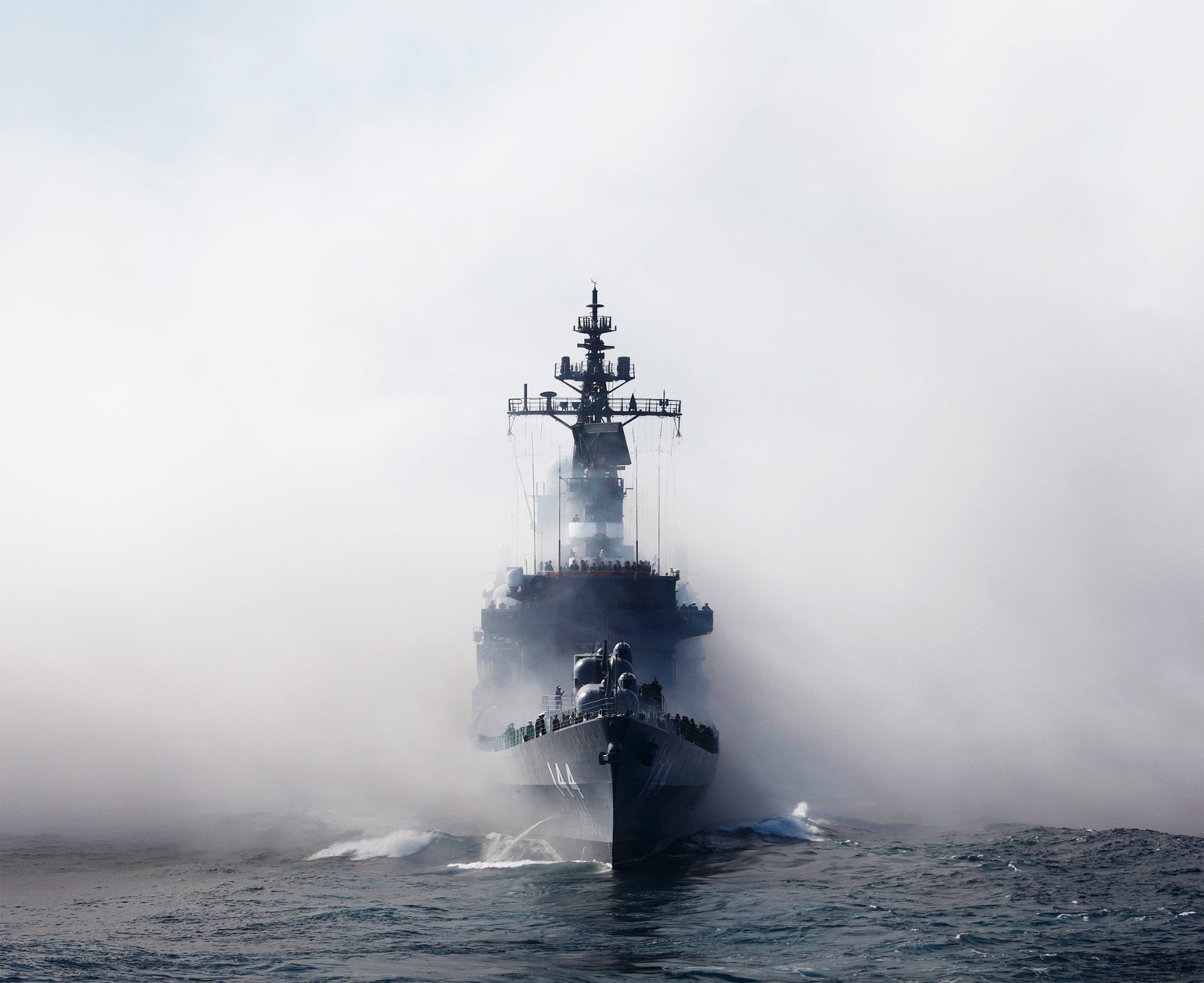
It goes on to declare that, in order to “achieve” that aim, “land, sea, and air forces, as well as other war potential, will never be maintained,” and that the state will not recognise the “right of belligerency” (ius ad bellum).
Japanese constitutional lawyers therefore frequently debate whether the existence of the country’s armed forces, officially known as the Self-Defence Forces, is compatible with the constitution.
A challenge to the post-war settlement
Proposals to repeal the pacifist clause, which, together with the demilitarisation of Germany after the Second World War, is regarded as one of the cornerstones of the international security architecture, come primarily from two parties: Sanseitō, whose name roughly translates as the “Do It Yourself Party”, and the Conservative Party of Japan.
Sanseitō won 15 seats in the February election. Although it is not part of the LDP–Ishin coalition, it is widely expected to support the planned tightening of migration policy, particularly with regard to immigration from Islamic countries. The Conservative Party of Japan, founded in 2023, does not hold a single seat in the lower house and has two councillors in the upper house.
The leader of the so-called DIY Party, Shōhei Kamija, whose political movement originated in part from a YouTube commentary channel, met LDP Vice-President Tarō Asō on 25 December last year. The two politicians discussed areas of political convergence, and Asō reportedly offered his younger colleague “some advice”.
Even within the ranks of the Liberal Democratic Party, one of Japan’s longest-established political forces, there are voices calling for a fundamental rethink of the existing security framework. On 29 December, upper house member Ishi Hirai reacted to Chinese naval exercises around Taiwan by arguing that Japan should acquire its own nuclear weapons as a deterrent.
“Not only have China’s military exercises surrounded Taiwan from the east, west, south and north, but the exercise area on the northern side is also pressing against the western edge of the Senkaku Islands. The threat from China is now imminent. Strengthening national defence is an urgent task for our country, and discussions on nuclear weapons and constitutional revision can no longer wait,” he wrote on the social media platform X.
The analytical portal Bellum Acta noted that Hirai is of Chinese origin. He was born in Sichuan province under the name Shi Ping, and the Chinese Communist authorities have previously imposed sanctions on him for calling for the overthrow of the regime.
Sanseitō significantly strengthened its position in the House of Councillors elections, winning 15 of the 248 seats in July 2025. It marked the most substantial advance of monarchist and far-right forces since the end of the Second World War.
Even the oldest party is shifting to the right
According to domestic and international observers, the strengthening of what are often described as “far-right” political forces in the Land of the Rising Sun is driven by rising migration and concerns about insufficient integration. In 2023 and 2024, around 3.4 million people reportedly arrived in Japan for work, a trend that Takaichi moved to curb in November.
On 4 November, the prime minister instructed the relevant ministries to tighten controls and enforcement in areas ranging from unpaid insurance contributions and expired visas to unauthorised logging. In the same month, she also announced a crackdown on public order, targeting what she referred to as “prostitution networks”. The proposed amendment would penalise not only sex workers themselves but also their “clients”.
These measures indicate that the policy shift extends beyond migration alone, although the issue remains the most frequently cited concern among Japanese voters. The figure of 3.4 million foreign nationals represents a marked increase compared with the data published by the International Organization for Migration (IOM) in 2020, which recorded nearly 2.8 million foreign residents, “representing about two per cent of the total population”.
That is why both domestic and international media began last year to report on growing Japanese unease about the influx of foreign nationals, particularly from Islamic countries. Japan has long maintained a certain social distance towards outsiders – the term “gaijin” (foreigner) is often regarded as pejorative – yet recent criticism has been directed more specifically at particular groups.
The Australian-founded, later Japan-based weekly The Diplomat noted, citing at least ten opinion polls, that voters “are no longer anti-immigrant”. However, Sanseitō and the Conservative Party were both established only within the past decade and have cultivated a far stronger presence on social media than the older parties.
“The large number of votes won by Sanseitō candidates and some independent anti-immigration candidates can be attributed more to their populist style of speech and engagement on social media,” the magazine observed.
Demographic pressure and migration
Japan is also grappling with profound demographic change. After the economic boom of the 1990s, the population began to age rapidly, while many of working age postponed starting families. The result has been a steadily ageing society and a shrinking workforce. The Japanese term shōshi kōreika is used to describe this trend of low fertility and population ageing.
The Asia-Pacific Journal has estimated that Japan will require approximately 6.9 million foreign workers by 2040 in order to meet the government’s GDP growth targets. The country’s current birth rate stands at around 1.4 children per woman, well below the replacement level of 2.1.
Despite the perceived economic need for immigration, public debate has taken a distinct turn online. On social media platforms, particularly among so-called netizens, inflammatory narratives familiar from parts of the West have gained traction, including stereotypes about Pakistani migrants and conspiratorial claims alleging that Jewish groups are using Islamic migration to destabilise developed countries.
Muslims, who number approximately 420,000 and account for around 0.3 per cent of the population, are increasingly the subject of political controversy. Only about 47,000 Muslims are of Japanese origin, according to Mizuho Umemura, an upper house member representing Sanseitō. At the end of November, she publicly called for a ban on Islamic burials.
Umemura spoke of what she described as the spread of Islamic cemeteries, arguing that they undermine Japanese customs and risk contaminating groundwater. Responding to questions about the need for burial sites, she stated that foreigners who choose to settle in Japan should be informed that in the event of death “they can either be cremated or their remains can be repatriated” at their own expense.
Faced with mounting labour shortages and growing pressure on the social security system, Japan will have to address the question of migration more directly or find alternative ways to counter its demographic decline.
A new world war on the horizon
The reference to nuclear weapons is of far greater long-term significance. It comes from a member of the ruling coalition and cannot be dismissed lightly.
Japan and Germany were the defeated powers of the Second World War. In its aftermath, the victors regarded both states as historically aggressive and imposed strict limits on their rearmament. Japan therefore incorporated a constitutional restriction on maintaining armed forces. Similar ideas were initially discussed for Germany, although the strategic demands of the Cold War soon altered that approach.
Japan’s demilitarisation and the integration of West Germany’s military structures into NATO, alongside its economic integration into what later became the European Union, have long been regarded as central pillars of the post-war security order. Many political scientists, particularly in the West, continue to defend that framework.
One of the earliest indications that this order may be shifting emerged in Berlin, where voices have called for the development of nuclear capabilities that could, in the event of an existential threat, be converted into military use.
Takaichi’s decisive victory in the repeat election, along with renewed calls to repeal Article 9 of the Constitution and to pursue rearmament, is presented by some commentators as a sign of an emerging new era. The “departure” in question, however, refers to a far-reaching transformation of the so-called rules-based order so often invoked by European leaders.
Even many of its proponents now concede that this order, often described in more technical terms as the post-war security architecture, is under strain and may be entering a period of decline.
The world has experienced roughly 80 years without a direct global conflict between major powers. That relative stability is widely attributed to the post-war settlement and to the willingness of the defeated states to accept the conditions imposed by the victors. Yet the foundations of that settlement are increasingly contested. As Pope Francis warned at the beginning of his pontificate, the world has, since the start of this millennium, been living through what he termed a “piecemeal Third World War”.
The war in Ukraine has drawn Russia closer to Iran and North Korea, while the conflict in the Gaza Strip has had repercussions in Syria and parts of North Africa. Against this backdrop, tensions have also emerged between Saudi Arabia and the United Arab Emirates, both of which may align more clearly with one or another regional bloc.
The comparison with the late 1930s is frequently made. The German invasion of Poland in 1939 was preceded by Japan’s invasion of China in 1937, marking the start of the Second Sino-Japanese War. The Second World War thus grew out of a chain of interconnected regional conflicts.
At the same time, the Second World War followed the first, then known as the Great War, after barely two decades, and the order created by the Treaty of Versailles never had the opportunity to consolidate fully. By contrast, earlier large-scale conflicts such as the Crimean War or the Seven Years’ War are sometimes described by historians as proto-global wars, though separated by much longer intervals.
It may therefore be argued that any security architecture or “rules-based” international order has a limited lifespan. The erosion of such an order tends to become visible through symbolic challenges to its core pillars – and the present period may prove no exception.