
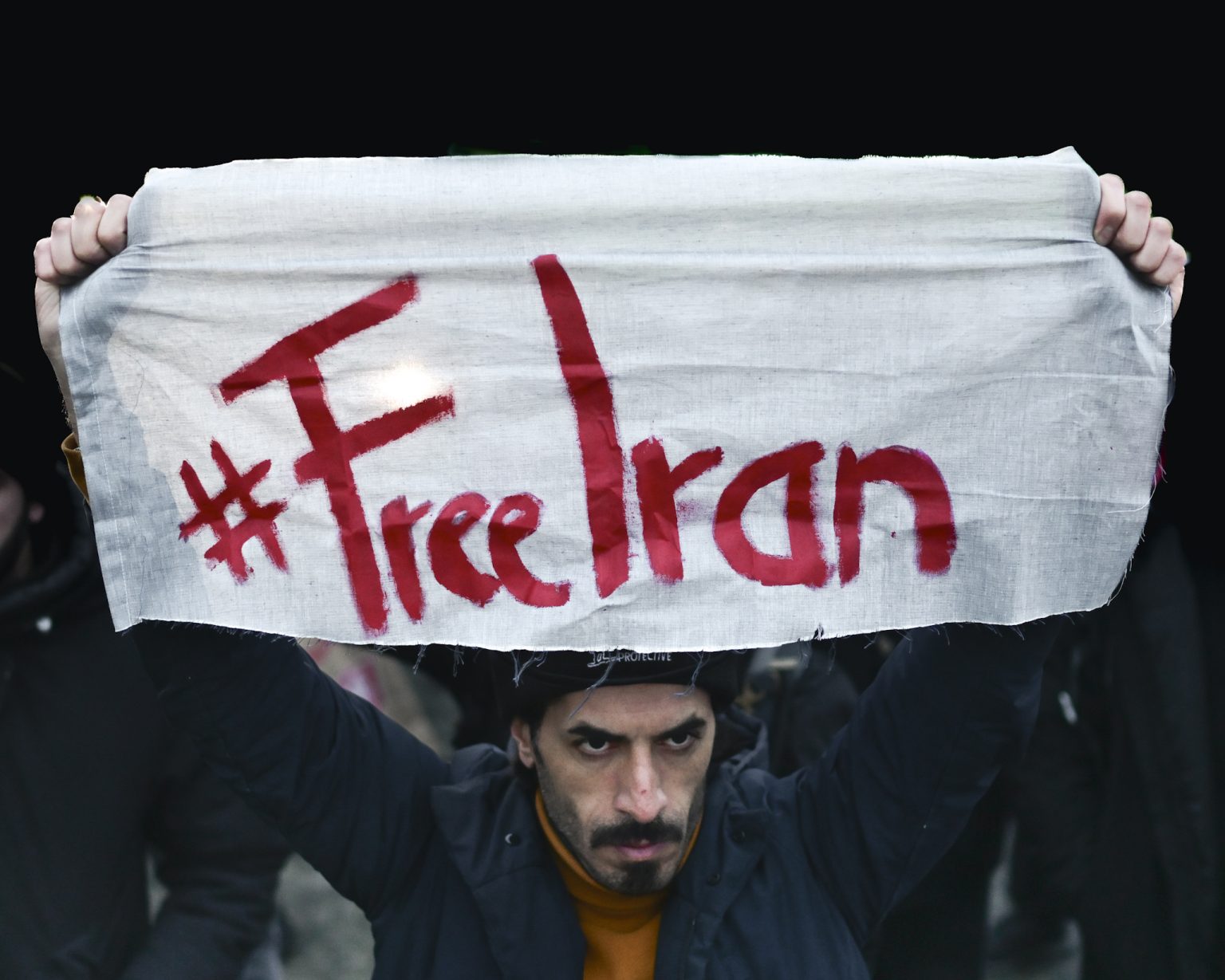
Tehran. Monarchist demonstrators in Iran have once again taken to the streets in recent days, launching a fresh round of protests that began on 28 December last year and later escalated into violence, resulting in deaths among both protesters and members of the security forces.
In early January, Tehran deployed special forces known as NOPO, or the Counterterrorism Special Forces, to quell the unrest. The units temporarily suppressed the street protests, yet demonstrations soon resumed with renewed intensity, prompting the deployment of the most hardline combat formations – the Islamic Revolutionary Guard Corps.
The regime’s powerful paramilitary force then permitted the families of those killed to bury the dead. In accordance with Shiite Islamic custom, a 40-day mourning period followed. After it elapsed, protests flared up again on 17 February in Iran’s second-largest city, Mashhad.
Demonstrators once again chanted the slogan “Death to the three corrupt: mullahs, communists, MEK”, the final acronym referring to the left-wing extremist People’s Mujahideen Organisation [the organisation is banned in Iran; its leadership is in exile – editor’s note].
Protests also broke out at the Behešt-e Rezván cemetery in the city of Shahriar, near Tehran. Mourners raised photographs of Amir Mohammad Loftí, who was shot dead on 9 January.
Any depiction of faces occupies a legally ambiguous space under Islamic law. Although not explicitly prohibited, it constitutes a powerful symbolic gesture of resistance to theocratic rule.
In addition to suppressing the protests, the Guards are again attacking Kurdish positions in the north-west of the country. They reportedly struck the vehicle of the opposition Kurdish politician Omar Ilchanizadi. He was not in the car at the time of the attack, but two members of the Peshmerga units were killed.
External pressure
Alongside the renewed demonstrations under the slogan “Javad Shah” [long live the Shah, a reference to the Pahlavi dynasty – editor’s note], pressure on the Shiite government is also mounting from its strategic adversaries. At the end of January, Israeli intelligence sources told the media that the White House and the Pentagon were preparing plans for a “week-long” military operation.
Statements from members of the Trump administration also emerged. They told The Wall Street Journal that they had helped smuggle around 6,000 Starlink communication terminals, produced by billionaire Elon Musk’s company, into Iran. Despite the government’s deliberate throttling of internet access, protesters were able to transmit accounts of the violence to the outside world.
The government of the ayatollahs is also burdened by the worst water crisis in the country’s history, partly the result of inefficient water management. Large-scale extraction systems draw almost all available groundwater at once, leading to subsidence of up to 35 centimetres per year. After a brief period of accumulation, severe shortages follow.
For that reason, discussions were held in January last year about relocating the capital, a move that would have affected around ten million residents of Tehran. On 20 November, President Massoud Pezeshkian acknowledged that the proposal to move the capital from Tehran to the historic region of Makran was becoming a necessity. “We no longer have a choice,” he said.
There has already been one war ...
Israel struck Iran’s nuclear facilities on 13 June 2025, the day the International Atomic Energy Agency released its report on Tehran’s nuclear programme. While the report noted a continued increase in enriched uranium stockpiles, it did not present conclusive evidence of an active weapons programme.
The Israeli Air Force targeted the facilities at Fordow, Natanz and Isfahan. Twelve days later, the United States joined the campaign, deploying B-2 Spirit bombers against the same sites. US President Donald Trump subsequently declared that Iran’s nuclear programme had been “obliterated”.
American involvement provided Tehran with a pretext to strike the al-Udeid base in Qatar, although the attack was widely described as largely symbolic. Against Israel, however, Iran deployed substantial firepower. By the end of the conflict, there were concerns that Israeli air defences could deplete their interceptor stocks for the Iron Dome and David’s Sling systems.
Amid reports of a possible second round of hostilities, the US Department of Defense dispatched a second aircraft carrier and an amphibious group to the Arabian Sea. The USS Gerald R. Ford, which had recently been operating in the Caribbean against what Washington termed “narco-terrorists” from Venezuela and Colombia, joined the USS Abraham Lincoln in reinforcing the American naval presence in the region.
... and maybe there will be a third
The attack — the details of which Trump has yet to decide — is intended as a response to the lack of progress in negotiations on a new nuclear agreement. The original accord was concluded by Tehran in 2015 with the administration of Barack Obama and three European states in the so-called E3 format.
In 2018, Trump unilaterally withdrew from the agreement and imposed severe sanctions as part of his “maximum pressure” policy. These were partially eased by his successor in the White House, Joe Biden, who in September 2023 unfroze a total of $6 billion in humanitarian funds held in South Korean banks.
Following his second inauguration, Trump once again adopted a hard line towards Iran, a stance critics interpret as pandering to Israeli interests.
Since 20 January 2025, Israeli Prime Minister Benjamin Netanyahu has visited the White House six times. US Ambassador to Jerusalem Mike Huckabee has met the convicted spy Jonathan Pollard, and several members of the administration are openly pro-Israel.
During his first term, however, Trump also cultivated warm relations with key Arab powers. Some of them — Qatar, the United Arab Emirates and Egypt — have in recent years moved closer to Israel, partly in connection with extensive investment ties with the United States worth billions of dollars.
Iran’s theocratic government is therefore losing allies among Arab states as well as among militant and terrorist organisations. Movements such as Hamas, Hezbollah and Yemen’s Ansar Allah, also known as the Houthis, have been significantly weakened by the war against Israel, even though they are attempting to regroup.
This year, representatives of Iran and the United States met twice, on 6 and 17 February. Foreign Minister Abbas Araqchi rejected Trump’s threats but added that a “framework” understanding had been reached with envoys Steve Witkoff and Jared Kushner in a process under way since April 2025.
Nevertheless, continued American military and diplomatic pressure may yet contribute to instability within the Shiite regime, which is already being weakened by renewed protests. Their second phase is only just beginning, but it could, in a plausible scenario, threaten Khamenei’s position.
Such a development would add further strain to an already fragile Middle East — understood in its broader geopolitical sense as stretching from Morocco to Pakistan. In recent months, parts of this wider region have become arenas for proxy competition between the United Arab Emirates and Saudi Arabia.
As the French analyst Clément Molinhas has observed, Riyadh backs the Sudanese army, while Abu Dhabi supports the Rapid Support Forces. Rival influence is also visible in Ethiopia, where the conflict involving the Tigray People’s Liberation Front intersects with broader regional alignments.
A certain Emirati–Saudi tension also extends to Libya, where Saudi Arabia has supported the internationally recognised government, while General Khalifa Haftar has relied on backing from the United Arab Emirates. Proxy conflicts have also affected Yemen, where Abu Dhabi supports the Southern Transitional Council, while the Presidential Leadership Council enjoys Saudi support.
It has also been alleged that the Saudi monarchy has begun bribing the Houthis to attack positions held by southern separatists calling for the restoration of South Yemen.
Relations between Riyadh and Abu Dhabi have recently hardened further. In 2020, the Emirates joined the Abraham Accords, formally recognising Israel and establishing diplomatic relations. According to The Washington Post, this move earned Abu Dhabi the label “Israel’s Trojan horse” in parts of the Saudi discourse.
“After Saudi Arabia bombed the Emirates’ partner forces in Yemen on December 30, the number of Saudi posts criticising Israel increased dramatically, with 77 per cent of comments attacking the Emirates as ‘Israel’s proxy carrying out Zionist plans to divide Arab states,’” wrote the analyst David Ignatius.
Riyadh also described the framework of agreements with Tel Aviv, presented by Trump during his first term, as a “political-military alliance in the guise of religion”. This characterisation was rejected by Senator Lindsey Graham, who, in a speech at the Munich Security Conference, called on Crown Prince Mohammed bin Salman to “relax”.
Pakistan has once again become the target of accusations of supporting militant groups, this time from representatives of the Taliban in Afghanistan. A spokesman, Zabihullah Mujahid, stated that the movement “has evidence” that Pakistan’s ISI intelligence service helped establish and finance training camps for Islamic State Khorasan.
This is the same branch of the self-proclaimed caliphate that carried out the terrorist attack at Crocus City Hall near Moscow in March 2024.
Commenting on the threat of war between Tehran and Washington, Mujahid noted that the Islamic Republic had defended itself “relatively successfully” in previous confrontations and had a legitimate right to self-defence. “In the event of a possible conflict between Iran and the United States, Iran would have the capacity to emerge victorious,” Mujahid added.
From regional conflict to global fault lines
What began as a “war in Israel” or a “war in the Gaza Strip” is gradually expanding into a broader ethnic-religious confrontation with global implications. If one adds Iran’s alignment with Russia and China, and Israel’s partnership with the United States and several Gulf states, it increasingly resembles Pope Francis’s warning of a “fragmented Third World War”.
The result could be renewed migration flows from North Africa and the Arabian Peninsula towards the European Union. Even if the conflicts in the Maghreb and the Arabian Peninsula seem distant, their impact may ultimately be felt in Europe — whether on the streets or in public finances.