
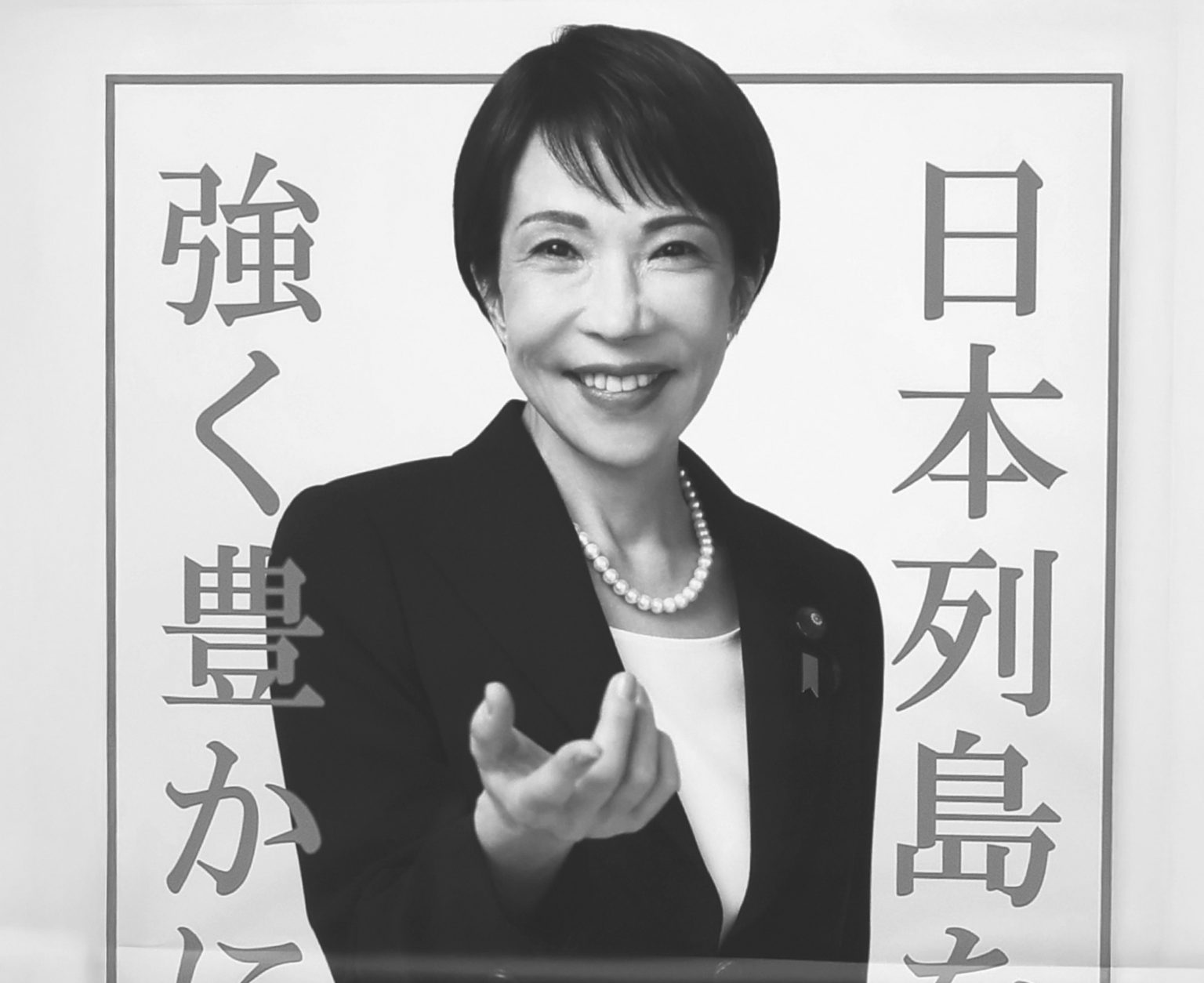
Tokyo. In early February, Japan's prime minister secured a mandate from voters that her predecessors could scarcely have imagined. Two-thirds of the seats in parliament is a windfall for a party that in recent years has struggled with minority governments.
Sanae Takaichi may be stepping into the political space left by Shinzo Abe’s departure. No one has yet managed to follow in the footsteps of her mentor, the long-serving prime minister and central figure in Japanese politics for much of the past two decades.
An important figure
When the current prime minister assumed the leadership of the Liberal Democratic Party and of the government in the autumn, the outlook was bleak. Led by uninspiring figures, the party’s support had halved in recent years.
Takaichi replaced her intra-party rival Shigeru Ishiba. He was regarded as so colourless that when President Donald Trump spoke to reporters about Japan, he could not recall his name and referred to him as "Mr. Japan". Yet he considers the country a key player in the American geopolitical game.
When Trump first entered the White House, he invited then prime minister Abe as his first foreign guest and showered him with honours. Ahead of this year’s election, he publicly endorsed Takaichi.
It is no surprise that the US is interested in Japan. It remains the most important stronghold of American influence in a region where tensions between Washington and Beijing are intensifying and where the shape of the emerging multilateral order is being determined.
No other country hosts as many American soldiers as Japan. Yet the most important trading partner of this key American ally is China. A Sino-American conflict would be devastating for Japan, as the country is heavily dependent on imports – primarily from China, the US and Australia – as well as on exports, mainly to China, the US and South Korea.
Duck necks and returning pandas
There are also American expectations regarding Japan’s role in such a conflict. Washington would almost certainly want Japan to be directly involved, ideally in a proxy war in which the Japanese would bear the main burden. Critics of the prime minister fear that she is moving in that direction.
In November, she caused a storm in relations with China when she declared that a Chinese attack on Taiwan would constitute an existential threat to Japan. In Japanese understanding, that would imply military involvement.
No Japanese prime minister has spoken so openly.
The taboo extended to any mention of a hypothetical conflict and to Japanese participation in it.
China reacted sharply. The consul in Osaka wrote that it was necessary to "chop off dirty duck necks", and Beijing imposed economic measures restricting exports of rare earths and tourism, as well as imports of Japanese food. Even the pandas were affected, returning from Tokyo Zoo to the land of the dragon. The Chinese public welcomed the tough response, while at home the prime minister emerged as a political star defying the Chinese giant.
Washington appears satisfied; Trump knew whom he was backing. How the two East Asian powers will now manage the consequences remains to be seen.
US protectorate and nuclear weapons
Relations with the US are far from straightforward. The American security umbrella remains a thorn in the side of Japanese pacifists, who oppose the presence of American troops and the country’s involvement in US wars, as well as of nationalists, from whose ranks Takaichi hails.
They have long called for a more equal relationship with Washington, seek to amend Article 9 of the Japanese constitution, drafted under American occupation, and wish to honour the memory of Japanese officials executed after the Second World War for war crimes.
Takaichi makes no secret of her desire to revise the constitution. The Americans are no longer opposed to such a move; on the contrary, they want Japan to be able to deploy its armed forces without restriction. Despite her electoral triumph, however, Takaichi lacks a majority in the upper house to push through constitutional change, and the outcome of the required referendum remains uncertain.
Regardless of how that unfolds, Japan is set to invest in new weapons systems, with nuclear submarines at the centre of the debate. Tokyo is also planning to establish a proper intelligence service, as it currently lacks a fully fledged one.
In the longer term, it cannot be ruled out that Japan will reconsider its status as a non-nuclear-weapon state. According to insiders, it possesses the material and technological capacity to build a bomb within a year if deemed necessary. The official rationale would be deterrence against North Korea, which periodically tests missiles in Japan’s direction, but the strategic focus is China.
Complex relations with superpowers
The complexity of Japan’s relationship with the US is evident both in Trump’s approach and in its dealings with Russia. Strategic importance to Washington does not shield Tokyo from Trump’s business-oriented view of the world. The White House incumbent has taken issue with Japan’s trade surplus and with its purchases of Russian liquefied natural gas, which account for roughly a tenth of its gas imports.
Last year, Japan sought to avert punitive tariffs in Washington. Following his October visit to Tokyo, Trump announced with satisfaction that Japan would invest $550 billion in the US. It may not be coincidental that a week after the visit the prime minister issued a sharp statement on Taiwan.
One of former prime minister Abe’s most significant diplomatic achievements was the rapprochement with Russia. Under pressure from the Biden administration, his successors have reversed much of that course. Abe succeeded in building a working relationship with President Putin, leading to a noticeable thaw in Japanese-Russian ties.
The two countries have yet to conclude a peace treaty and remain at odds over the Kuril Islands, which the Soviet Union seized in the final weeks of the Second World War. Abe was able to reach a number of understandings with Putin, enabling, among other things, descendants of displaced Japanese to visit the Kurils.
Much of that has unravelled since Russia’s invasion of Ukraine, as Japan has aligned itself closely with Washington and subordinated its Russia policy to the principle of Western unity. That unity itself appears increasingly fragile. How Abe’s protégé Takaichi will navigate this situation remains an open question.
In one area, she appears determined to go further than her mentor. Relations with South Korea deteriorated during Abe’s tenure, with a modest improvement coming only under his otherwise unremarkable successors. Although both countries are key American allies – with tens of thousands of US troops stationed in South Korea – and are bound by strong economic ties, history continues to divide them.
Many in South Korea remain deeply resentful of half a century of Japanese colonial rule, culminating in atrocities during the Second World War. In that respect, Seoul often finds itself aligned with Beijing in disputes with Japan, including over the islands between the two countries. South Korean public opinion is particularly sensitive to Japanese politicians from the nationalist camp, such as Abe and now Takaichi.
Unorthodox behaviour
The current Japanese prime minister is making considerable efforts to overcome this hostility. In January, she invited the South Korean president to her home region and accompanied the visit with gestures of goodwill that went beyond standard protocol. A video of the two of them playing drums in outfits reminiscent of contemporary Asian pop bands went viral. Takaichi herself played drums in a heavy metal band in her youth.
It is a promising start, but much will depend on how the prime minister addresses contentious issues from their shared past, on which she has so far adopted a hardline nationalist stance. One test will be whether she visits the Yasukuni Shrine, where convicted war criminals are honoured alongside Japan’s war dead; another will be her approach to ceremonies on the disputed islands.
It is not only through drumming that the prime minister breaks with convention. In traditionally patriarchal Japan, she is the first woman to hold such high office and, unlike many senior politicians, she does not come from a political dynasty. Abe’s father, for example, was a minister and his grandfather prime minister.
Her parents decided there was little point in sending their daughter to an elite school in Tokyo, so she had to make her own way in the provinces. Although she belongs to the most conservative wing of the Japanese political spectrum, this did not prevent her from divorcing and later remarrying the same man whose surname she bears.
Alongside her mentor Abe, she has cited Margaret Thatcher as an inspiration – another forceful conservative leader who challenged established norms. Her legacy remains contested in Britain.
Will Takaichi become a new Iron Lady? Will Trump forge a partnership with her similar to that between Reagan and Thatcher? At the very least, he has already formed a strong view of her and will likely not refer to her as "Mrs. Japan".