The Berlinale Scandal and the Architecture of Cultural Power
The Berlinale scandal is more than a festival incident. It exposes a publicly financed film system in Germany and across Europe that moves hundreds of millions of euros each year and generates political expectations.
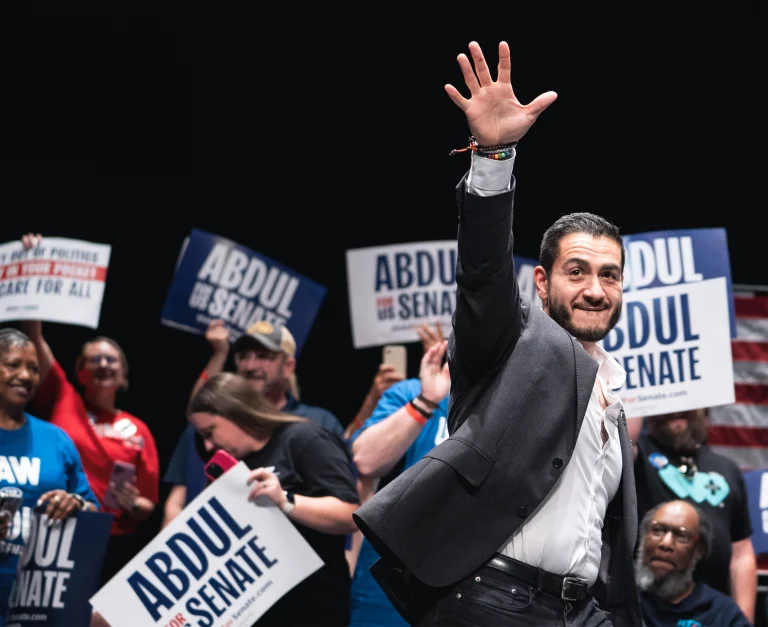
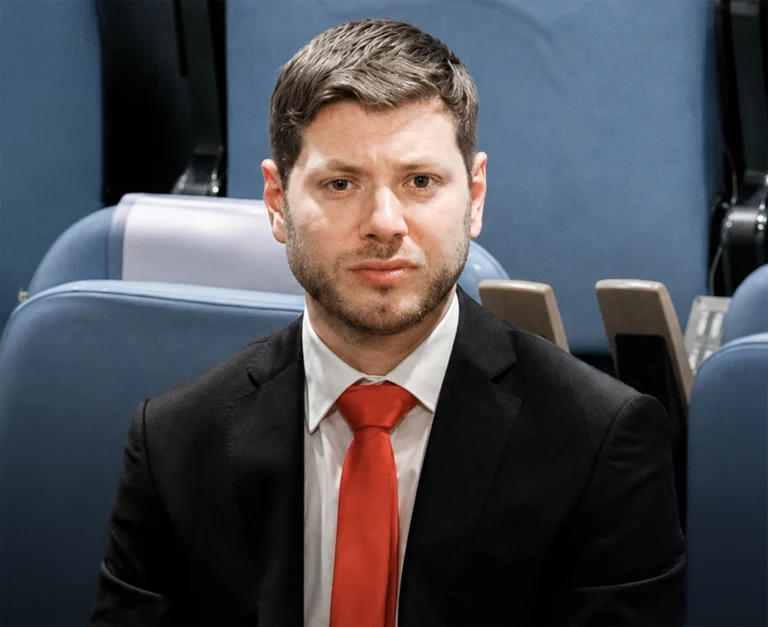
The controversy surounding Abdallah Alkhatib puts the spotlight on the bigger picture. Photo: Arturo Holmes/Getty Images
|
Berlin. ‘Art may do anything’ is a frequently quoted maxim of the liberal cultural order. Yet how free is it in practice when key institutions, juries and funding panels control substantial public resources while emerging from comparatively homogeneous milieus? Within and beyond the film industry, debate has resurfaced over whether artistic freedom and structural one-sidedness are compatible. When taxpayers’ money in the tens of millions is at stake and cultural authority rests with relatively closed networks, the public is entitled to ask questions. Among them is whether the much-invoked diversity is genuinely reflected in the minds of those who decide on projects, prizes and programmes. Since the Berlinale 2026, that question has returned to the fore.
At the award ceremony for the GWFF Best First Feature Award, the Palestinian director Abdallah Alkhatib referred in his acceptance speech to an alleged ‘genocide in Gaza’ and declared: ‘We will remember everyone who stood by our side, and we will remember everyone who was against us.’ Heckling followed. A federal minister left the auditorium. On stage, there was no clear rebuttal.
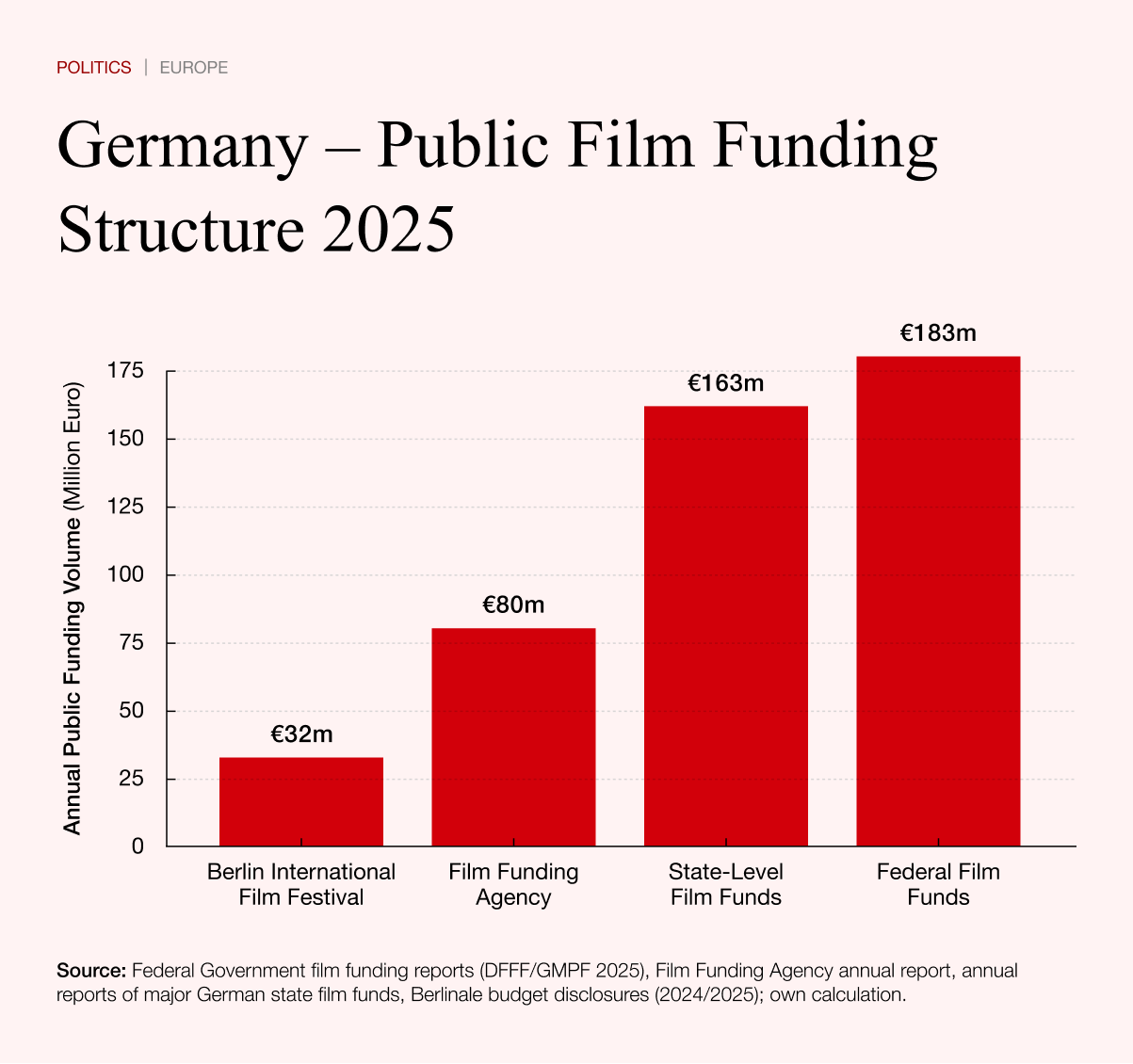
Since then, debate has centred on sensitivity, responsibility and the role of the festival leadership. Yet to read the episode solely as a personnel or communication issue would be too narrow. The incident casts light on a structural feature of the German and European cultural model: film is to a large extent publicly financed. Where public funds flow, political expectations arise. The Berlinale is not a private-sector event. It forms part of the federally owned cultural events company Kulturveranstaltungen des Bundes in Berlin GmbH. Its annual budget amounts to 32 million euros, of which the federal government most recently provided up to 12.8 million euros. Additional funding comes from the state of Berlin as well as sponsorship and ticket sales. A considerable share of the overall budget is therefore drawn from public coffers.
Such figures shift the perspective. Artistic freedom remains a fundamental value. Yet a festival co-financed by the state with sums in the tens of millions is also cultural infrastructure. It represents not only films but a system. That system is now under scrutiny.
The Berlinale is merely one visible node in a far broader funding architecture. Germany ranks among Europe’s most generously financed film locations. At federal level, the central instruments are the Deutscher Filmförderfonds (German Federal Film Fund) and the German Motion Picture Fund. In 2025, grants totalling 183 million euros were awarded through these programmes. From 2026, the two schemes are to be equipped with 250 million euros annually. The aim is to attract international productions to Germany while ensuring domestic projects remain competitive.
In addition, the Filmförderungsanstalt operates nationwide and is financed through levies imposed on the film and video industry. Its annual funding volume exceeds 80 million euros. Cinema support alone reached 14.1 million euros in 2025. Strong regional funds also operate at state level. The Filmstiftung Nordrhein-Westfalen, the FilmFernsehFonds Bayern and the Medienboard Berlin-Brandenburg each allocate sums in the tens of millions every year. Taken together, federal and state programmes place overall German film funding in the high hundreds of millions.
These sums underline a central point: in Germany, film is not merely artistic expression but a politically and economically structured sector. Funding entails industrial policy, employment and international visibility. At the same time, it entails selection. And selection entails power. The structure is federal. Different juries, advisory boards and committees decide on projects. Formally, such plurality is intended to prevent ideological bias. In practice, however, milieu effects persist. Those who master the language of funding applications, understand networks and align aesthetically with prevailing expectations navigate the system more easily.
A festival such as the Berlinale serves as a shop window for that architecture. It showcases what is funded, awarded and presented internationally. When political statements are made on such a stage, they are inevitably perceived as part of a culture partly financed by the state.
Official annual reports and budget statements of the respective German federal and state film funding institutions (2024/2025); own compilation.
France: Centralisation and Cultural Strategy
A glance at France highlights the contrast. There, the Centre national du cinéma centralises film funding. For 2026, expenditure of more than 800 million euros is envisaged. The system is financed through earmarked levies on cinema tickets, television broadcasts and streaming services.
France explicitly treats film as an instrument of national cultural policy. Decision-making is centralised, responsibility concentrated. Funding levels clearly exceed those of the German federal government. At the same time, political involvement is openly articulated. Film is regarded as an element of cultural sovereignty. Conflicts are not avoided, yet they unfold along clearly defined institutional lines. The structure is less fragmented than in Germany.
Italy and Spain: Tax Incentives Rather than Direct Grants
Italy and Spain pursue a different approach, relying heavily on fiscal incentives. In Italy, depending on category, productions may claim tax credits of up to 40 per cent of eligible production costs. The instrument primarily serves to enhance location attractiveness. Spain grants international productions a tax rebate of 30 per cent on the first one million euros of the assessment base and 25 per cent on amounts exceeding that threshold. The cap reaches the tens of millions per production. In regions such as the Canary Islands, even more favourable conditions apply.
Such models shift the emphasis. The state defines fiscal parameters, producers calculate commercially. Political conflicts are less directly tied to substantive jury decisions. Germany, by contrast, combines direct grants with a federal committee structure. That creates plurality, but also complexity and diffusion of responsibility.
In the United States, no film funding system of European magnitude exists. The National Endowment for the Arts operates with an annual budget of around 200 million US dollars across all art forms. Film productions are financed predominantly through studios, private investors and streaming platforms. State cultural policy plays a secondary role in day-to-day production. That does not mean culture and politics are separate. On the contrary, conflicts are more visible, more personalised and often more aggressive than in Europe.
The culture war in the United States is now frequently staged as public psychodrama rather than fought through funding committees or budget debates. A recent example is the renewed clash between Donald Trump and Robert De Niro. De Niro, for years one of Trump’s most prominent critics in Hollywood, appeared at ‘State of the Swamp’, a counter-event to the president’s State of the Union Address. There he sharply attacked the president. Trump responded on Truth Social with a personal tirade. Such escalations have long become part of American political entertainment.
Earlier, the British comedian, actor and producer Ricky Gervais had once again stirred the pot. Gervais is among the most recognisable figures in global show business. As multiple host of the Golden Globe Awards, he became known for merciless monologues targeting Hollywood’s moral self-assurance. At the 2020 ceremony he delivered what has since become an iconic line: ‘If you do win an award tonight, don’t use it as a political platform to make a political speech. You’re in no position to lecture the public about anything.’ He was addressing an industry that regularly uses acceptance speeches to advance political messages, from climate policy to migration.
Following the most recent Grammy Awards, Gervais revived the quotation and remarked drily: ‘They’re still not listening.’ His intervention was aimed less at specific content than at the ritual itself. The moral pose, his implicit criticism suggested, has become a fixed element of the awards industry.
The episode illustrates how ideological conflicts in the United States often unfold. They are not primarily disputes over cultural policy competences or funding lines, but media contests between stars, studios, platforms and politicians. Every post, every speech, every awards ceremony becomes a stage. Reach replaces committees, outrage replaces protocol. Each moral gesture carries the risk of instantly becoming ammunition for the opposing side.
Money, Power and Interpretative Authority
The incident at the Berlinale exposes a fundamental tension. The more heavily culture is publicly financed, the more politically it is interpreted. The larger the sums involved, the greater the expectation of institutional sensitivity.
With its budget of 32 million euros, the Berlinale is not an isolated festival. It stands at the centre of a funding architecture that mobilises hundreds of millions each year. Its stage is not merely an aesthetic space but part of state-supported cultural policy. The core question is therefore not whether art may do anything. It is how public cultural institutions define their role when they serve as platforms for free expression while simultaneously receiving substantial taxpayer funding.
Germany invests high hundreds of millions of euros annually in film. France allocates more than 800 million euros. Italy and Spain offer tax incentives of up to 40 per cent. The United States provides around 200 million dollars in public cultural funding but no comparable film support system. These figures are not incidental. They form the structural framework within which debates such as the one surrounding the Berlinale arise. Those who administer such sums manage not only art but societal expectations.
The current scandal is therefore not the cause but the symptom. It points to an architecture in which artistic freedom and state financing are inseparably intertwined. As long as that model endures, festivals such as the Berlinale will repeatedly become arenas of political contention. Not because art has suddenly become political, but because its institutional foundations have long been so.
Welcome to the comments section of the Štandard daily. Please take note of our guidelines, comments are moderated by us. You can contact the moderators at support@statement.com.
Participate in the discussion
Comments are available to subscribers only. If you'd like to join the discussion, choose a subscription starting at €6.72 per month.
All comments 0
Register
Comments are available to registered users only. If you'd like to join the discussion, register here.