
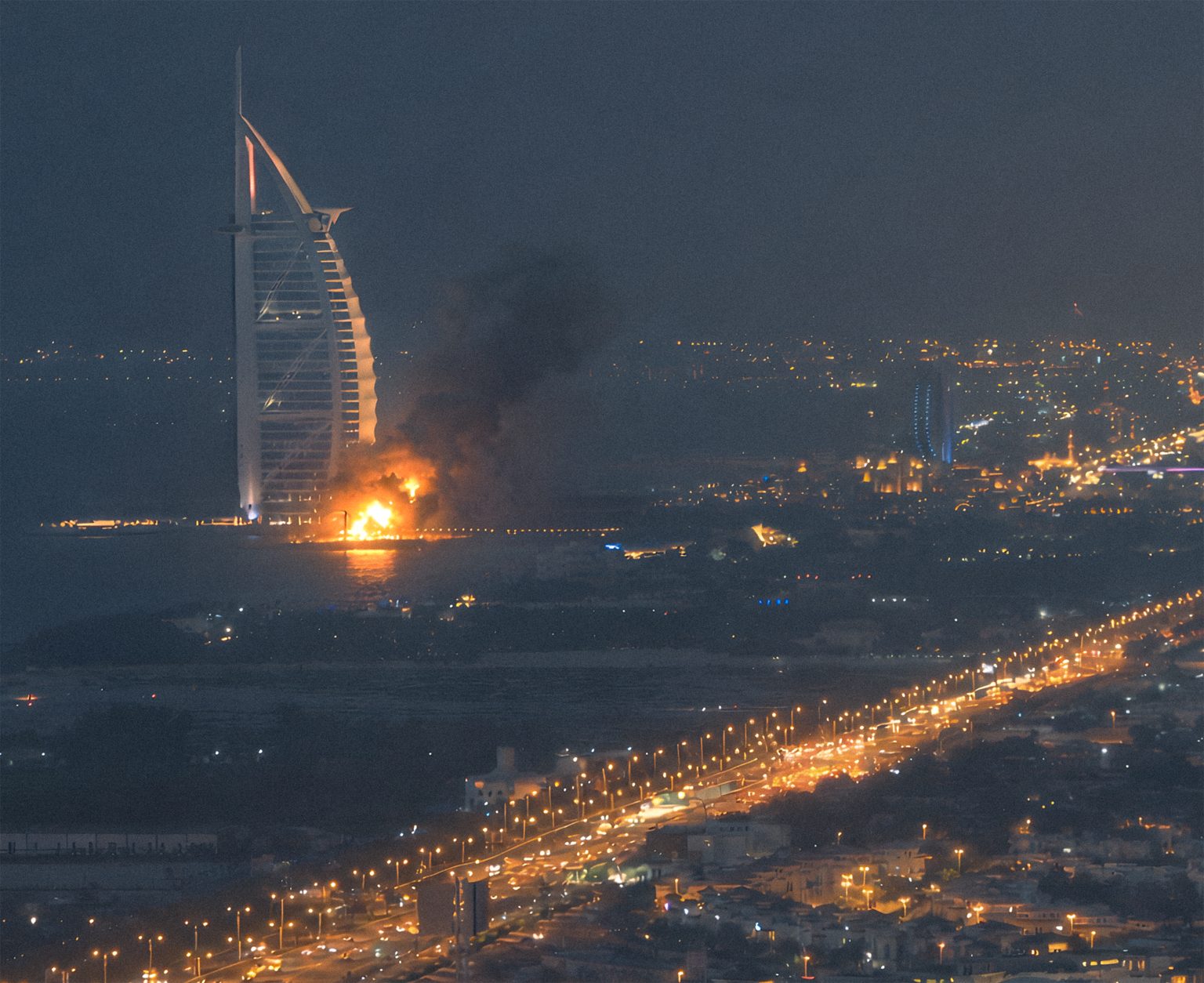
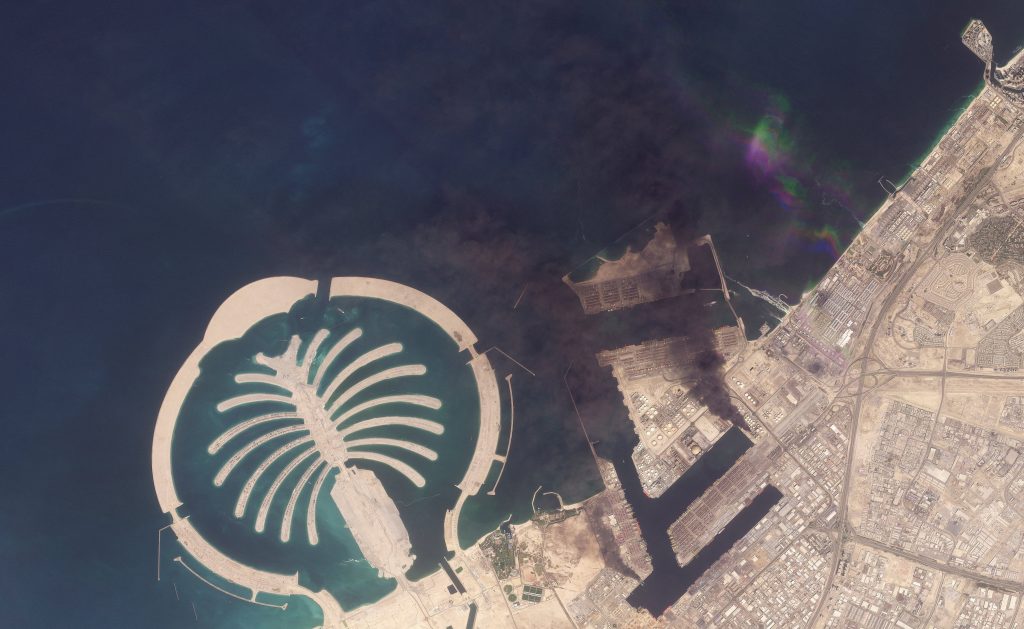
‘My God, this is the view from my balcony,’ said influencer Hofit Golan, her voice filled with disbelief as she filmed smoke rising from an explosion over Palm Jumeirah, an artificial island long regarded as a symbol of Dubai’s luxury and calm.
‘This is in front of my house. My God,’ she told her millions of followers.
For decades, many residents – from Arabs fleeing other conflicts to Westerners drawn by low taxes and an orderly, comfortable lifestyle – have seen Dubai as a safe haven, far removed from the turbulence of the wider Middle East.
That sense of security was abruptly shaken when Iran launched hundreds of drones and missiles towards Gulf states. Although most of the projectiles were intercepted by air defences, falling debris caused damage to parts of Dubai, including areas near some of its most recognisable landmarks.
Among the locations affected were the luxury Burj Al Arab hotel and Palm Jumeirah, home to high-end hotels, expensive apartments and sweeping views popular with influencers. Residents described being startled by explosions as missiles and fighter jets crossed the night sky.
Panic and fear
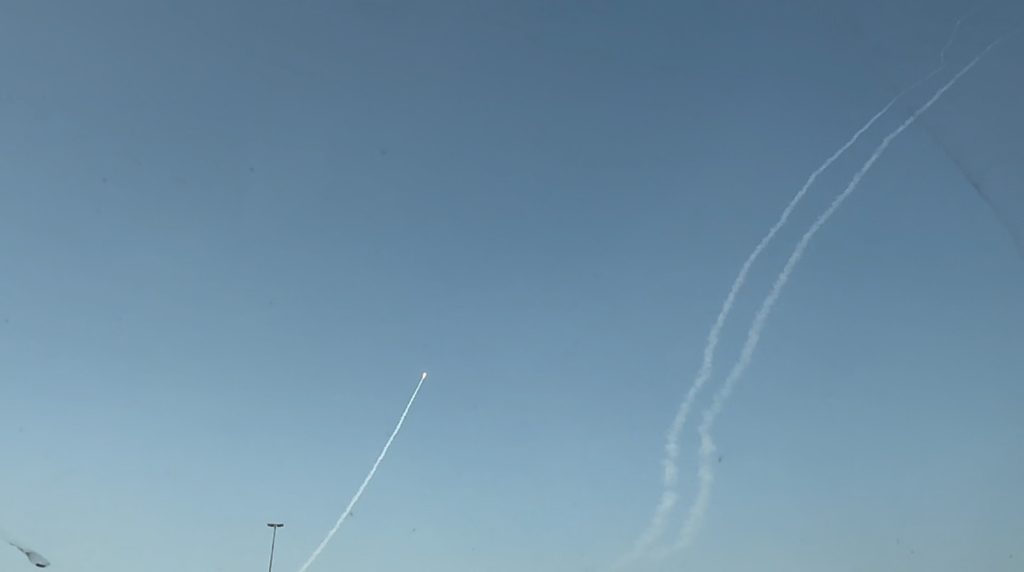
Daniel Holmes, a businessman based in Dubai with a large Instagram following, said he was woken by the interception of a rocket, which he observed from his balcony.
‘Everyone here is saying, “Don’t worry, man, everything’s fine”,’ he wrote in a post on social media. ‘But I say there’s a real war going on around Dubai, where you live. I’ve never seen anything like it.’
The mood was echoed in conversations across the city, the Middle East’s largest commercial and tourist centre. Some residents spoke openly about leaving – at least for the time being – while others insisted that Dubai and the United Arab Emirates could still guarantee security and stability.
Expatriates account for roughly 90 per cent of the United Arab Emirates’ population.
A Western expatriate and mother of two primary school children said she was unsettled after hearing a rapid succession of explosions.
‘They really keep us on our toes,’ she told Reuters in a text message. ‘It’s almost as if their only goal is to keep us in a state of panic and fear.’
Another resident, who has experienced previous conflicts in the region, said he had never expected to hear drones being shot down in the UAE.
‘I wasn’t mentally prepared. I was terrified, in fact I was (hiding) in the bathroom,’ he said, requesting anonymity for fear of the country’s strict media laws.
Jamen Fadel, a 36-year-old resident originally from Syria, said he saw no reason for alarm, citing the authorities’ ability to protect the population and communicate with residents.
‘I see that not much is happening, just a few minor things,’ he said. ‘Nothing terrible, because the government here, thank God, protects everyone.’
The Dubai Media Office said on Saturday that images of earlier, unrelated fires in the city were circulating on social media and warned that legal action would be taken against those who published misleading content.
Some influencers appeared to have deleted their original posts.
Everyone for themselves
On Sunday, as Iran’s retaliatory action in the Gulf intensified, residents described an unusually subdued atmosphere. Roads that are normally busy, even at weekends, were quiet in several districts. The Ministry of Human Resources and Emiratisation recommended that private sector employees work remotely until Tuesday.
Many small businesses in residential neighbourhoods – barbers, corner shops and other local services – remained closed.
Some residents reported long queues at supermarkets, delays to food deliveries and shelves that were less well stocked than usual.
On social media, users argued over reports of panic buying.
‘STOP! You’re not leaving any essentials for others,’ one user wrote on a Facebook forum for Dubai residents.
‘My husband was standing in line at a local store and the person in front of him had 15 baguettes in their shopping cart and there was absolutely no meat left,’ said another.
A third user replied, ‘There are no rules during war. It’s every man for himself.’
Business as usual?
The authorities sought to signal continuity.
On Saturday evening, the ruler of Dubai was photographed at Emirates Super Saturday, a high-profile horse racing event in the emirate, which the government media office described as ‘a special evening marked by exciting races and fierce competition’.
Robyn, a British national who had been staying at the Fairmont hotel earlier in the week, described the attacks as a reality check.
‘I always thought that one day something would happen and it would spread to the UAE and surrounding areas,’ she said.
‘But the fact that it happened is definitely very grounding, and you suddenly realise that all that glitters is not gold.’
(reuters, im)