
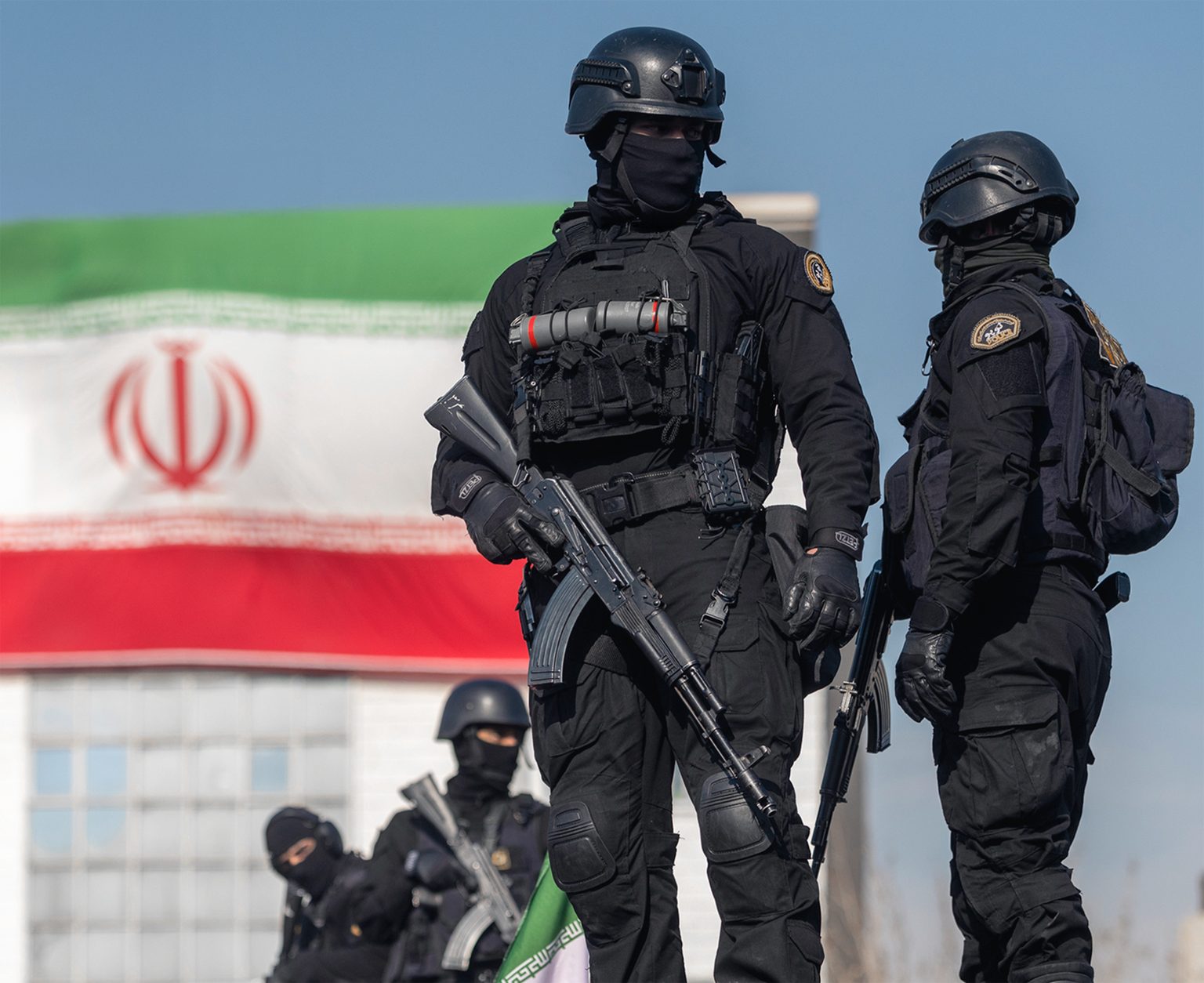
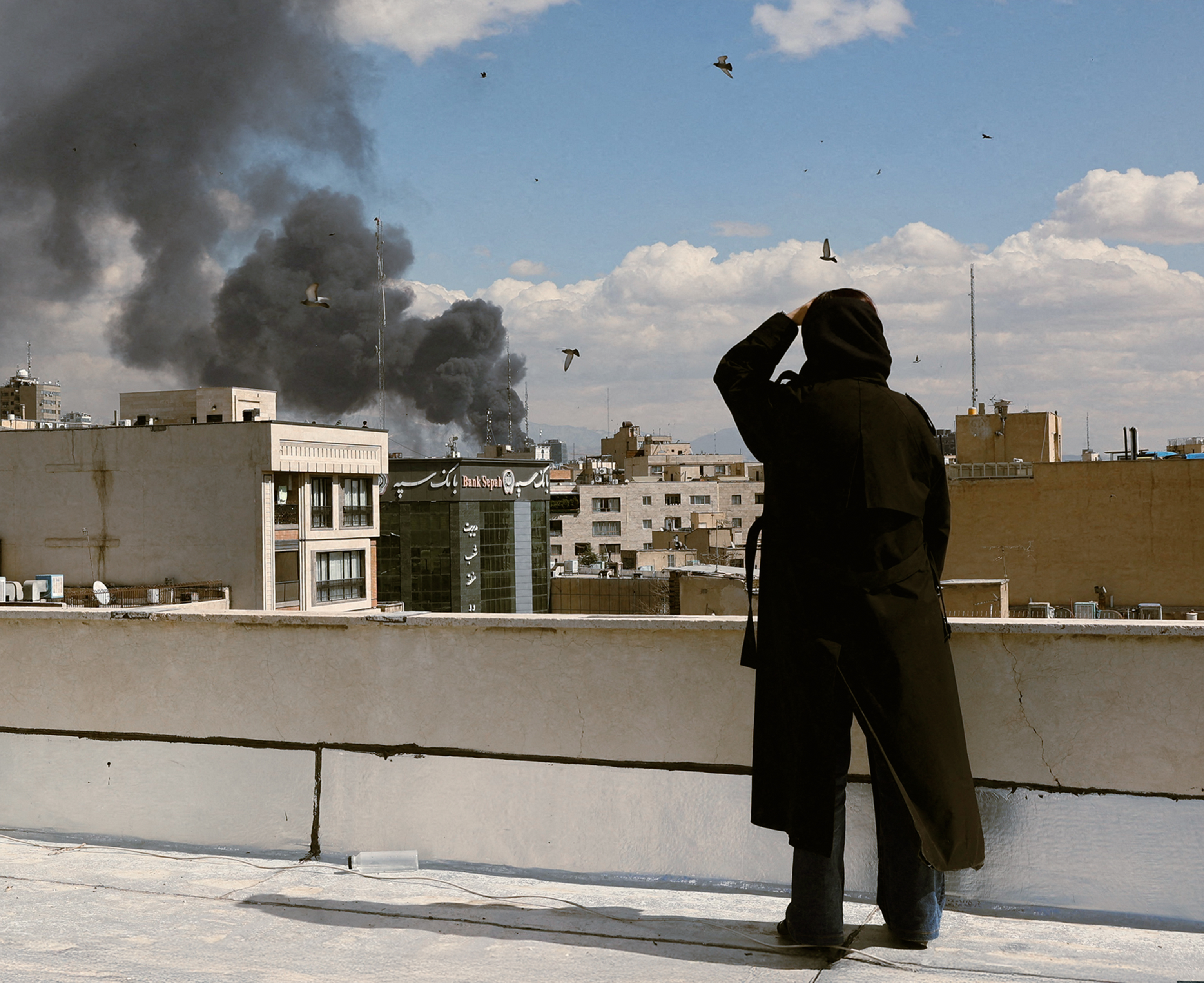
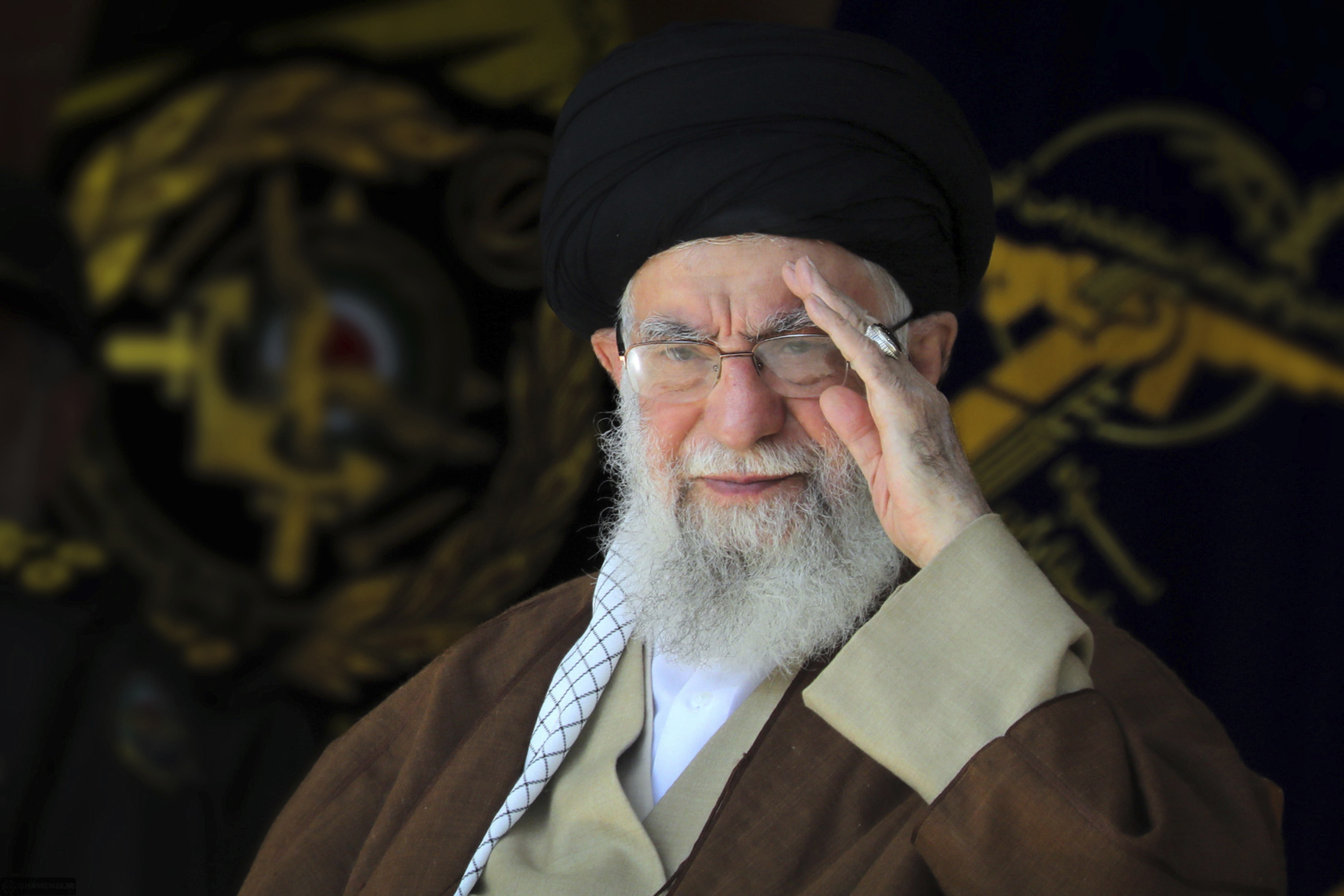
On Saturday 28 February, Israel and the United States launched coordinated air strikes on Iran. In attacks on Tehran, the spiritual leader and head of state, Ali Khamenei, and most of the leadership of the Islamic Republic were reportedly killed. The regular army, the Artesh, and the Islamic Revolutionary Guard Corps responded by shelling American bases in the Arab states of the Persian Gulf.
In Tehran, some residents were said to have celebrated the strike on Khamenei’s bunker within minutes, while protests by both opponents and supporters of the theocratic regime later broke out across the country. In the holy city of Qom, clerics raised a red Ashura flag above the Jamkaran Mosque.
The red banner symbolises unavenged blood – a reference to the killing of the third imam of Shia Islam, Hussein ibn Ali, in Karbala in 680. In revolutionary iconography, it signifies a call for retribution against perceived enemies of the faith and, in practice, is often directed against Sunni rivals as well as non-Muslims.
Supporters of the Islamic revolution that overthrew Shah Mohammad Reza Pahlavi in 1979 appear prepared to continue hostilities. The opposing side is equally determined. US President Donald Trump has announced that strikes against the religious leadership will last at least four weeks.
At the heart of the dispute lies the failed attempt to revive a nuclear agreement, from which Trump withdrew unilaterally in 2018. While his envoys, Steve Witkoff and Jared Kushner, sought to reach an understanding with Iranian Foreign Minister Abbas Araghchi on limiting uranium enrichment, Tel Aviv insisted on restrictions on ballistic missile development.
That argument was subsequently adopted by the Trump administration, underlining once again the close alignment between the White House and Israeli security concerns.
Before Khamenei’s death, Reuters cited sources in the White House as claiming that Tehran was preparing attacks on US military bases, an assertion presented as justification for a ‘preemptive’ strike. Yet US Secretary of State Marco Rubio later told Congress that the Pentagon possessed no concrete evidence of such plans.
This will not be another Libya
Following the killing of the supreme leader, a so-called triumvirate assumed temporary authority, comprising President Masoud Pezeshkian, Chief Justice Gholamhossein Mohseni Ejei and a senior member of the Guardian Council. The council functions not only as a constitutional watchdog but also wields veto power over parliament and oversees the Council of Experts, the body responsible for appointing the supreme leader.
The intricate system of nominations, oversight and dismissal powers was cited by the Tehran Times before last year’s Israeli-American operations as evidence of institutional resilience.
Iran’s political order, the newspaper argued in April 2025, rests on constitutionally enshrined bodies, unlike the rule of Muammar Gaddafi, which was based ‘on his personal power and tribal alliances’. It warned at the time against proposals by Israeli Prime Minister Benjamin Netanyahu for a ‘Libyan model’ in dealing with Iran.
The Persians – whom the German philosopher Georg Wilhelm Friedrich Hegel described as ‘the first historical nation’ – have inhabited regions such as Persis, Media, Parthia and Khorasan since antiquity. Unlike Libya, Iran possesses a historical memory spanning millennia, a factor that has often preserved a sense of continuity despite repeated changes of regime.
Since late December 2025, demonstrators carrying flags bearing the Lion and Sun have protested against the theocracy. The emblem, introduced in 1501 under Shah Ismail I of the Safavid dynasty, became a longstanding symbol of monarchy. Although the Safavids were succeeded by the Afsharids, Qajars and ultimately the Pahlavis, the state’s continuity remained closely tied to the name Iran.
The Lion and Sun has also been adopted by some officers of the Artesh who reportedly refused to obey the Islamic government. According to Reza Pahlavi, commonly described by foreign media as the ‘crown prince’, around 20,000 soldiers had defected by July 2025.
In a recent video address, Pahlavi suggested that his circle in exile is in contact with demonstrators who have resumed protests since February. Monarchist groups appear to be preparing for a possible restoration of the Pahlavi dynasty and even the coronation of a Shah Reza II.
The clash between Persia and Iran
Opposing the army and street protesters stand the Revolutionary Guards, a powerful parallel force with greater manpower and funding, as well as their own naval, air and space units and the elite Quds Force, which coordinates allied militias across the Middle East.
The Guards are not alone in defending clerical rule. Following the announcement of Khamenei’s death, rallies were held at which participants chanted ‘death to Israel’ and ‘death to America’, pledging loyalty to the Islamic Republic.
Although the relative strength of monarchists, reformists and hardline supporters remains uncertain, the regime retains a substantial social base.
Alongside the prospect of revolution – which might succeed if domestic activists and exiled leaders were sufficiently coordinated – the risk of open civil war is increasingly discussed. Supporters of the former Shah portray Iran as a ‘Persian nation state’, while adherents of the clerical establishment describe it as a ‘Shia superpower’ and a bastion of ‘pure Islam’ in a predominantly Sunni region.
Should neither side prevail swiftly, Iran could face a protracted internal conflict. The country’s mountainous terrain and ethnic diversity would complicate any struggle for control.
Monarchist rhetoric may deter Kurdish groups in the north-west, Arab communities in the south-west and Baloch populations in the east from aligning with a centralised nationalist project. At the same time, monarchist figures have promised to ease restrictions on Sunnis, Christians and Zoroastrians.
The clerical establishment has also sought to signal inclusiveness. In October 2025, Tehran’s city council inaugurated a metro station named after the Virgin Mary (Marjam-e Moghaddas). Reform-minded currents persist within the system, associated with former president Hassan Rouhani and the incumbent Pezeshkian.
To retain power, however, the theocracy must act swiftly in the wake of Khamenei’s death. Some analysts have speculated about his son Mojtaba as a successor, while others point to Hassan Khomeini, grandson of the revolution’s founder, Ruhollah Khomeini.
Paradoxically, certain Western observers describe Hassan Khomeini as a reformist, casting doubt on his prospects among hardliners. More conservative figures within the establishment may ultimately prevail.
After forming the triumvirate, Pezeshkian stated that the Council of Experts would choose a new supreme leader ‘within a few days’. Should that process falter amid institutional breakdown, power could shift to the streets or to elements within the Revolutionary Guards.
Will the strikes change Iran?
Even within the Trump administration, doubts have emerged as to whether a sustained campaign would be sufficient to topple the Shia regime. Over the past year, Washington and Israel have twice struck Iranian targets, a strategy that may inadvertently push neutral actors towards Tehran.
In June last year, B-2 Spirit bombers targeted not an abstract ‘regime’ but a sovereign state with a population of more than 80 million. The consequence has been a deepening polarisation between monarchists and Islamists.
The fragile stability of Iran’s institutions has, for now, been managed by Ali Ardasir Larijani, secretary of the Supreme National Security Council. Born in Najaf, he has consolidated considerable influence since his appointment in August 2025, coordinating political, military and diplomatic strategy behind the scenes.
The council oversees the Ministry of Defence and commands the Artesh, the Revolutionary Guards and the police. It also played a central role in suppressing the December protests. Although Larijani comes from a clerical family, his middle name, Ardasir, recalls the founder of the Sassanid dynasty, reinforcing his image as a bridge between revolutionary and national traditions.
He cannot assume the office of supreme leader, yet as a former commander of the Revolutionary Guards he remains well placed to shape events from behind the curtain, as analysts believe he did during Khamenei’s lifetime.
Larijani also acted as a key intermediary between Tehran and Moscow on nuclear development, travelling repeatedly to the Russian capital. The state-owned company Rosatom is involved in constructing additional units at the Bushehr nuclear power plant on the Gulf coast.
Even so, he may struggle to retain control over the Guards should they decide to assert authority in their own name. Rising unrest, the depreciation of the rial and mounting water shortages add to the pressure.
Iran’s uncertain future
Iran thus confronts its gravest crisis in centuries. Earlier dynastic transitions, from the Safavids to the Pahlavis, and even the revolution of 1979 ultimately produced clear outcomes.
Now several scenarios are conceivable: a tightening of clerical rule, the Revolutionary Guards emerging as the dominant force, a monarchist comeback or an extended confrontation between rival camps.
The decisive factor will be the balance of power between competing visions of the state. If the monarchists prevail, they will seek to restore the crown. If the Guards triumph, they will entrench the structures of clerical authority or, at minimum, their own security apparatus.
Should neither gain the upper hand, Iran could descend into a destructive civil war, with far-reaching consequences including renewed migration towards Europe. Control of ballistic missile capabilities and of the nuclear programme would then rest with whichever faction proved stronger – and after the end of Khamenei’s rule, no undisputed religious authority would remain to uphold the longstanding fatwa against nuclear weapons.