
It comes as no surprise that the US–Israeli offensive in Iran has provoked a retaliatory response in the form of a stranglehold on the world’s energy artery. It is also no secret that China would suffer the greatest shortage of oil and gas. However, this does not mean that Beijing would automatically be the most affected player.
What Hormuz Means for China
Around 20 to 25 per cent of the world’s oil flows through this key strait.
A similar figure applies to LNG, which accounts for roughly half of the global gas trade. This means that tankers transporting this commodity through the strait carry about one-tenth of the world’s supply.
The lion’s share of loaded ships have China as their destination.
Today, China imports a large volume of oil from Russia, about one-fifth of its total supply. The five oil-producing countries of the Middle East also play a major role: Saudi Arabia (14 per cent), Iran (11 per cent), Iraq (10 per cent), Oman (7 per cent) and the United Arab Emirates (six per cent). A certain volume also comes from Kuwait and Qatar.
More than half of China’s total imports come from the Middle East.
Some Arab states are able to transport part of their exports without passing through the Strait of Hormuz by ship. This applies in particular to Oman, which has key ports beyond the strait, as well as Saudi Arabia.
Saudi Arabia previously built the East–West oil pipeline, which leads to the Red Sea coast. The pipeline has the capacity to transport up to around seven million barrels of oil per day. Since the oil superpower exports roughly the same volume, theoretically little from its ‘kitchen’ should be missing from the market within a few days.
There are two problems. The first is that Saudi Arabia uses part of the pipeline’s capacity, about two million barrels per day, to supply its own refineries, which process oil for domestic use. The second is the risky Bab al-Mandab strait, where Yemeni rebels are active.
The United Arab Emirates can also bypass Hormuz via a pipeline, but it only has the capacity for about two-thirds of its exports.
Other exporters, including Iraq, Iran and Kuwait, must transport all their oil from the Persian Gulf through the Strait of Hormuz.
Without significant protection from Arab suppliers, China could lose up to 30 per cent of its oil supplies if the strait were blocked.
Gas Is a Slightly Smaller Problem
Not only oil flows through the strategic route from the Persian Gulf, but also a significant volume of liquefied natural gas. This accounts for roughly one-fifth of the LNG market and about one-tenth of the global gas market.
Around one-third of China’s LNG imports arrive via this route. They also imports gas through pipelines, mainly from Russia and Central Asia. In addition, around 60 per cent of its needs are covered by domestic production.
Although the shortfall in supplies from the Middle East is not small in absolute terms, around 30 billion cubic metres, it accounts for only six to seven per cent of China’s annual consumption of roughly 430 billion cubic metres.
Huge Reserves and Alternative Options
Although the halt of transit through the Strait of Hormuz is not an easy situation for China, Beijing had anticipated it.
This is evident, for example, from its huge oil reserves, which can cover roughly a tenth of its annual consumption. Given that China has not lost all its imports as a result of the blockade of the strait, its reserves could last for up to four months.
Although the shortfall is large in absolute terms, China’s position is far better than that of Japan, Myanmar, the Philippines or Pakistan, which are almost entirely dependent on oil from the Persian Gulf.
This supply crisis is also pushing oil prices sharply higher. At one point, the price of Brent crude approached $120 a barrel before settling in the $90 to $100 range. US WTI crude is also expensive, which runs counter to Donald Trump’s pre-election promises, as he based a significant part of his campaign on inflation under Joe Biden.
This is one of the reasons why the White House is trying to rehabilitate Russian energy exports on the global market and is granting exemptions from sanctions. Incidentally, this clearly shows that Israel ranks higher than Ukraine on the United States’ list of priorities.
Against this background, it can be expected that part of China’s shortfall will be covered by oil from Russia. However, it will be significantly more expensive than in previous months, as the country will be competing with the rest of Asia for supplies. Russian production and export logistics capacities are not unlimited.
The impact on prices is already visible. While Russian oil until recently traded at a large discount to Brent, observers say the trend has now reversed and Moscow is able to sell its black gold in these markets at a premium of several dollars in some cases.
In addition, Beijing has long sought to protect China from the shock of oil shortages in the transport sector. One example is the promotion of electric vehicles, which are significantly more popular in the country than in Europe or the United States because they are cheaper and the infrastructure is more developed.
This policy is particularly advantageous because gas and oil account for only a small share of electricity production, about four per cent. This is significantly less than in most Asian economies, where both commodities account for roughly half of electricity production. In China, electricity is produced mainly from coal and renewable sources, whose share in the energy mix is rising rapidly.
China Tends to Rely on Russia for Gas in the Long Term
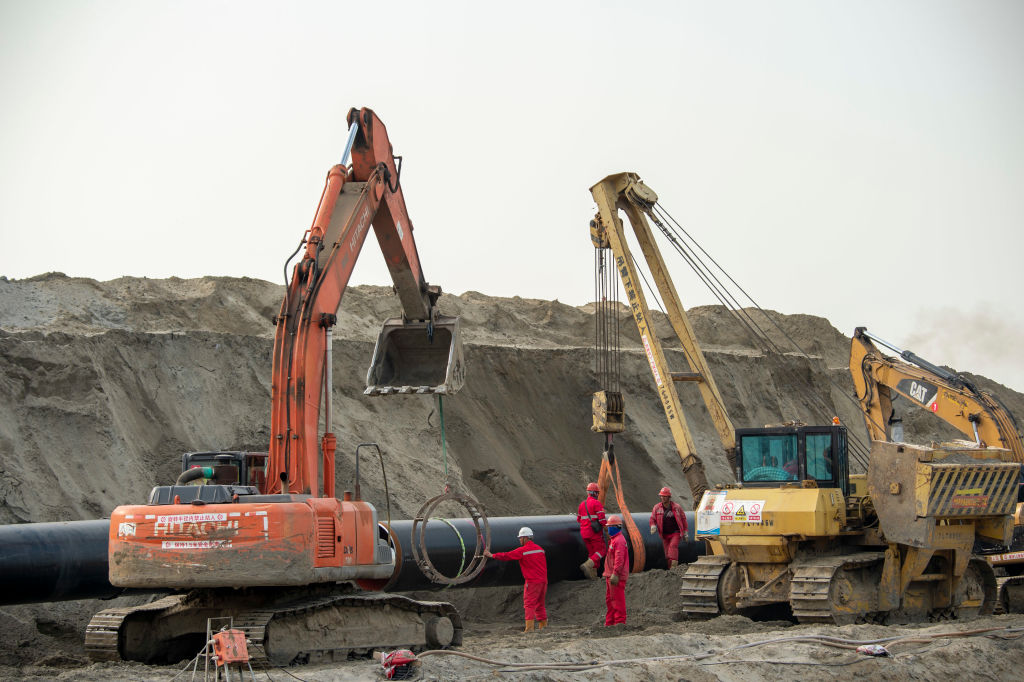
As for the shortfall in liquefied gas supplies, neighbouring Russia is the logical supplier. Although the capacity of the Power of Siberia pipeline, which transports 38 billion cubic metres a year, was fully utilised last year, both sides agreed in September to gradually expand capacity to 44 billion.
Another branch of the pipeline is also planned. Power of Siberia 2, with a capacity of 50 billion cubic metres, is expected to be completed around 2030. Although the project has been progressing slowly so far, the current crisis may motivate both sides to cooperate much more quickly. For Russia, a stable inflow of revenue will be very welcome, while for China it will provide much greater flexibility in the future.
In both cases, this is more of a long-term prospect. In the short term, Beijing may try to outbid European and Asian competitors in the battle for Russian, American or Canadian liquefied natural gas.
It can also offset part of its LNG imports by switching to other sources of electricity, such as coal or renewable energy. Finally, it can focus on maximising domestic production.
As for the shortfall in liquefied gas supplies, neighboring Russia is the logical supplier. Although the capacity of the Power of Siberia pipeline, with a volume of 38 billion cubic meters per year, was maximally utilized last year, both sides agreed in September last year to gradually expand capacity to 44 billion.
Who Will Pay the Bill for the US-Israeli War?
In summary, although China is in a delicate situation, its economy will not collapse in the coming weeks because of a lack of oil. In the event of a long-term blockade lasting several months, it would be a different story. The government would probably have to limit oil consumption and maximise the production of diesel or petrol from coal, in addition to efforts to increase supplies and transport capacity from Russia, Central Asia, Africa or America. Under normal circumstances this is an expensive and environmentally unfriendly process, but that tends to change in times of crisis.
However, China and other Asian countries are not the only ones paying the price for the war in the Middle East.
The consequences of the war will also be felt in the United States. Although the country is a major producer of oil and gas and is not at risk of physical shortages, the market is global and disruption will also be reflected in the wallets of American consumers. According to estimates by economists at Oxford Economics, price growth could accelerate by about 0.2 to 0.3 percentage points.
European countries, however, will pay a much higher price in this regard. Although they do not import much oil or gas from the Persian Gulf, in an interconnected market they will feel the impact on prices more strongly than the overseas superpower because of competition with Asia for supplies.
According to economists, inflation in the eurozone could rise by as much as half a percentage point, and in Italy by more than one point. As a result, many investors are wondering whether the central bank will raise interest rates.
These are relatively conservative estimates that may increase significantly over time and with any escalation. So far there are no signs that the situation around the Strait of Hormuz will calm down. On the contrary, Iran’s new spiritual leader, Mojtaba Khamenei, has declared that the strait will remain blocked.
Gas prices in Europe could rise significantly in the event of a prolonged blockade, as a complete ban on Russian gas is also approaching. EU members will stop purchasing liquefied gas from Russia from 2027. This accounts for around seven per cent of imports to the EU. From autumn next year they also want to eliminate the remaining pipeline gas, which accounts for another six per cent.
Moreover, Europe is not only struggling on the energy front but also on the migration front.
The European Union Agency for Asylum recently warned in its annual report that Israeli and American military action in the Middle East could trigger a new wave of migration. ‘With a population of approximately 90 million, even partial destabilisation could trigger refugee movements of unprecedented scale. The displacement of even 10 per cent of Iran’s population would be equivalent to the largest refugee waves of recent decades.’
Early signs of such a scenario are already emerging. On 12 March the UN High Commissioner for Refugees reported that up to 3.2 million people had been displaced within Iran since the outbreak of the conflict. Many are reportedly fleeing Tehran and other major cities towards the north of the country and rural regions where they hope to find safety. If the situation deteriorates further, these internal movements could soon spill beyond Iran’s borders.
The consequences would not stop there. The war may also reshape the strategic landscape far beyond the Middle East. In Ukraine, Kyiv could quickly face shortages of key US-made weapons as Washington’s attention and resources shift elsewhere, while Moscow stands to benefit from rising commodity prices. Instead of bringing stability, the conflict risks opening another chapter of geopolitical instability that stretches from the Middle East to Europe.