
Frankfurt. That Jeffrey Epstein was deeply embedded in a network of politics, high finance and the international establishment is well documented. Presidents, billionaires, scientists, entrepreneurs and members of European royal houses were among those in his orbit. In recent years it has become increasingly clear that Epstein operated less as a conventional investor than as an intermediary between power, money and influence. The more documents from the so-called Epstein files are analysed, the clearer this role becomes.
New reporting shows how far these connections truly reached. Between 2016 and 2018, people in Epstein’s circle appear to have discussed the possibility of acquiring Deutsche Bank, one of Europe’s most important financial institutions. The idea ultimately never moved toward a concrete implementation. Yet emails and documents from the released files offer a revealing glimpse into the thinking of the network around him.
Deutsche Bank as a wounded financial giant
To understand the scale of these considerations, one must look at the situation at Deutsche Bank in the mid-2010s. The long-established Frankfurt institution was then in one of the most difficult phases of its history.
The consequences of the global financial crisis of 2007 and 2008 were still being felt. Numerous legal disputes weighed on the balance sheet, while the bank also had to reach multibillion-dollar settlements with American authorities. Particularly significant was a settlement with US regulators over misleading mortgage dealings from the period before the financial crisis. Deutsche Bank alone had to pay 7.2 billion dollars.
These pressures were also reflected in the capital markets. The share price had fallen sharply and the confidence of many investors had been shaken. At times the bank’s market value sank to around 17 billion dollars. For a bank once regarded as a symbol of German financial power, this represented a dramatic decline.
In the international financial world, takeover speculation circulated repeatedly at the time. Analysts discussed possible mergers or acquisitions by other large banks. Names such as UBS or Barclays appeared regularly. Official negotiations were never confirmed, but the debate illustrated how uncertain the future of the institution had become. It was precisely during this period that another idea emerged – one that has remained largely unknown until now. However, it did not originate in European boardrooms, but in the orbit of Jeffrey Epstein.

Epstein as a networker for the super-rich
For years Jeffrey Epstein was far more than merely a wealthy investor. He saw himself as an intermediary between influential figures. His network included billionaires, politicians, scientists and members of the international establishment.
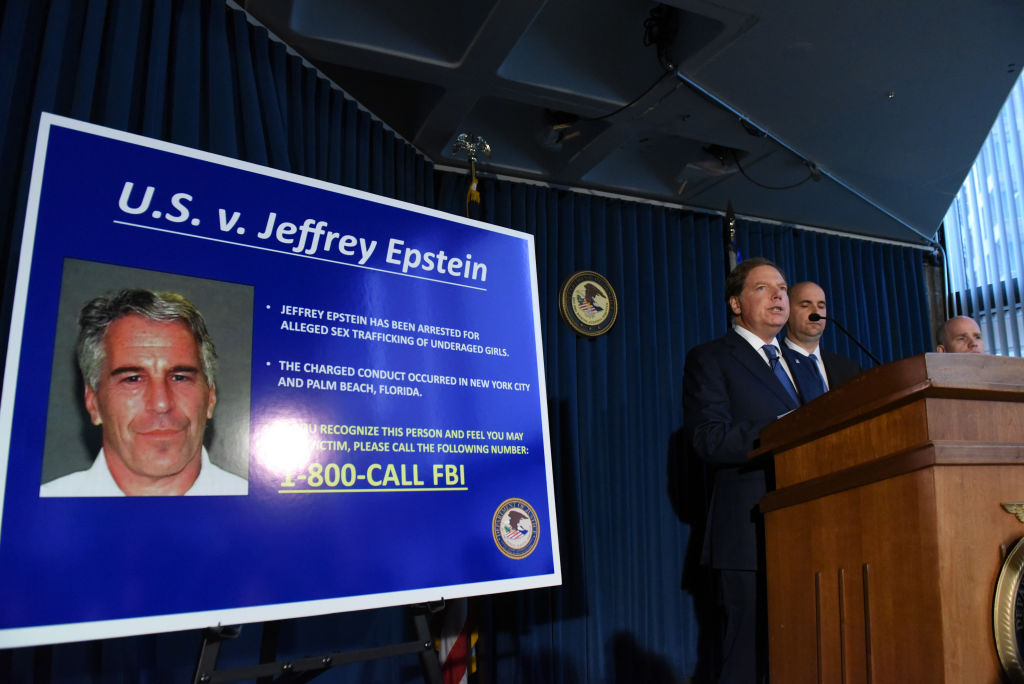
Between 2013 and 2018 Epstein himself was a major client of Deutsche Bank. Before that, the US bank JPMorgan Chase had ended its relationship with him. One reason was his earlier conviction for soliciting prostitution from a minor. Nevertheless, Epstein was accepted as a client by Deutsche Bank. A former JPMorgan employee who later moved to Deutsche Bank had recommended him. Epstein, it was argued, could generate substantial inflows of capital and might also introduce further wealthy investors as clients.
In fact, Epstein held more than 40 accounts at the bank. Some of them consisted of so-called trust structures through which assets were managed without appearing directly in his name. Payments to young women were later routed through these accounts, officially recorded as hotel expenses or tuition fees. Deutsche Bank later said it had come to recognise the relationship as a mistake.
David Stern and the plan for a takeover
The driving force behind the discussions about a possible takeover of Deutsche Bank was not Epstein himself. At the centre of the plans stood a German businessman named David Stern, who is internationally well-connected and has moved for years in the circles of billionaires, investors and political decision-makers. He is regarded as someone who forges contacts and brings influential figures together.
Stern attracted particular attention because he is said to have once introduced Epstein to Prince Andrew. Photographs show Stern at receptions at Buckingham Palace. In one image he is even seated directly beside Queen Elizabeth II. In the published Epstein documents, Stern’s name appears more than 7,000 times. The papers indicate that by 2016 at the latest he had begun repeatedly presenting Epstein with one idea: to buy Deutsche Bank.
In March 2016 Stern set out his thinking in an email to Epstein. Deutsche Bank was worth only about 17 billion dollars on the stock market, he wrote. ‘We should do something.’ His concept was ambitious. A group of international investors would acquire a significant stake in the bank or even take control of the institution. The management could then be replaced and the bank restructured. Parts of the group could be sold in order to make financing the takeover easier.
Stern evidently saw the crisis at Deutsche Bank as an opportunity. The low market valuation made the institution, in his view, a possible target for an alliance of investors.
Stefan Krause as a possible key figure
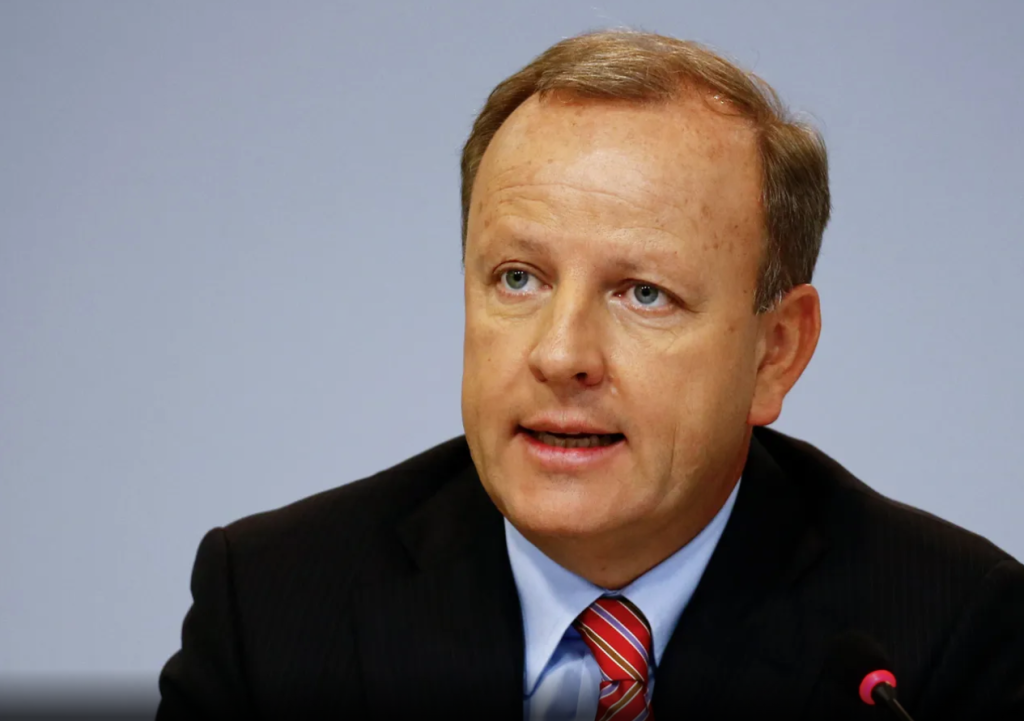
An important role in Stern’s thinking was played by Stefan Krause, the former chief financial officer of Deutsche Bank. Krause had left the group shortly before and was regarded as an experienced manager in international banking. Stern recommended Krause to Epstein in particularly glowing terms. Even Apple founder Steve Jobs had wanted to appoint Krause as chief financial officer of the technology company shortly before his death, Stern wrote in an email.
In the summer of 2016 Stern eventually sent Epstein Krause’s curriculum vitae. Epstein later forwarded this information to Ariane de Rothschild, the head of the Swiss private bank Edmond de Rothschild. Alongside Krause, Stern mentioned several potential investors. These included backers from Qatar and China who might take part in a takeover.
Prominent names from the international financial world also appeared in the documents. One of them was the American billionaire Leon Black. Black is a major investor and art collector and also became a client of Deutsche Bank through Epstein.
According to investigations, both Black and Ariane de Rothschild are said to have considered taking part in a takeover of Deutsche Bank. However, the documents do not provide clear evidence that concrete negotiations ever took place.
Fateful meeting in a New York apartment
In the autumn of 2016 a meeting finally took place between David Stern, Jeffrey Epstein and Stefan Krause. The conversation was held in Epstein’s luxurious apartment in New York.
What exactly was discussed there has not been recorded. What is known, however, is that Epstein subsequently introduced Krause to the investor Leon Black. In an email Epstein later wrote to Stern: ‘Ich mag Stefan. Ich habe ihn Leon vorgestellt.’ Whether Krause was in fact expected to play a role in a possible takeover scenario remains unclear. David Stern did not abandon his idea in the years that followed. Again and again he tried to persuade Epstein to become involved with Deutsche Bank.
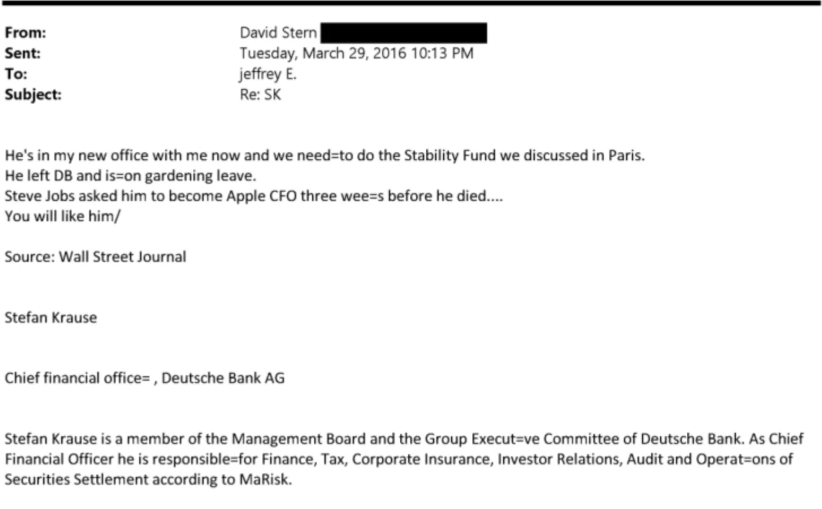
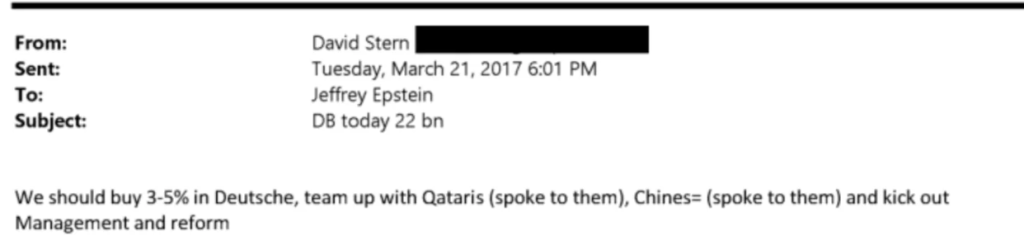
In 2017 he again proposed acquiring three to five per cent of the bank together with Chinese and Qatari investors. The management could then be replaced and the bank ‘reformed’. Epstein, however, reacted with caution and rejected several of these proposals.
In March 2018 Stern made another attempt. This time he even brought the Chinese entrepreneur Jack Ma into the discussion, the founder of the internet group Alibaba. Ma could help lead Deutsche Bank ‘into the future’, Stern wrote. Politically this might be sensitive, but economically it was promising.
Shortly afterwards Stern also sent Epstein the curriculum vitae of the Dutch banker Ralph Hamers and explained that he had already spoken with him about the ‘Deutsche Bank idea’. A response from Epstein to these proposals can no longer be traced in the documents.
The end of the relationship
While Stern continued to consider possible options, Epstein came under increasing pressure. New reports about his past appeared in the media and investigations against him were reopened. In December 2018 Deutsche Bank finally began closing Epstein’s accounts. According to the documents, the assets held there were transferred to the Bank of Puerto Rico.
In 2019 Epstein was arrested again. A few weeks later he died in a prison in New York. His death was officially classified as suicide.

An image from the Epstein files showing David Stern at the opening of a new office for his company Asia Gateway in Beijing in 2011. Source: US Department of Justice
A glimpse into the power structures of global finance
The episode casts a striking light on the networks surrounding Jeffrey Epstein. It shows how the global financial elite, political influence and international power structures can operate.
From today’s perspective, it appears remarkable that a notorious convicted sex offender was involved in discussions about a possible takeover of Deutsche Bank. At the same time the episode illustrates how vulnerable even large financial institutions are in periods of economic weakness.
Deutsche Bank says today that it has learned from the affair. Internal controls to combat financial crime have been significantly strengthened. The published documents show above all one thing: behind the scenes of international finance, plans sometimes emerge that rarely reach the public.