
The biologist Paul R. Ehrlich rose to prominence at a moment of global anxiety. The post-war population boom, decolonisation and fears of resource scarcity created fertile ground for stark warnings. His central claim was simple and powerful: humanity was breeding itself into catastrophe. Mass famine, he argued, was not a distant risk but an imminent certainty. ‘The battle to feed all of humanity is over,’ he wrote, predicting hundreds of millions of deaths in the 1970s and 1980s.
Those predictions did not come to pass. Instead, the late 20th century saw one of the greatest expansions in food production in human history. The Green Revolution transformed agriculture, particularly in countries such as India, which Ehrlich had singled out as likely to collapse. Global calorie availability rose, life expectancy increased and extreme poverty fell.
The reasons for his false predictions are now widely understood. Ehrlich underestimated technological innovation, market adaptation and human ingenuity. He treated population growth as a dominant, almost mechanical force, while neglecting the dynamic responses that scarcity can provoke. In doing so, he mistook a complex, adaptive system for a simple equation.

Ehrlich's influence on policy and society
Yet to focus only on predictive error is to miss the deeper significance of Ehrlich’s work. His influence extended far beyond academic debate. The Population Bomb, his best-known book, helped establish a worldview in which human beings themselves were increasingly seen as a problem, a burden on finite planetary resources rather than agents of progress.
This shift in perspective had profound consequences. Ehrlich did not merely warn of danger. He entertained solutions that, even at the time, raised ethical alarm. He discussed the possibility of coercive population control, including forced measures in extreme circumstances. While often framed hypothetically, such ideas contributed to a broader intellectual climate in which individual rights could be subordinated to perceived global necessity.
That climate was not confined to the West. In the 1970s, anxiety about population growth became a central theme in international policy circles. The Club of Rome report The Limits to Growth, alongside Paul Ehrlich’s earlier work, strengthened a growing conviction that unchecked population expansion and industrial growth could lead to systemic collapse.
At the time, it was far from clear how the findings of a computer simulation conducted by a 17-member team of experts, led by the economist Dennis Meadows at MIT, would come to shape global politics. Using a pioneering model known as World3, the researchers examined the interaction between population, industrial output, food production, natural resources and pollution.
Rather than offering a single prediction, they outlined a series of scenarios, many of which pointed to a dangerous ‘overshoot’ of the planet’s limits, followed by a sharp decline in living standards and population if prevailing trends continued. Published in 1972, the report challenged the dominant assumption of limitless economic growth and propelled environmental concerns into the political mainstream, influencing debates that would later coalesce around the idea of sustainable development.
These ideas spread rapidly, gaining traction among intellectuals and wider society alike. Yet neither Ehrlich nor his contemporaries anticipated the swift and dramatic decline in birth rates that would unfold across much of the world over the following 50 years, with Africa the notable exception.
Far-reaching worldwide consequences of antinatalism
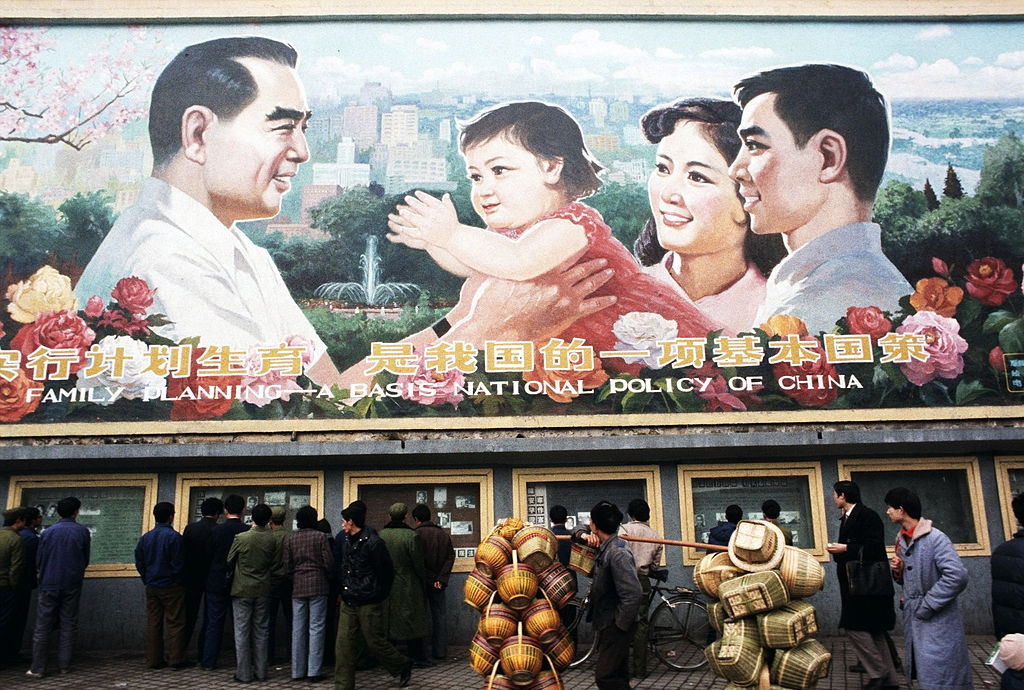
In China, where leaders were grappling with development challenges on an immense scale, similar assumptions took hold. By the time Deng Xiaoping consolidated power, population control had come to be seen as an essential component of modernisation. The result was the One-Child Policy, introduced in 1979, one of the most sweeping and intrusive social engineering projects in history.
It would be simplistic to attribute that policy directly to Ehrlich. China’s decisions were shaped by its own political logic and internal debates. But Ehrlich’s ideas formed part of the global intellectual environment that lent such measures legitimacy. The underlying premise was shared: that rapid population growth posed an existential threat requiring decisive, even coercive, intervention.
The human cost was immense. Forced abortions and sterilisations were widely documented. Families were subjected to surveillance and penalties. A profound gender imbalance emerged, alongside long-term demographic distortions that continue to affect China today. What was presented as a rational response to crisis became a source of enduring social strain.
More broadly, the legacy of Ehrlich’s thinking can be traced in today’s demographic anxieties. Across much of the developed world and increasingly in parts of Asia, birth rates have fallen below replacement level. Governments now grapple with ageing populations, shrinking workforces and the economic consequences of demographic decline. The fear is no longer that there are too many people, but that there are already too few.
Legitimate worries that had a disastrous impact
This reversal does not mean that Ehrlich’s concerns were entirely misplaced. Environmental degradation, biodiversity loss and climate change are real and pressing challenges. But these legitimate concerns have been used to coerce and manipulate politicians around the world. His insistence that human activity has limits retains force. His error lay in translating long-term risks into immediate certainties and in framing humanity itself as the central problem.
In the end, he leaves behind a paradoxical legacy. He helped to awaken global awareness of environmental constraints, yet did so in a way that often overstated urgency and understated complexity. His warnings mobilised attention, but also encouraged a strain of thinking that proved both empirically flawed and morally hazardous.
Obituaries should tend towards generosity. His influence formed part of a broader cultural shift, one that cast population growth increasingly as a problem rather than a source of renewal. In that climate, scepticism towards family formation and childbearing gained intellectual legitimacy, feeding strands of modern antinatalism. The result is a legacy that extends beyond failed predictions, contributing to a world now grappling with persistently low birth rates and the long-term consequences of having fewer children than many societies need to sustain themselves.