
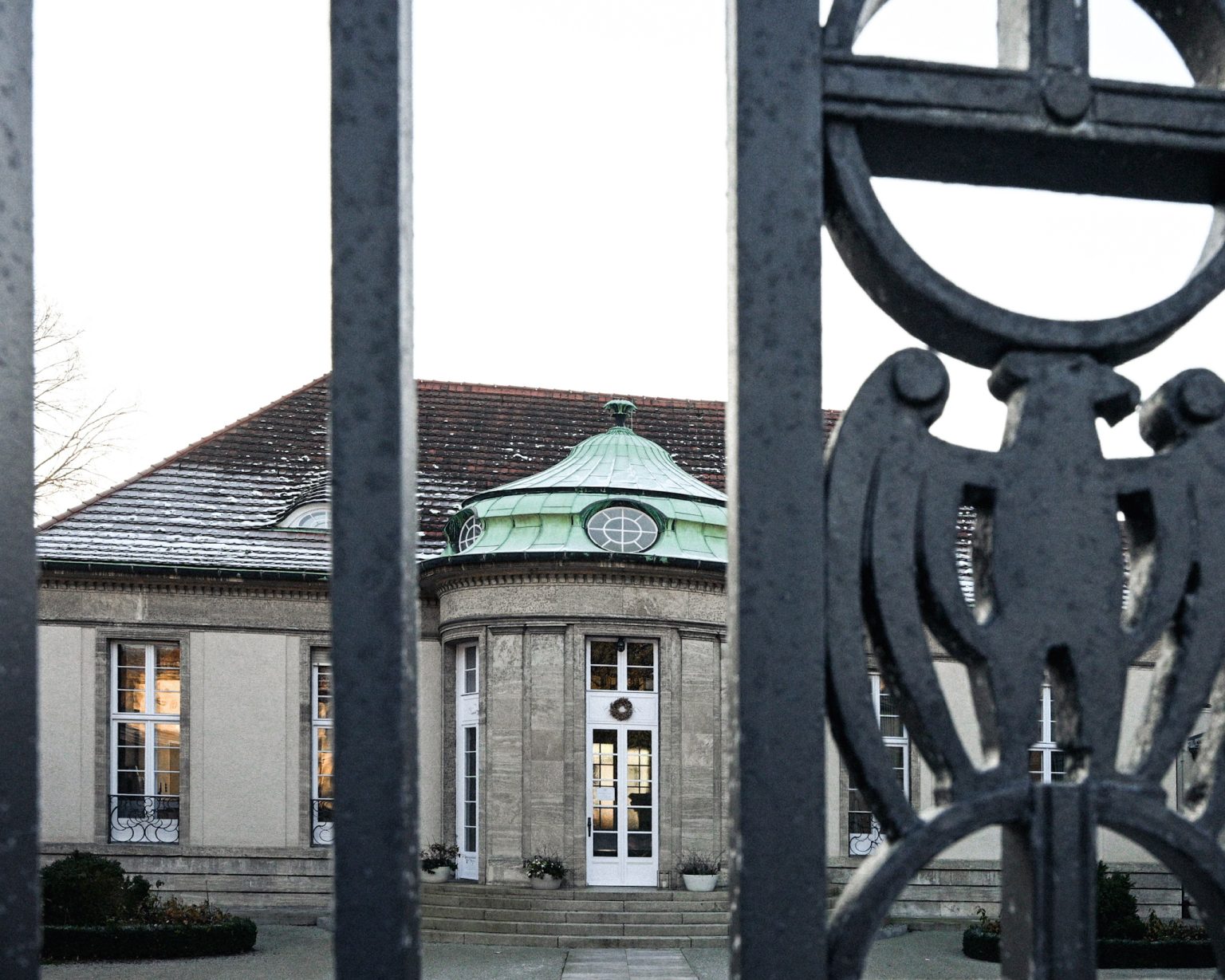
Potsdam. For readers outside Germany, the case may at first seem difficult to grasp. Why is the country still talking, more than two years later, about a meeting in a villa in Potsdam? Why did mass demonstrations, government politicians, the domestic intelligence service and the courts all play a role? And why is the name Correctiv so central?
Correctiv is a well-known investigative platform in Germany that presents itself as a public-interest media organisation. Internationally, it might be described as a hybrid of investigative outlet, activist platform and fact-checking infrastructure. Crucially, however, Correctiv is not a conventional, fully privately funded newsroom, even if it seeks to give that impression. Over many years, the organisation has received substantial public funding from federal ministries and state-backed programmes. That proximity to the state gives the affair its political charge. The issue is not merely journalism, but the influence of a partly taxpayer-funded actor on political reality and on voters’ behaviour.
The starting point: a meeting and its interpretation
On 10 January 2024, Correctiv published an article titled ‘Secret plan against Germany’. It centred on a private meeting held in Potsdam in November 2023. Among those present were right-wing activists, business figures and individual politicians. One of the most prominent names in that context is the Austrian activist Martin Sellner, widely regarded as a leading figure in the so-called Identitarian Movement.
Such gatherings, in themselves, would not ordinarily trigger a major political crisis. What proved decisive was the interpretation. Correctiv portrayed the meeting as centring on a ‘masterplan’ under which the removal of millions of people from Germany was allegedly discussed – including German citizens considered unwilling to integrate into German society. It was precisely that escalation that turned a private meeting into a national controversy, not least because politicians from both the AfD and the CDU were in attendance.
The effect was immediate. Within days, a journalistic publication had turned into a political emergency. Thousands of demonstrators took to the streets, organised by a broad alliance of parties, NGOs, churches and trade unions, to protest against what was portrayed as a secret meeting of right-wing extremists. Members of the government adopted that framing and sharpened it further. Terms such as ‘deportation plans’ came to dominate both the debate and media coverage – a linguistic analogy that appeared to evoke the deportations of Jews in the Third Reich. The difficulty, however, is that the term was never used at the meeting itself, nor did much of what Correctiv claimed occur.
The mobilisation of demonstrations ‘against the right’ was therefore not based on an official investigative report or a judicial finding, but on the account of a single media outlet. That account was taken up by large parts of the political and media system and amplified further. A piece of reporting became a societal narrative.

The question of ‘remigration’ and early doubts
At the centre of the substantive controversy stood the term ‘remigration’. Within right-wing circles, it is used with varying meanings – from the deportation of individuals required to leave the country to more far-reaching concepts. Correctiv presented the Potsdam meeting as including discussions of measures affecting German citizens.
Alongside Martin Sellner, AfD Bundestag member Gerrit Huy also came into focus. She was reported to have suggested stripping dual nationals of their German citizenship. Claims of that kind later became central to the legal dispute.
Doubts soon began to emerge. Individual journalists and media outlets started to scrutinise the reporting more closely, while some participants in the meeting denied that such presentations or discussions had taken place at all. The criticism was that Correctiv had failed, at key points, to distinguish clearly between verifiable facts and interpretative amplification. The account, critics argued, relied on suggestive language and political conclusions that did not necessarily follow from the underlying material.
Correctiv itself later qualified certain terms and claims, in part under pressure from early court rulings that required it to revise statements concerning specific individuals. The story began to unravel. Yet the original narrative remained politically potent and was repeatedly reinforced by reporting in public television and radio. The Correctiv report shaped televised debates about the AfD, fed into official assessments of the party by security authorities as evidence of alleged right-wing extremism and persisted as the dominant interpretative framework in public discourse.
The ruling: a challenge to the core of the story
The decisive turning point came on 17 March 2026 at the Berlin Regional Court II. The proceedings addressed whether key statements by Correctiv constituted permissible opinion or impermissible statements of fact.
The court prohibited several central claims. Most notably, Correctiv may no longer assert that a ‘masterplan for the expulsion of German citizens’ was discussed in Potsdam. It also barred claims that Martin Sellner had presented an ‘expatriation concept’, as well as certain attributed statements by Gerrit Huy. Legally, the crucial point is that the court classified those elements as statements of fact by Correctiv – not mere interpretation.
For the first time, the core of the original narrative has thus been shaken in legal terms. Little of substance remains of what was presented as an exclusive and explosive investigation. The damage to those who attended the meeting, however, endures. For more than two years, they were suspected of having taken part in a racially motivated gathering allegedly aimed at removing millions of people from the country.

Public funding, training programmes and a problematic context
It is particularly contentious that, even after the ruling, Correctiv appears likely to continue receiving public funding. In 2026 alone, more than €200,000 in taxpayer money is being channelled into projects run by the organisation, according to the German news platform Nius. One project, funded through the federal family ministry’s ‘Demokratie leben!’ programme under Minister Karin Prien, receives precisely €140,114.45. Its title: ‘Flashpoint Disinformation: training on dealing with TikTok in fire services and voluntary associations’. As part of the project, Correctiv journalists, who have just been subject to a court ruling over the dissemination of false claims, train young firefighters and members of associations in how to identify and counter disinformation.
In addition, the state of North Rhine-Westphalia is providing a further €60,000, under media minister Nathanael Liminski, for the youth project ‘Salon 5’. The initiative targets young people and teaches the basics of journalism – from research and social media to podcasting. Here, too, the issue of ‘disinformation’ plays a central role.
The political sensitivity is evident. While Correctiv offers state-funded training on recognising disinformation, a court has classified key elements of its own most influential investigation as impermissible statements of fact – in other words, fake news. No review of the funding practice has so far taken place. The federal family ministry did not respond to a corresponding enquiry, while authorities in North Rhine-Westphalia have merely stated that no further funding is currently planned for 2027.
The implications of the ruling are considerable. The very claims now prohibited formed the foundation of the political and societal reactions in early 2024. They underpinned the mobilisation of millions, the sharp political rhetoric and, not least, the classification of the AfD as extremist by state bodies.
Correctiv disputes that assessment and maintains that the ‘factual core’ of the investigation remains intact. Yet that ‘core’ – a meeting and discussions about migration – would scarcely have triggered such mass mobilisation on its own. Nor would it have constituted anything inherently objectionable. It was, at most, a private lecture event on current political topics. The political escalation arose only through dramatic amplification.

A case study in power and media
The Correctiv affair is therefore more than a single media controversy. It shows how closely media, politics and state-funded actors have become intertwined. Parties, politicians and state broadcasters alike helped to turn the reporting of a publicly co-funded outlet into a national scandal. It also demonstrates how quickly a piece of journalism can become a political event – and how difficult it is to reverse that process.
The consequences for those involved are, in some cases, irreversible. Some participants in the meeting have lost their jobs or professional engagements. The host of the venue lost funding for a construction project. For many, the reputational damage cannot be undone.
The Berlin ruling is not the end of the matter. Further proceedings will follow. Yet it marks a significant turning point: for the first time, a wide-ranging and politically charged media report that mobilised an entire country has been legally challenged at its core. A phase of reckoning has begun, one likely to extend far beyond this single case.