A warning written in fire: antisemitism and the targeting of Britain’s Jewish spaces
An arson attack in Golders Green is not an isolated incident. As antisemitism rises across Britain, deeper questions about safety and belonging are becoming harder to ignore.
Chief Rabbi Sir Ephraim Mirvis attends the scene after four Hatzolah ambulances were set on fire. Photo: Leon Neal/Getty Images
|
Jewish ambulances in Golders Green were set on fire this week. The prime suspect is an Iran-aligned group, Harakat Ashab al-Yamin al-Islamiya, the Islamic Movement of the People of the Right Hand. This was not merely an act of vandalism. Set beside a synagogue in one of London’s most recognisably Jewish neighbourhoods, the attack carried a symbolism that is difficult to ignore, a direct strike at a community’s institutions, its sense of safety and its place in British life.
It would be comforting to dismiss such incidents as exceptions, the work of a few extremists, detached from the broader national mood. But the evidence of recent years suggests otherwise. The United Kingdom has witnessed a sustained and troubling rise in antisemitic incidents, with thousands of cases recorded annually at historically high levels. The pattern is not episodic but persistent.
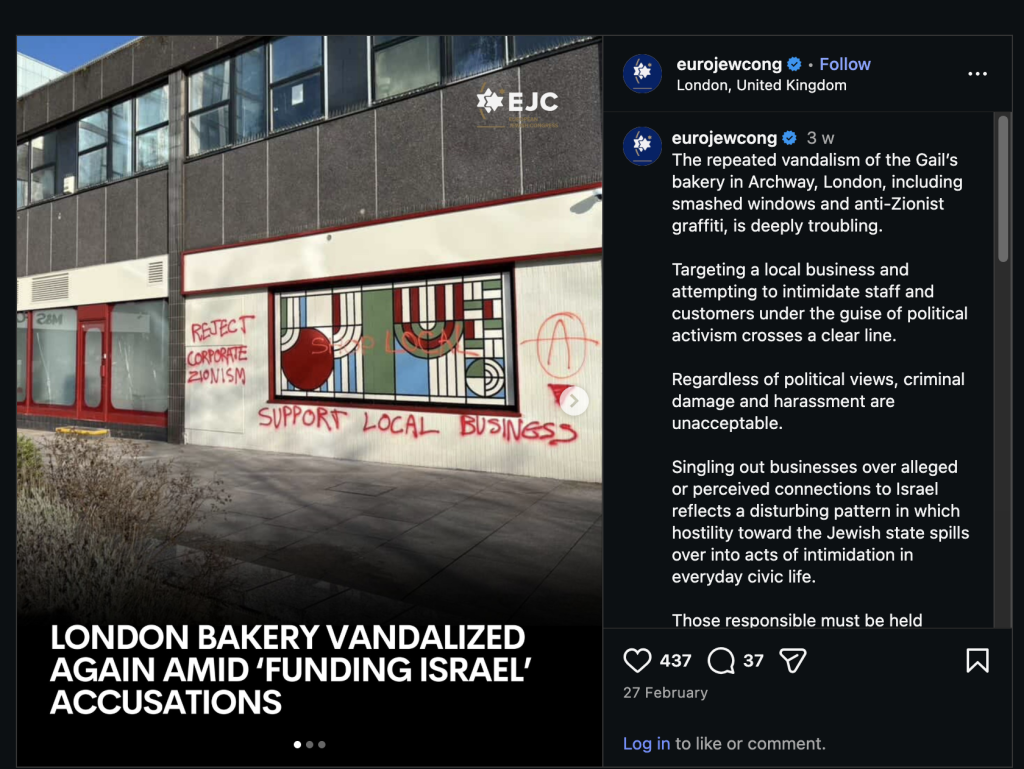
Within these numbers lies a trend that should concern anyone who cares about the health of a plural society. Synagogues and Jewish buildings, visible, communal, symbolic, have increasingly become points of aggression. These are not abstract statistics. They translate into vandalised buildings, threatened worshippers and security barriers being normalised. The Jewish-owned bakery Gail's in London has become one such example of repeated vandalism and threats. This is costing the UK jobs and investments.
Jewish-owned Gail’s Bakery buildings have been vandalised and targeted in antisemitic attacks. Source: Instagram/Euro Jewish Congress
Behavioural shift observed in Jewish communities
The consequences are no longer only physical but also demographic. In recent years, some British Jews have quietly chosen to leave the country or are actively considering doing so, citing security concerns and a sense that everyday life has become dangerous. Others have relocated within the UK to areas perceived as safer, or have altered their behaviour, avoiding public displays of their identity, changing schools, or reconsidering long-term plans. This is a subtle but profound shift. When a community begins to weigh its future in such terms, the issue has moved beyond isolated incidents into something more structural.
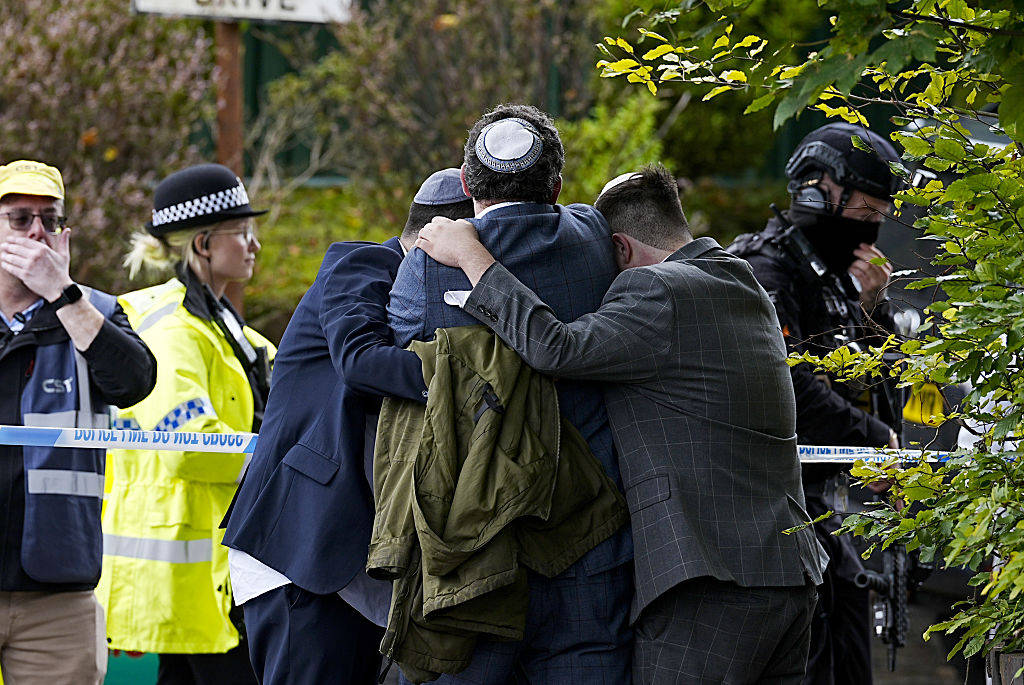
Recent incidents have deepened that sense of unease. In 2025, a synagogue in Manchester was targeted in a deadly antisemitic attack, underlining the fact that violence once considered unthinkable in modern Britain is no longer hypothetical. Elsewhere, large-scale demonstrations linked to the war in Gaza have heightened tensions, prompting counter-protests such as the March Against Antisemitism in 2023, as sections of the Jewish community expressed alarm at the tone and rhetoric of some marches.
Members of the Jewish community console one another outside the Heaton Park Hebrew Congregation in Manchester after a suspected terror attack in 2025 in which two people were killed and the assailant was shot dead by police. Photo: Peter Byrne/PA Images via Getty Images
Questionable response to antisemitic incidents by authorities
There have also been controversies around the response of authorities. In one widely reported case, charges were dropped against individuals involved in a London convoy accused of making antisemitic threats 'to rape Jewish daughters', raising questions about consistency and deterrence in the enforcement of the law.
The reasons for these incidents are complex, but the trajectory is clear. Antisemitism in Britain has been fuelled by multiple ideological streams, from the far right to Islamist extremism, and increasingly from parts of the political fringes of the Left where hostility to Israel bleeds into hostility towards Jews themselves. The war in Gaza since October 2023 has acted as a catalyst, intensifying tensions and, in some cases, translating into hostility directed at Jewish communities at home.
Yet explanation is not justification. To understand the context is not to excuse the consequence. When a synagogue becomes a target, or when ambulances serving a Jewish community are set on fire, something more fundamental is at stake than political disagreement. It is the erosion of a basic civic principle that religious minorities can live openly, visibly and without fear.
The attack in Golders Green is particularly revealing in this respect. It did not occur in a marginal or hidden corner of the country, but in a neighbourhood long associated with Jewish life in London. The choice of target, emergency vehicles operated by a Jewish charity, speaks to a cruelty that extends beyond ideology into something more visceral, the dehumanisation of a community.
Britain is witnessing an increase in hostility towards Jews
There is also a cumulative effect to consider. A single incident may shock; a succession of incidents reshapes behaviour. Jewish schools increase security, synagogues install barriers, and individuals begin to conceal visible signs of their identity. Over time, what was once exceptional becomes normal.
Britain likes to think of itself as a country that has learned from history, one that recognises the dangers of prejudice when left unchecked. It has long prided itself on offering refuge, whether to Jews fleeing persecution in Tsarist Russia or those escaping Nazi Europe.
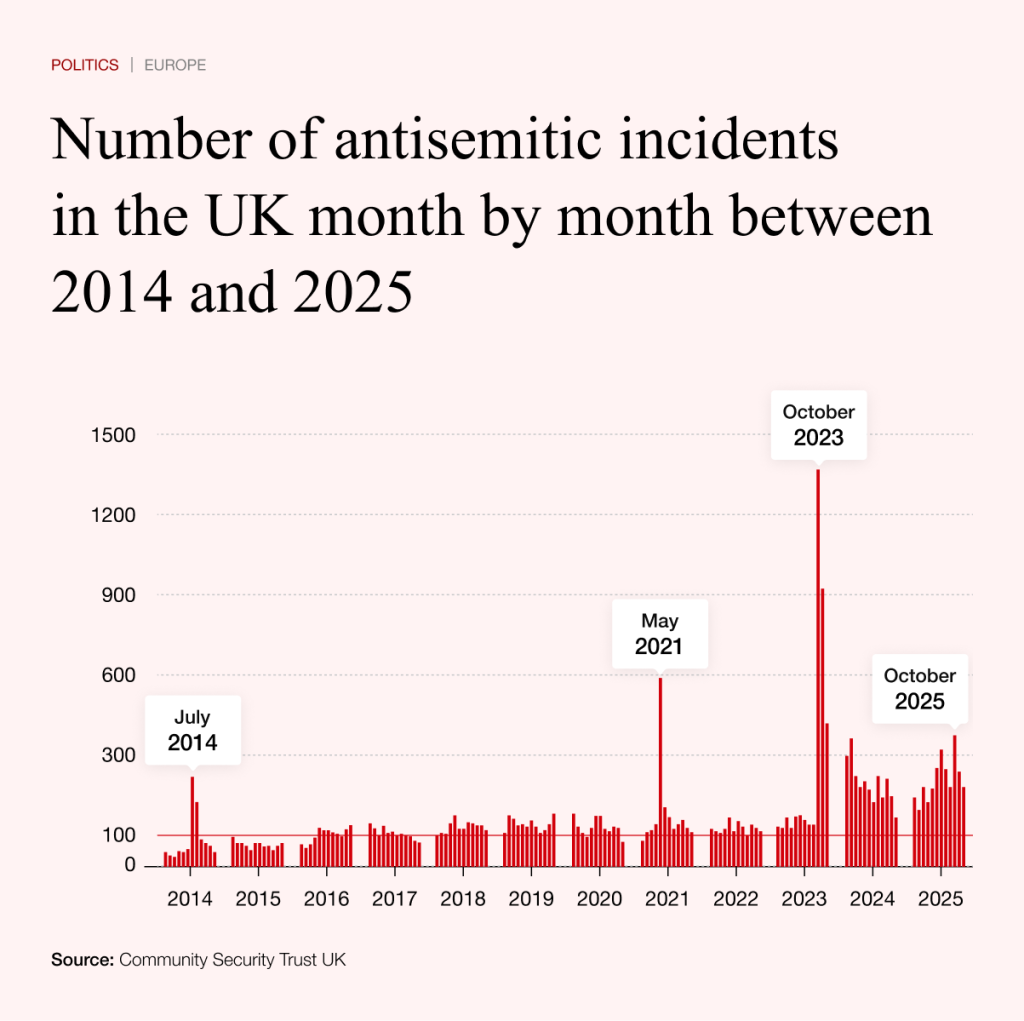
To treat recent incidents as isolated crimes is therefore to misunderstand their significance. The Community Security Trust recorded the second-highest annual total of antisemitic incidents in 2025, with 3,700 cases, a four per cent rise on the 3,556 recorded the previous year.
Number of antisemtic incidents in the UK by month since 2014. Source: Community Security Trust UK
These figures point to a deeper shift. Antisemitism is no longer confined to the margins but is increasingly visible in public spaces, in political rhetoric and in the everyday experiences of British Jews.
The response, therefore, cannot be merely reactive. It is often repeated that antisemitism has no place in the UK. Condemnation after each incident is necessary, but insufficient. What is required is a sustained political, social and cultural effort to draw a clear boundary between legitimate debate about the State of Israel and the targeting of Jewish people under the cover of anti-Zionism.