
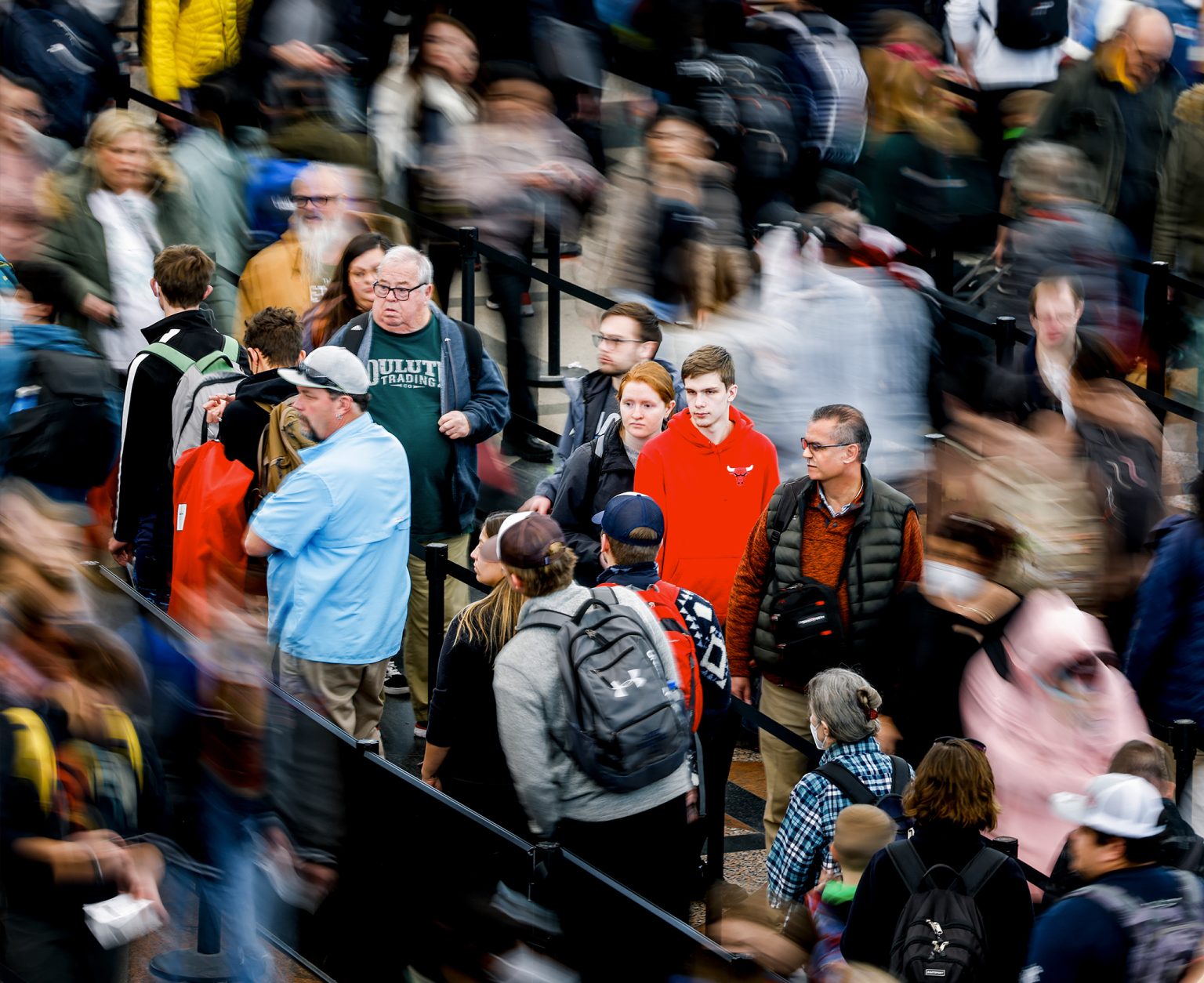
Washington. The scenes resemble those of a dysfunctional state: queues stretching for hours, overwhelmed security checks and passengers waiting more than three hours to clear security. Yet the cause of the disruption lies not in aviation but in a political conflict over voting rights.
US President Donald Trump is seeking to introduce stricter electoral rules through the Save America Act. The aim is to ensure that only those genuinely entitled to vote can cast a ballot. Specifically, the proposal centres on mandatory identity checks, proof of citizenship and tighter limits on postal voting.
As Democrats oppose the measures, Trump has escalated the confrontation. He has tied approval of the federal budget – and with it the funding of key agencies – to progress on the legislation. The result is a political deadlock now felt directly in daily life, with airports among the hardest hit.
A systemic shift in electoral law
The Save America Act is not a technical adjustment but a fundamental restructuring of the American electoral system. At its core lies voter registration. In future, a simple declaration of citizenship would no longer suffice; voters would have to prove it with documents such as a passport or birth certificate. The change would affect millions of Americans who are currently registered through simplified procedures, including online systems or standardised forms.
The legislation also provides for mandatory identity checks at the point of voting. Without valid photo identification, only a provisional ballot would be permitted, subject to later verification.
In addition, the Act would significantly alter the practice of postal voting. Having expanded in recent years, it would now be curtailed through stricter eligibility criteria, additional identity requirements and tighter deadlines. The intention is to anchor voting more firmly in controlled environments.
Another key provision strengthens the role of the federal government vis-à-vis the states. While electoral law in the United States has traditionally been organised in a decentralised manner, the Act would introduce uniform minimum standards for the first time, creating a more regulated national framework out of a patchwork of regional systems.
At its heart, the reform represents a clear shift: away from trust and self-declaration towards documented identity and verifiable eligibility. Supporters see this as a necessary basis for confidence in democratic processes. Critics, by contrast, warn that additional hurdles could make voting more difficult, particularly for those who lack the required documents.

Deadlock in Washington, chaos at airports
The political confrontation is already having tangible consequences. As Republicans and Democrats fail to agree on a budget, the Department of Homeland Security remains only partially funded. Among the affected agencies is the Transportation Security Administration, which is responsible for airport security screening.
Many employees have been working without pay for weeks or have stayed away from their posts. The result is staff shortages, longer waiting times and mounting strain. At peak times, a significant share of personnel is missing – at some airports far more. Operations are slipping out of balance.
In an effort to stabilise the situation, the government has resorted to an unusual measure. Officers from U.S. Immigration and Customs Enforcement have been deployed at airports. Their role is not to conduct security checks themselves but to provide support beforehand, for example by managing queues and directing passenger flows.
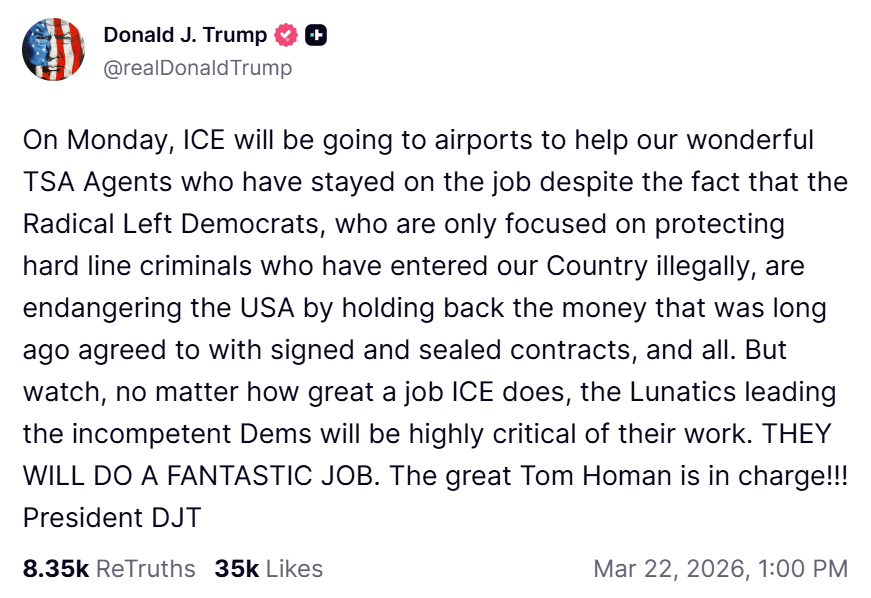
That an immigration authority is now taking on functions within civil aviation illustrates how far the situation has escalated. At the same time, it underscores that the measure is a stopgap. The underlying cause – the political conflict – remains unresolved.
Washington is now attempting to contain the most visible damage. The Senate has advanced a package intended to restore funding to parts of the Department of Homeland Security, including airport security. Yet the core dispute over voting rights and immigration policy has not been settled, merely postponed.
Europe has already faced this debate
The American confrontation may appear unusual at first glance. In fact, it reflects a conflict that has been unfolding in Europe for years. A striking example is Austria’s 2016 presidential election, which was annulled – not because of proven large-scale fraud, but due to irregularities in the counting of postal votes.
In Slovakia, postal voting has also come under scrutiny. Prime Minister Robert Fico is examining whether to restrict or abolish it for voters abroad. The justification lies in safeguarding electoral integrity and in the view that voting under controlled conditions is more reliable than casting a ballot by post.
The dividing line is the same as in the United States: greater access or greater control. Democracies depend not only on correct procedures but on trust in those procedures. It is precisely that trust which is increasingly at the centre of political disputes.
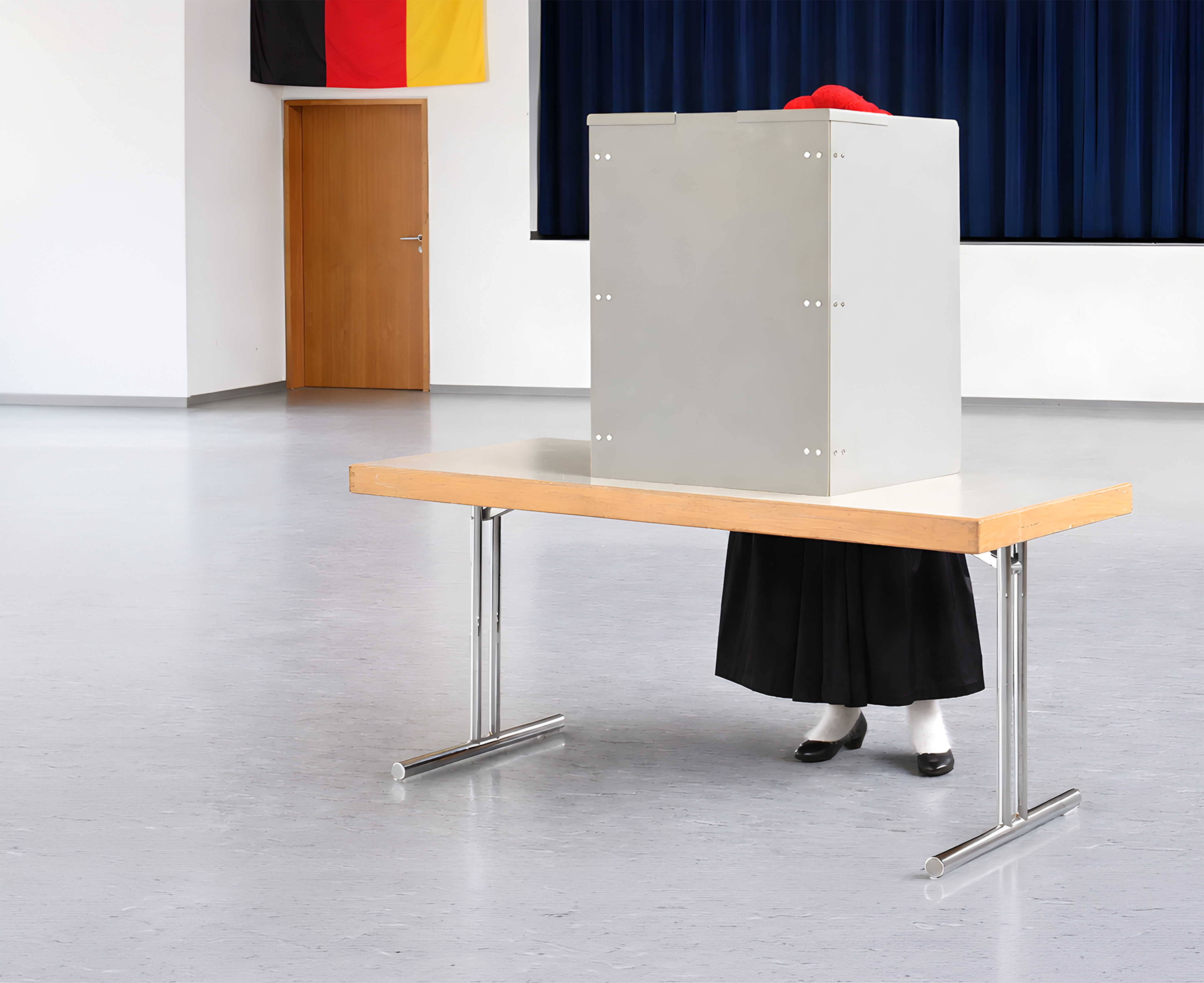
The current crisis in the United States is therefore more than a political quarrel. It shows how quickly institutional stability can come under strain when fundamental questions can no longer be deferred. A law on voting rules leads to chaos at airports, a budget deadlock forces agencies into improvised solutions, and suddenly an immigration authority is present at security checkpoints.
It may appear improvised, yet it reflects a system in the process of reordering itself.