
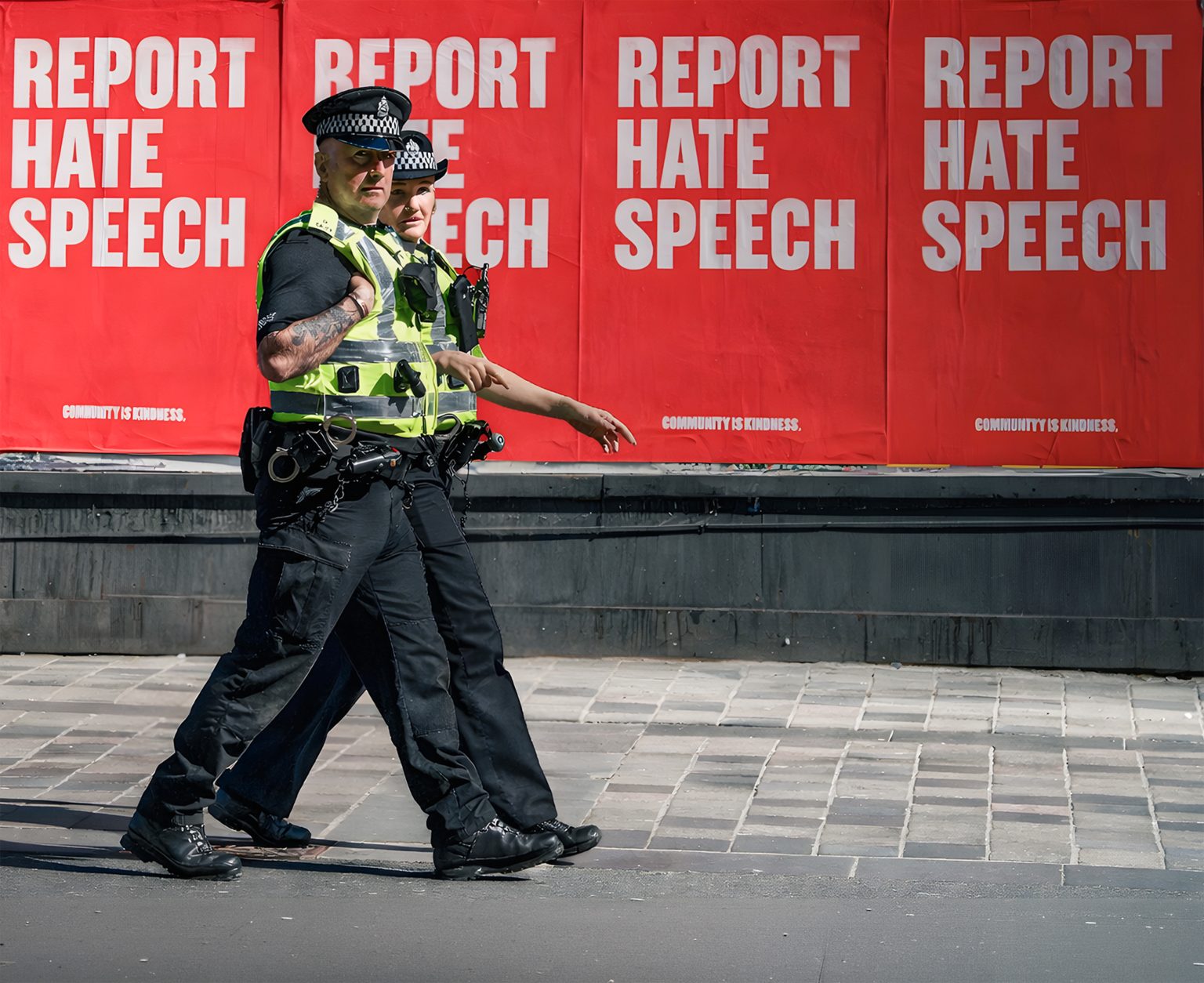
The British government has abolished the system of so-called ‘Non-Crime Hate Incidents’, formally ending a mechanism that for years allowed police to record even lawful expressions of opinion. The practice – logging citizens for alleged ‘hate incidents’ that did not meet the criminal threshold and, in some cases, visiting them with warnings – had been criticised by civil liberties groups from the outset. Home Secretary Shabana Mahmood said police should in future focus on genuine crime rather than pursuing ‘entirely lawful tweets’.
The move is notable. Criticism of the system had grown over several years, both legally and politically. By abolishing it, the government draws a line many observers had long called for and signals, at least rhetorically, a return to the police’s core tasks.
A system built on perception rather than proof
The practice dates back to 2014 and was developed by the College of Policing, a non-elected body that issues guidance for police forces in England and Wales. It rested on a strikingly broad approach: a report could be made if someone felt subjectively offended or distressed by a remark. No criminal offence was required, nor any concrete evidence to prompt police action. The consequences were far-reaching. Between 2014 and 2019, nearly 120,000 such incidents were recorded. Some cases appeared no more serious than a bad joke. Even children were affected, including a nine-year-old girl who was logged over a comment made in the school playground.
A particular concern was that such records could surface in enhanced background checks, known as DBS checks. A non-offence could therefore carry real professional consequences, for example for teachers, care workers or volunteers. The case of former police officer Harry Miller brought the practice into legal focus. After officers visited his workplace over a poem he had shared on social media, he took the matter to court. In 2021, the Court of Appeal ruled the practice unlawful. Even so, it continued in practice for years and was only finally halted by the Metropolitan Police in autumn 2025.
A new framework for old problems
The formal abolition of the system marks an end to the practice, yet the replacement model also raises questions. Certain incidents are now to be recorded as ‘anti-social behaviour with a prejudice element’ if they meet a newly defined threshold. The focus remains explicitly on conduct below the level of criminality. The underlying logic therefore persists: events without a criminal offence are documented, personal data stored, and potential consequences for background checks remain.
The government insists that lawful expressions of opinion will no longer be recorded. At the same time, the system is designed to continue registering non-criminal behaviour. A clear dividing line is therefore hard to discern, even if thresholds are to be tightened. Much will depend on the discretion of the authorities in determining what falls above or below a self-defined threshold. Legal certainty looks different.
What happens to the existing data?
A further unresolved issue concerns existing records. An estimated 100,000 entries remain in police databases and can still be disclosed. The House of Lords voted in March in favour of their deletion, but implementation by the government has yet to follow.
Alongside the abolition, the government also presented a wide-ranging action plan under the title ‘Protecting What Matters’, officially aimed at strengthening social cohesion, but in practice extending deep into the digital sphere. Platforms are to face stronger obligations to regulate content and mitigate risks posed by their algorithms.
Selected researchers are also to be granted access to platform data in order to analyse developments such as radicalisation or disinformation more closely. The government argues that social tensions increasingly emerge online and must therefore be addressed there. Critics, however, warn of a gradual expansion of interference with freedom of expression.

Between relief and renewed control
Particularly contentious is the introduction of a new, non-statutory definition of ‘anti-Muslim hatred’, which includes ‘prejudicial stereotyping’. The term is not clearly defined in law. At the same time, the government acknowledges that it may cover behaviour that is not necessarily unlawful. A special envoy is to be appointed to oversee its application across different sectors, from public authorities to educational institutions and beyond.
While supporters see this as a contribution to protecting minorities, critics warn of blurred boundaries and potential overlap with existing legislation such as the Equality Act 2010.
Taken as a whole, the abolition of Non-Crime Hate Incidents is a visible step towards a stronger focus on actual offences. At the same time, it is clear that the government intends to retain instruments for identifying and managing social tensions at an early stage. The balance remains politically delicate, lying between legitimate security interests and the question of how far the state should go in regulating behaviour that is not criminal.
The coming months will show whether the announced shift in course leads to a tangible easing or whether the practice continues in modified form. What is already clear is that the debate over the limits of state influence on free expression in Britain is far from over and is entering a new, more nuanced phase.