
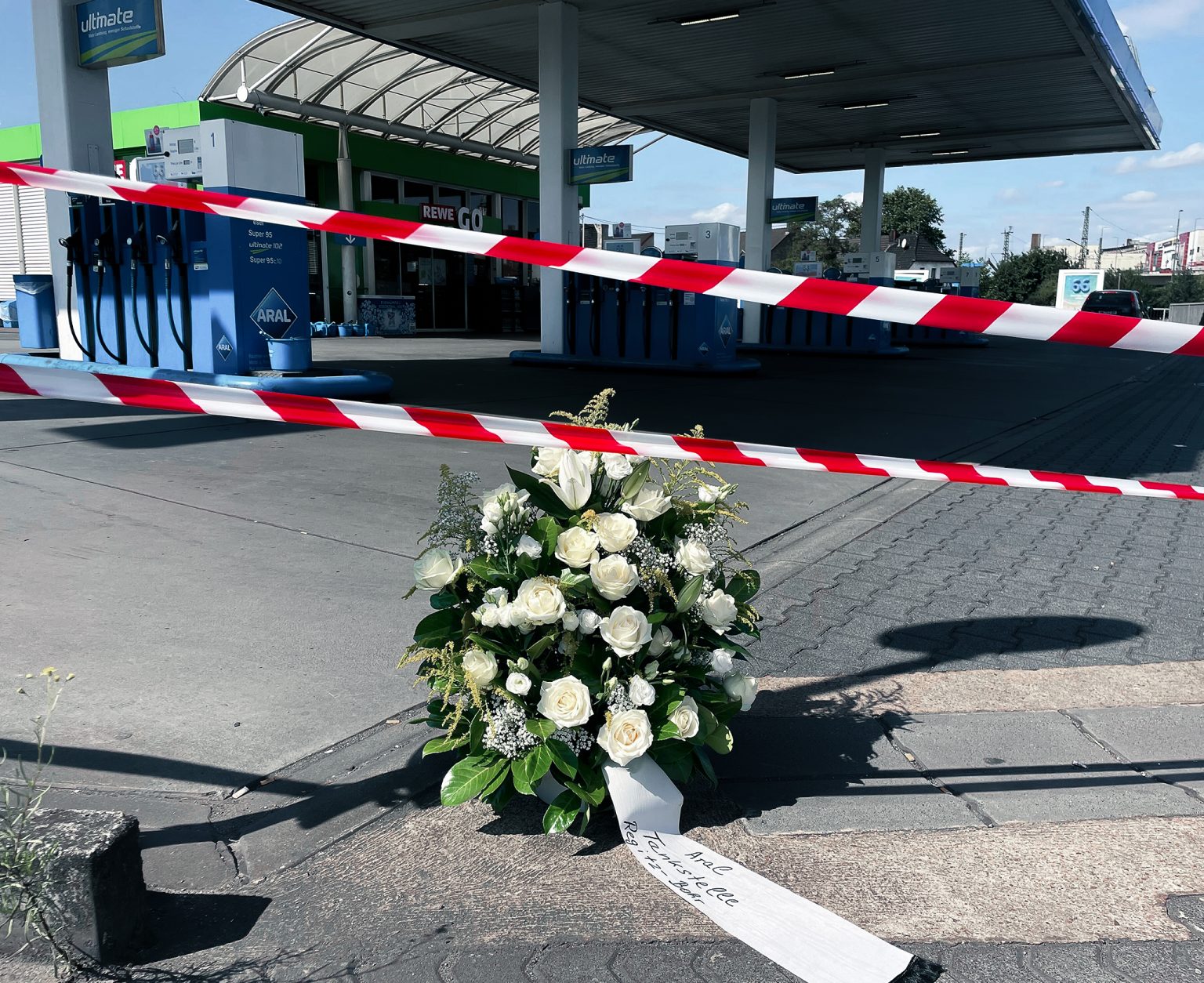
The brutality of the case leaves little room for mitigation. In August 2025, Ahmet G., then 19 and of Turkish descent, robbed a petrol station in Völklingen in Saarland, taking €600. When officers attempted to apprehend him shortly afterwards, the situation escalated within seconds. G. seized a trainee officer’s service weapon and opened fire on 34-year-old police officer Simon Bohr. A total of 17 shots were fired, at least six of them striking the officer. Even after he had fallen to the ground, the attacker continued shooting. A final shot to the head killed Bohr. A second officer arriving at the scene exchanged fire with the attacker and wounded him.
The course of events is starkly clear. An armed robbery, the deliberate disarming of a police officer and the continued assault on an already defenceless victim point to a controlled and extremely violent course of action. Expectations of the legal response were correspondingly clear. Yet it is precisely those expectations that the Saarbrücken Regional Court has disappointed – with a ruling that has left large parts of Germany in disbelief.
A verdict that is hard to comprehend
Presiding judge Jennifer Klingelhöfer acquitted Ahmet G. of murder. He was convicted only of aggravated robbery. Instead of a prison sentence, the court ordered his indefinite placement in a psychiatric hospital. The central reasoning was that the defendant had suffered from paranoid schizophrenia and an anxiety disorder and that his capacity for control had been significantly impaired. ‘Fear had taken over his thinking,’ the judge said. G. fired the shots because he believed he was under a subjective threat to his life.
That line of argument raises serious questions. Even the expert report on which the court relied does not describe an offender fully driven by delusions. There is no mention of voices, but rather of diminished control. In legal terms, that is a crucial distinction, as it tends to support diminished responsibility rather than a complete lack of criminal responsibility.
There is another point that reinforces the criticism. The expert assessment itself appears, in part, inconsistent and open to challenge. On the one hand, it does not establish a classic delusional control of the act. On the other, it serves as the basis for the far-reaching conclusion of a complete lack of responsibility. In effect, the decision shifts from the court into the realm of psychiatric evaluation, without that evaluation appearing consistently coherent. In a case of such gravity, this raises the question of whether the threshold for a finding of complete incapacity was set too low.
Neither the prosecution nor the defence had sought such an outcome. Prosecutors had argued for 13 years’ youth custody for murder and related offences, while the defence had pleaded for manslaughter. The court departed from both positions and opted for the most lenient of the available assessments. Given the specific course of events, involving deliberate action and repeated gunfire, that decision appears, to many observers, a departure from a comprehensible approach to sentencing.

Outrage among politicians and police
Reactions to the ruling have been correspondingly sharp and extend far beyond the individual case. Alice Weidel, co-leader of the Alternative for Germany, described it as a scandal and wrote on X: ‘Such rulings are staggering – and amount to a free pass for future offenders.’ Her criticism focuses on the signal such a decision sends.
There has also been strong criticism from within the police. The German Police Union described the ruling as ‘a slap in the face’ for officers. Its Saarland state chairman, Markus Sehn, said the judgment did not deliver justice for the fallen colleague. While the placement in a psychiatric institution was ‘a small consolation’, as it meant the offender would not be immediately released, it did not address the underlying problem. Particularly significant is the fact that several officers involved in the operation remain traumatised and in some cases are no longer able to perform their duties.
The case has also been followed with concern at federal level. Heiko Teggatz, deputy federal chairman of the German Police Union, spoke of the continuing pain within the entire police community and stressed that violence against emergency personnel must not be relativised. At the same time, he expressed the expectation that the prosecution would lodge an appeal.
An appeal has in fact already been announced, a step many see as a first move towards correction.

More than an isolated case
The slain officer Simon Bohr leaves behind a wife and two young children. In the aftermath of the crime, numerous politicians expressed their sympathy. Anke Rehlinger (SPD) said: ‘A young police officer has been torn from life and from his family. Hardly anyone can imagine the suffering of his relatives.’ Alexander Dobrindt (CSU) added: ‘I am appalled and shocked by the brutal act of violence in Völklingen.’
When it comes to the ruling itself, however, the political response has been notably restrained. While the crime was unanimously condemned, there has been no equally clear assessment of the court’s decision. That leaves not only the individual case in question, but also a broader issue: the reliability of the rule of law.
At the heart of the matter lies a deeper problem. German criminal law provides for finely graded distinctions between responsibility and non-responsibility in order to account for mental illness. That distinction, however, only holds if its application remains comprehensible. When an act of such intensity is ultimately not classified as murder, the impression arises that the law has drifted away from reality.
The forthcoming appeal will have to determine whether the ruling can stand. Regardless of the outcome, it has already had an impact that extends far beyond a single case. For many observers, the decision is no longer merely a controversial judgment, but a symbol of a justice system that has lost its sense of proportion at a decisive moment. It is a ruling that not only raises serious questions, but also erodes trust and is therefore widely perceived as a judicial scandal.