

The conquest of space today resonates with the mood that prevailed at the threshold of the modern age, when the New World was being discovered. The idea promises unprecedented profits and a thriving economy, with new resources and possibilities appearing almost endless.
In economic and geopolitical terms, however, orbit has historically served a far more pragmatic purpose. It has acted as a sophisticated instrument designed to drain an adversary financially.
While the first space race in the 1960s was won by the United States thanks to its massive economic superiority, in 1966, at the height of the Apollo program, the National Aeronautics and Space Administration (NASA) absorbed 4.4% of the federal budget. The second race in the 1980s was used by Washington to bring the Soviet Union definitively to its knees. Moscow’s efforts to keep pace with US space and weapons technology cost an unsustainable 15%–20% of GDP.
Return to Growth After Lean Years
Since then, space projects have often been viewed as a money black hole, where huge sums are sunk with minimal tangible results for the broader economy. As the Cold War faded, the power struggle disappeared and space research had to confront fiscal reality. Geopolitical easing tightened budgets. After many lean years, however, interest and investment in space began to revive.
The value of the global space economy has grown steadily in recent years. From around $180bn in 2005, it climbed to $330bn in 2014 and reached an estimated $613bn in 2024.
That implies steady growth of about 6.7% per year. With the closely watched Artemis II mission and the follow-on Artemis III and Artemis IV flights, this may seem the ideal moment to invest in the long-neglected sector. But the main pitfall remains.
The Impregnable VIP Lounge
It is not easy for average investors to access the flow of public money entering the Artemis program. Three main private-sector winners operate largely behind closed doors without public shareholders.
Two companies share the most lucrative contracts for lunar landers, referred to by NASA as the Human Landing System (HLS).
Elon Musk’s SpaceX, which is providing the Artemis III and Artemis IV missions, is reportedly preparing a historic initial public offering (IPO) as early as July. For now, however, it remains unavailable to the general market. Rival Blue Origin, involved in the Artemis V mission, belongs to Jeff Bezos and is also privately held.
A third key player, Texas-based Axiom Space, faces the same situation. Although it holds lucrative contracts to develop and manufacture lunar spacesuits, investors cannot access it. The company, founded by former NASA International Space Station (ISS) program manager Michael Suffredini and entrepreneur Kam Ghaffarian, is funded entirely by private venture capital. Investors therefore must search public markets for indirect exposure.
Traditional Giants: Certainty Diluted by Defense Programs
The situation on public markets is not straightforward. Investors must choose between two types of companies. The first group consists of traditional aerospace and defense corporations such as Lockheed Martin, Boeing and Northrop Grumman, for which space activities represent only a fraction of total business. Yet their role is embedded in the foundations of the Artemis program.
Boeing and Northrop Grumman were involved in developing the Space Launch System (SLS) rocket, while Lockheed Martin designed the Orion spacecraft.
These prestigious contracts, however, are often only a small portion of overall revenues. At Lockheed Martin, the space segment has historically generated less than one fifth of total revenue, about 18%. At Boeing, revenue from space programs remains marginal, overshadowed by commercial aviation.
Buying Lockheed stock because of Artemis is therefore comparable to buying a supermarket chain solely for its in-house bakery. Profits from lunar activities are masked by fluctuations in fighter jet sales or demand for artillery munitions.
The Public Market: End of Illusions and Hard Selection
Investors seeking pure-play space companies face a major risk: limited cash to execute ambitious plans. The prospect of technological revolution and extraordinary profits has long attracted capital. Elon Musk’s vision of colonizing Mars intensified that enthusiasm, and translating the idea into an investment strategy proved tempting.
Between 2021 and 2023, several so-called New Space companies went public. Most used the shortcut of a Special Purpose Acquisition Company (SPAC), a publicly traded shell that raises funds before merging with a target firm.
This structure allowed companies to bypass the rigorous scrutiny of a traditional listing and promote ambitious financial projections. When markets lost patience and cheap money dried up, valuations collapsed and share dilution followed.
The correction triggered a market shakeout. Space stocks are no longer viewed as a uniform graveyard of investor hopes. A smaller number of capable companies survived. They rely on real projects, working hardware and the prospect of sustainable revenue.
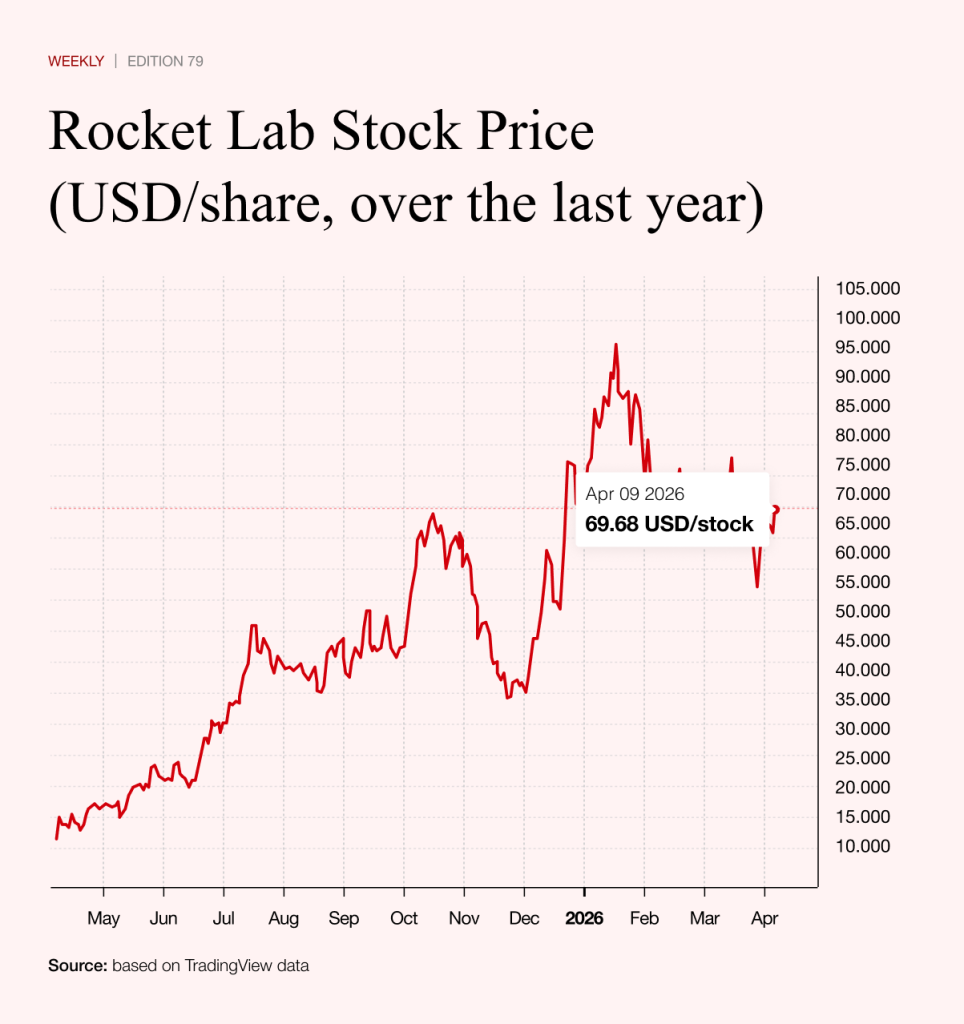
The market now offers a clearer range of options, from the data-driven stability of Planet Labs to the debt-heavy supplier Redwire and the high-risk lunar focus of Intuitive Machines. The standout performer of 2026, however, is Rocket Lab. Despite a recent drop to $69, the stock has delivered more than 286% annual appreciation.
The company has evolved beyond a small launch provider and now sells complete satellite systems and components. It is also closely linked to Artemis. It supported the CAPSTONE mission verifying the orbit for the Gateway space station and supplies solar arrays for Gateway and Orion. The investment still carries risk. While Rocket Lab holds solid cash reserves, development of the new Neutron rocket is consuming significant funds.
The ongoing Artemis II mission is crucial for the sector’s future. Investors want evidence of execution. For most small investors, however, opportunities remain limited. Public markets do not offer companies planning to colonize the Moon. Investors mainly gain exposure to suppliers of solar panels, communication antennas and navigation systems.