

Viktor Orban promised to build a workable post-liberal alternative to what he perceived as a declining and failing West. His political system rested on two main pillars: an assertive foreign policy that strongly emphasized Hungary’s national interests and a comprehensive social vision.
The latter was not merely about superficial culture wars against Wokeism or the LGBT agenda. Its deeper aim was to find a model capable of addressing the real Achilles’ heel of modern Western societies: demographic decline and falling birth rates. After 16 years in power, however, Hungary offers a different lesson. Diagnosing the problem accurately is far easier than solving it.
Hungary’s new prime minister, Peter Magyar, faces the same challenge: to return the birth rate to 2.1 children per woman. Yet he will likely struggle to find additional funding. Orban’s program was already extremely generous.
A Family State for 6% of GDP
On paper, the model appeared convincing. When Orban took power in 2010, the total fertility rate stood at 1.25 children per woman. By 2021, it had risen to 1.59. If the mechanism were that simple, all it would take is to shower young families with money. But a family is not an accounting machine into which a subsidy is fed on one side and a child emerges from the other.
Similar increases have been observed in countries without such generous family policies. A typical example is the Czech Republic: between 2010 and 2021, the total fertility rate rose from 1.50 to 1.83 children per woman.
The reason for this regional increase was largely pragmatic. Many postponed starting a family during the financial crisis and had children later, once conditions had stabilized.
In Hungary, moreover, the crisis was particularly severe. The economy contracted by almost 7%, and hundreds of thousands of families who had taken out mortgages in Swiss francs saw their repayments effectively double overnight after the forint fell sharply. The country was on the verge of bankruptcy and had to be rescued by an international loan of 20bn euro. It is hardly surprising that children were not born in such an atmosphere.
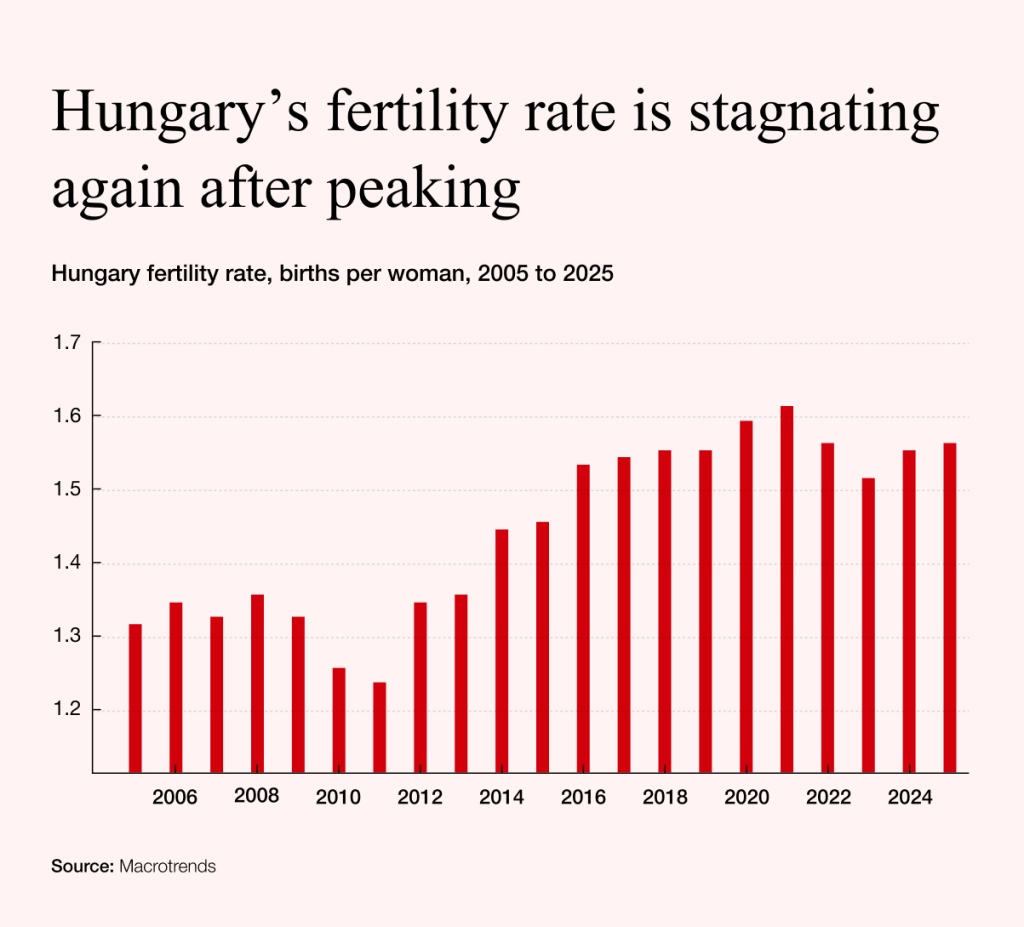
The Illusion of a Subsidy Miracle
When the economy began to recover, the backlog of postponed births began to unwind. Orban’s subsidies thus acted more as a bonus than as the primary cause of higher birth rates. Economic stimulus alone is not enough; higher birth rates are also linked to a sense of stability and confidence in the future.
Here, however, lies the most uncomfortable truth, one against which even billions in subsidies offer little protection.
The assumption that delayed parenthood can easily be reversed has fostered a false sense of calm for years. Many assumed that what young couples postponed at 25 could be made up at 30. The reality is far harsher: once children disappear from the life plans of 25-year-olds, they often do not reappear later. What began as a rational, temporary delay gradually and almost imperceptibly became a permanent absence that even the most generous state benefits cannot reverse.
Demographic Roulette
The generosity of Orban’s family policy was widely noted. Its main elements included lifetime tax exemption for mothers of four or more children, interest-free loans for newlyweds, which the state writes off entirely after the birth of a third child, and substantial non-repayable housing subsidies under the CSOK program, as well as subsidized purchases of cars with more than seven seats for large families.
On paper, the system resembled a family paradise. In practice, however, it contained a fundamental flaw, which the new prime minister, Peter Magyar, is now highlighting. From the outset, Orban’s system was tailored to the secure middle and upper classes, with a focus on those in stable employment and on taxpayers.
Magyar’s criticism is direct and factual: to qualify for a state-backed mortgage or an interest-free loan, a family first had to demonstrate strong financial standing. To benefit from zero income tax, parents had to earn sufficiently high incomes from which tax would otherwise have been paid.
The result was not a broad-based rescue of Hungarian families, but a significant transfer of public funds towards those who were already secure. Poorer families, people in the regions and single parents were far less able to access these benefits.
Moreover, the billions of forints channelled into housing subsidies were quickly absorbed by the market. Developers and sellers responded to the CSOK program by sharply increasing property prices. State support was thus largely capitalized into higher purchase prices, enriching property owners and, paradoxically, making housing even less affordable for young people.
According to Magyar, the Orban government has replaced genuine social policy with an unfair and ineffective instrument. His aim is to shift the focus from broad subsidies to targeted support for the socially vulnerable and to stabilize strained public services.
The contrast between the two approaches reveals a striking political paradox. For years, Orban’s system financially favored the very urban, better-educated class that later formed the core of the opposition and helped bring Peter Magyar to power. Magyar now plans to redirect family policy towards the most vulnerable and towards rural populations, that is, towards groups that have traditionally formed the core of Orban’s electorate, although Fidesz has recently been less dominant in the countryside.
Whether Magyar is repeating the same political mistake as his predecessor by subsidizing a group less likely to support him, or whether this represents a carefully calculated attempt to reshape the political landscape, remains unclear.
One conclusion, however, is already evident: regardless of political strategy, raising the birth rate sustainably above the replacement level of 2.1 children per woman will remain an extremely difficult task.