
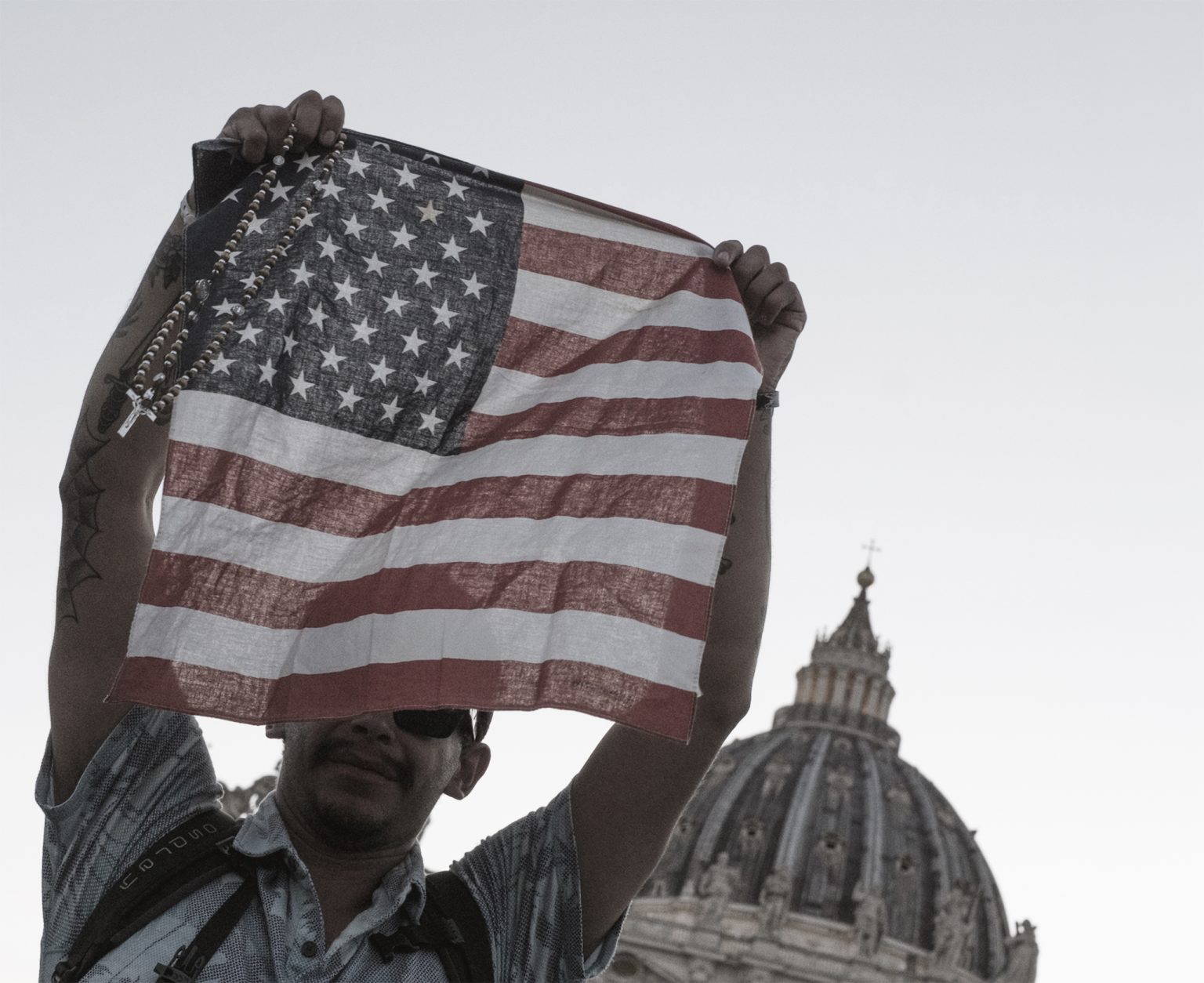
In recent weeks, a great deal of attention has been given to the long-distance exchange between Pope Leo XIV and President Trump regarding the war in Iran. Following the news, one might think the primary concern of the pope is global geopolitics, with a particular emphasis on criticizing the US president. This, however, fundamentally misses the thinking of the Holy Father. His role is not that of a politician but of a pastor, and in the United States he is likely far more concerned with witnessing to the Gospel than with taking aim at political actors.
I obviously cannot know the pope’s precise thinking, but I suspect his greater concern is the waning of devout and engaged Catholics.
The Church in Decline
In the United States, the Holy Father’s home country, the data are sobering. The number of priests declined rapidly from its peak of 600 ordinations per year in the late 1970s to around 400 per year in 1998. Since then, it has plateaued at that level and has not seen the significant drop observed in many other parts of the world. While there is still a shortage of priests, the situation could certainly be worse.
Baptisms are another story. For three decades, from 1978 to 2008, annual figures hovered at around one million per year. However, since 2008 baptisms have nearly halved and now stand at about 590,000 per year. Other indicators show that only one in four teenagers who attended Mass at least monthly in the mid-1990s were still doing so in the late 2010s, while 56% of those who stopped attending no longer identified as Catholic. Weekly Mass attendance across the US population fell from 12% in 1980 to 5% in 2021. Since the mid-1970s, 40% of Catholic schools have closed. Only 43% of self-described Catholics go to confession more than once a year, and vocations to religious life have declined by 70%.
By any standard, these statistics are alarming indicators that the Catholic faith in the United States is on a trajectory in the wrong direction.
Leo XIV’s Response
All of this is certainly on the mind of Pope Leo XIV, who has a unique relationship with the United States. What he plans to do about the crisis remains to be seen, but he is unafraid to speak about the Faith and the power of Christ to transform individuals, communities and societies.
For the next official gathering of the College of Cardinals in June (a consistory), the focus, as directed by Pope Leo, will be on Pope Francis’ apostolic exhortation, Evangelii Gaudium. This is no doubt a clue to Leo’s vision. The exhortation was issued early in Francis’ pontificate, before it was burdened by the weight of what some have argued was a failed pontificate. The document is evangelical at its core and was a stable bridge between the pontificates of Francis and Benedict XVI.
In his letter to the College of Cardinals earlier this month, looking ahead to the consistory, Leo noted:
“[Evangelii Gaudium] refocuses everything on the kerygma as the heart of our Christian and ecclesial identity. It was recognized as a ‘breath of fresh air,’ capable of initiating processes of pastoral and missionary conversion – rather than producing immediate structural reforms – and thus profoundly guiding the Church’s journey… [I]t calls every baptized person to renew their encounter with Christ, moving from a faith merely received to a faith truly lived and experienced. This journey affects the very quality of the spiritual life, expressed in the primacy of prayer, in the witness that precedes words, and in the coherence between faith and life. At the community level, it calls for a shift from a pastoral approach of maintenance to one of mission… From all of this flows a profoundly unified understanding of mission, which is Christ-centered and kerygmatic. It is born of an encounter with Christ that is capable of transforming lives and spreading through action rather than conquest… Even when the Church finds herself in a minority, she is called to live with confident courage, as a small flock bringing hope to all, mindful that the aim of mission is not its own survival, but the communication of the love with which God loves the world.”
If this is the Holy Father’s response to the situation facing the global Church, and he is telling us it is, then he envisions authentic witness to the transforming power of an encounter with Christ as the future of the Church. This ecclesial mission will take form differently according to local circumstances, but the goal is the same: encounter with Christ. It is not the preservation of institutions, the defeat of secularism, the increase in particular statistics, the capture of social media space or political engagement, all of which are good things. We can infer from Leo’s letter that they all flow from an encounter with Christ.
What Leo envisions specifically for the Catholic Church in the United States remains to be seen, but it is an evangelical agenda, not a political one. Those who look through a political lens to understand Leo’s relationship to the United States fundamentally misunderstand his thinking. For Leo, if we are to apply his thinking about the global Church to the United States, we must understand that he calls Americans to an encounter with Jesus. All the rest flows from that mission.
Jayd Henricks is president of Catholic Laity and Clergy for Renewal and a former executive director of government relations at the US Conference of Catholic Bishops.