
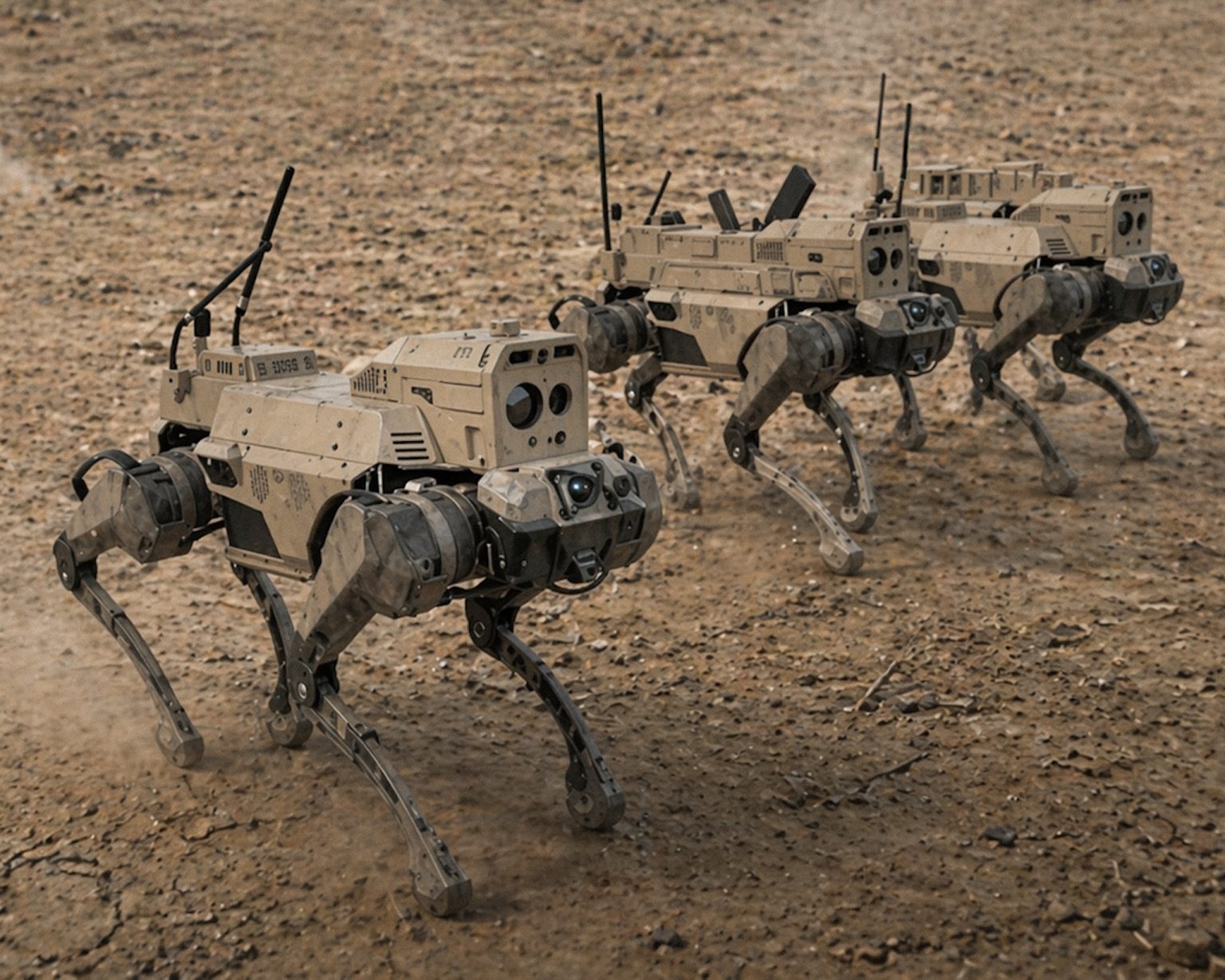
More and more military technology prototypes are beginning to mimic the structure and movement of animals. As warfare undergoes a fundamental transformation and traditional heavy machines such as aircraft carriers and bombers increasingly become liabilities, robotic birds and dogs are moving to the forefront of modern warfare.
Quadrupeds, particularly those made famous by videos from the American company Boston Dynamics, have recently attracted particular interest. Compared with tracked vehicles, their mobility allows them to avoid or overcome smaller obstacles more effectively along a planned route.
At the end of March, the Chinese military, together with the Southern Automation Institute, unveiled a pack of robotic wolves. They represent a major advance in battlefield technology because they operate through an advanced AI-based shared operating system.
According to the analytics portal Sinical China, they function as a coordinated unit, with individual robots synchronizing their movements with one another in real time. The South China Morning Post described the system as having a “collective brain”. In practice, it functions as a single device distributed across multiple pieces of hardware.
“The robots can be controlled through terminal consoles, by voice and with a tactical glove or control stick mounted on the rifle”, the Morning Post reported, adding that the robots can reach speeds of up to 15 km/h and carry payloads of up to 25 kg.
China May Be Pulling Ahead of the US
The shared operating system is also one of the main technological goals for China’s rival, the United States. In January, billionaire Elon Musk entered a classified Pentagon competition to develop a swarm of drones built around a similar “collective brain”.
The Pentagon’s $100m grant also attracted Musk’s former company OpenAI, led by his longtime rival Sam Altman. Both had previously distanced themselves from the idea of “developing machines to kill people”, but have since changed course. Musk has also worked with the federal government during the administration of Joe Biden.
The Pentagon wants drone swarms that can be controlled by voice, using a shared operating system capable of translating human speech into a form of digital command language. The Chinese team behind the robotic wolves addressed the same challenge more simply by adding joystick control.

Maglev Guns
Engineers in Beijing have also unveiled a new dual-purpose handgun using technology more familiar from the tracks of high-speed trains. What the website Interesting Engineering described as a “coil gun” is an electromagnetic firing device consisting of a barrel surrounded by electrical coils.
The weapon combines a coil gun with a rail-launching principle, using electromagnetic acceleration more familiar from large-scale railguns and high-speed maglev trains. While the US military often refers to larger versions of this technology as “electromagnetic cannons”, Chinese designers have reportedly reduced the concept to a handgun-sized weapon.
“The weapon, which is capable of firing 1,000 to 2,000 rounds per minute, can penetrate wooden planks from a distance of several dozen meters. Due to its adjustable power, it can disarm rather than kill at lower settings”, the portal noted.
The electromagnetic weapon offers a discreet alternative to traditional firearms, producing little to no muzzle flash, no smoke and minimal noise, making it suitable for urban operations, the Morning Post noted.
Alongside these highly publicized breakthroughs, China is also a leader in mainstream drone technology and, like the US and more recently Ukraine, is exporting it on a large scale. Israel, whose military is purchasing significant quantities of autonomous systems, is also benefiting from China’s role in the technological race.
Israel Is Concerned About Espionage
However, as Haaretz noted, the Israel Defense Forces’ (IDF) reliance on Chinese drones exposes a strategic vulnerability in an army that stands in clear opposition to Beijing. Israel remains firmly aligned with Washington, while China hosted delegations from Hamas and Fatah in 2024 in an effort to ease tensions between the two Palestinian movements.
At the same time, the Israeli Ministry of Defense has launched a new tender for 1,000 first-person view (FPV) drones. The bidding process closed at the end of February, and the systems are required to be resistant to jamming and capable of operating at night.
According to Haaretz, the IDF relies heavily on Chinese drones, raising concerns within Israel’s security establishment about potential espionage and the leakage of operational information.
Although the Defense Ministry pays relatively little for Chinese drones, the newspaper noted that the real cost may ultimately be borne by soldiers on the battlefield. It cited an anonymous executive from an Israeli drone company, who said the main reason for choosing Chinese suppliers was their strong price-to-performance ratio.
“Chinese drones are great because someone at the end of the chain, in China, subsidizes them, so that our military uses them. And the Israel Defense Forces cannot really ‘sterilize’ them and completely control the information that comes out of them”, the industry source said, referring to the military process of securing purchased drones against information leaks.
Despite these risks, China’s drone industry continues to grow. And while rising American players such as Anduril Technologies, which recently began construction of a large-scale factory in Ohio, are expanding rapidly, Beijing is keeping pace.
Their rivalry in the new technological arms race, which some analysts see as part of a new Cold War, is reshaping realities on more than one battlefield. The Donbas, Lebanon and the Gulf states, all heavily affected by this military buildup, offer clear evidence of that.