

With a new regulatory initiative, Turkey is targeting what has long served as a final digital refuge for many citizens: the anonymous use of virtual private networks (VPNs). According to reports by the pro-government newspaper Yeni Safak, Ankara plans to ban unlicensed VPN services. Approved providers would be required to log user data and make it available to authorities upon request.
VPNs are designed to encrypt data traffic, bypass geographic restrictions and protect users from surveillance. A service that records activity and shares it with authorities would turn that purpose on its head.
The proposal has officially been framed as part of a political initiative to “protect children”. Following violent incidents at schools in Sanliurfa and Kahramanmaras, where perpetrators were reportedly influenced by violent mobile phone games, the government is proposing a package of measures. These include parent-controlled “child SIM cards”, limits on the number of mobile numbers that can be registered per person and stricter regulation of VPN access.
Critics argue that this framing is misleading. While parts of the package focus on minors, the VPN provisions would affect all internet users, and the result would be a system in which digital anonymity exists only in a state-approved form.
VPN Surge Reflects Public Concern
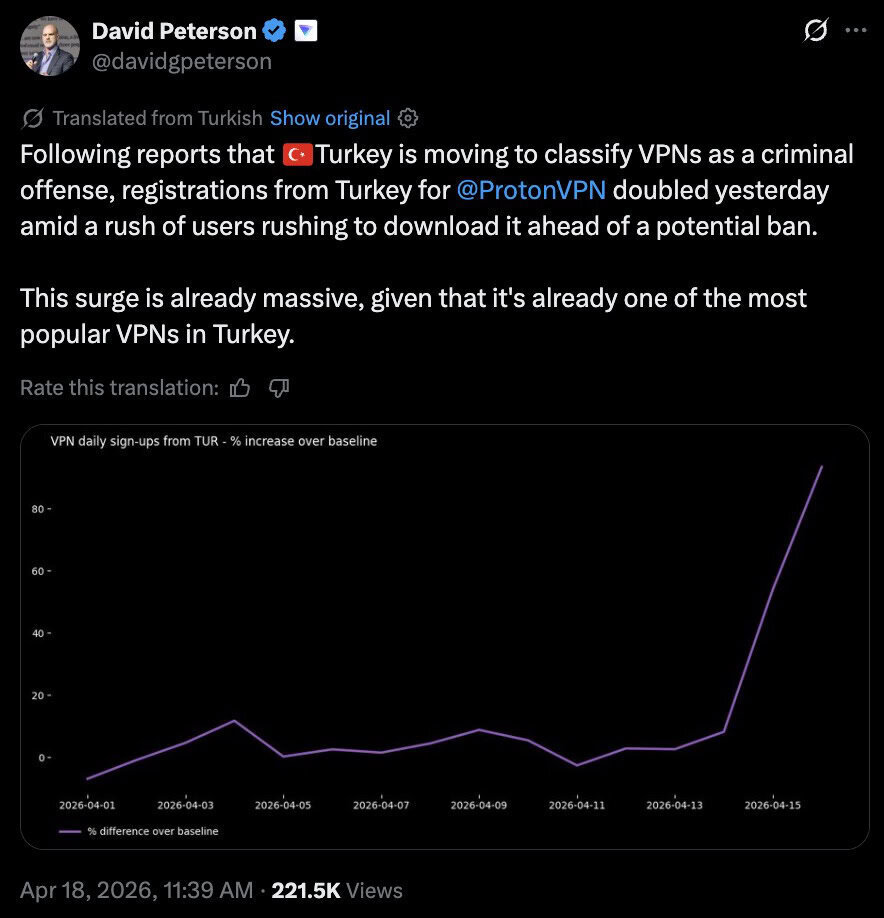
Public concern is already evident in the immediate response to the news. According to Proton VPN, new sign-ups from Turkey doubled shortly after the plans became known. David Peterson, a senior executive at the company, also reported connection disruptions and blocking, particularly on the Vodafone Turkey network.
The Swiss provider has begun advising users on workarounds, including the use of its “Stealth” protocol, which disguises VPN traffic as ordinary internet activity, and the “alternative routing” feature to bypass restrictions. Even if websites are blocked, apps would remain accessible via official stores or platforms such as GitHub.
Guidance of this kind is not unusual in Turkey. The country has a long history of internet restrictions and platform slowdowns. In August 2024, Turkish providers blocked numerous VPN services, prompting a 4,500% surge in registrations at Proton.
A similar pattern emerged in March last year following the arrest of Istanbul mayor Ekrem Imamoglu and the temporary throttling of major social media platforms. Proton reported a 1,100% increase in sign-ups at the time. These trends suggest a clear dynamic: the tighter the control over digital communication, the stronger the demand for ways to circumvent the restrictions.
The proposed licensing system would make such workarounds significantly more difficult. If only state-approved VPNs are allowed, users may retain formal access to protective tools but in practice operate within monitored channels.
From Privacy Tool to Control Mechanism
The real issue is not the blocking of individual providers, but the logic behind the system itself. A licensing model would not simply regulate VPN services – it would allow the state to decide who can operate. Providers unwilling to store user data might be excluded from operating in Turkey altogether.
This would not create a market for independent security services, but a permission-based system in which authorities determine the boundaries of acceptable privacy.
The implications are far-reaching. A VPN service that records user activity could make it possible for the state to track which websites users visit, who they communicate with and what information they access. The very data VPNs are meant to protect would be systematically collected.
This raises a broader question: in authoritarian or semi-authoritarian contexts, is digital security increasingly accepted only in controlled form?
Ankara argues that licensed services would offer greater safety, but critics see a paradox. Providers that offer genuine anonymity risk being excluded, while those willing to facilitate monitoring would remain operational.
The debate therefore extends well beyond Turkey. It reflects a global tension between security policy and digital freedom. Governments have long sought to regulate encrypted spaces, from messaging services to VPNs. The Turkish proposal, however, would go further by placing anonymity itself under state control.

This is what makes the issue so fundamental. It is not simply another internet regulation. It raises the question of whether digital safe spaces will, in future, exist only with government approval.
For many observers, the initiative therefore appears less about child protection and more about transforming a tool of freedom into an instrument of control.