China has caught up with the United States in real output, but its path to dominance is a race against time and an ageing population. Photo: Ji Haixin/VCG via Getty Images/AI
Who Runs the World Economy: America Has the Dollars, China Has the Factories
China has surpassed the United States in real output, but its path to lasting economic dominance is a race against time, slowing growth and an aging population.
China has built its strength not only on the market, but on a combination of state coordination, cheap labor, high investment, export discipline and favorable demographics. It understood prosperity not primarily as the result of consumption, but of production, infrastructure, savings and long-term social mobilization.
While America remained an economy of the dollar, Wall Street, technology firms and domestic consumption, China became an economy of factories, ports, manufacturing centers and supply chains.
Meanwhile, the American model created not only wealth but also civilizational fatigue. It gradually turned the citizen into a consumer, work into a service of convenience and freedom into the choice between products. Consumption, originally the reward for prosperity, became its meaning. Where an economy loses its higher purpose, the spirit of society weakens, along with its capacity for sacrifice, discipline, long-term planning and the pursuit of a common goal.
At first glance, it may seem that China’s path to dominance in the world economy is only a matter of time. It would seem one only has to wait: for China’s GDP to surpass that of the US, for its firms to dominate more technology sectors and for industrial strength to be transformed into political power.
But that view is dangerously simplistic. America still holds a huge lead in wealth, capital markets, military power, high technology, universities, currency strength and its ability to attract talent. The difference between the two economies is not merely one of growth rates. It is a difference in starting position, institutional strength and the type of power each can mobilize.
When Dollars Decide
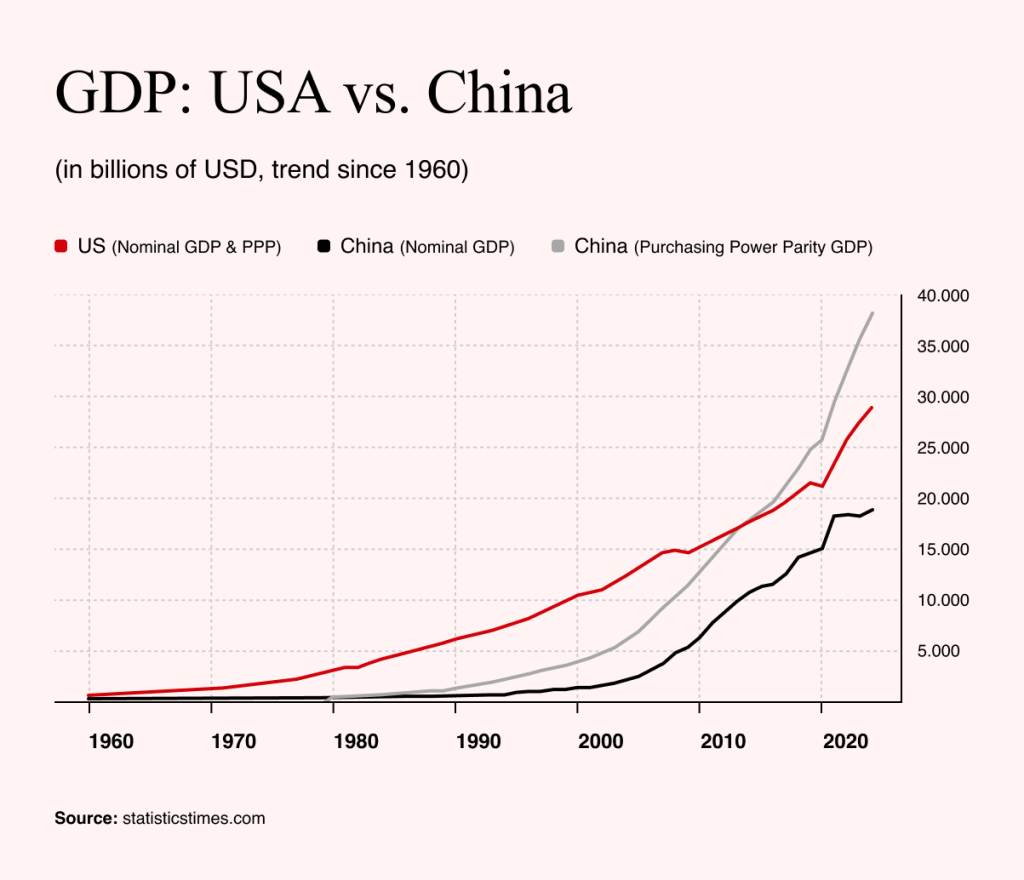
The classic indicator of economic comparison remains gross domestic product (GDP). In nominal terms, meaning current dollars at current prices and exchange rates, the situation is clear: the United States remains well ahead of China.
According to the International Monetary Fund’s April database, the US economy is projected to reach about $32tn in 2026, while China’s is expected to stand at roughly $21tn. This is not a cosmetic difference, but a gap equivalent to several German economies.
But nominal GDP measures the volume of economic activity, not its strategic quality. It also reflects growth in high-cost sectors such as health care, insurance, legal services and finance, which do not necessarily translate into greater productive, technological or geopolitical capacity.
Nominal GDP is therefore an important but limited indicator. It shows America’s weight in dollars, not the full structure of its power. That is why it is not enough to say that the US leads simply because its economy is larger at current prices. If we look at purchasing power parity, meaning how many real goods and services an economy can produce at home, the picture changes. That is where the Chinese counterargument begins.
Source: statisticstimes.com
The Chinese Counterargument: Purchasing Power Parity
Purchasing power parity (PPP) offers a different picture of the global economy. It does not compare economies only through exchange rates, but through what money can actually buy inside each country. A dollar in New York and a yuan in Beijing do not have the same purchasing power.
The same service, building, job or household product can be significantly cheaper in China than in the United States. That is why, by this measure, the Chinese economy appears larger than the American one.
In PPP terms, China has already overtaken the United States. According to International Monetary Fund estimates, China’s GDP in PPP terms in 2026 is roughly $44tn in international dollars, while US GDP stands at about $32tn. That difference cannot simply be dismissed as a statistical trick.
PPP captures more accurately the real volume of domestic production, consumption, infrastructure and services, in other words, how much an economy can actually produce within its own territory. From that perspective, China is no longer merely a catching-up power. It is an economic giant that has surpassed America in the scale of real output.
Demography and the Passage of Time
After economic size comes the second issue: dynamism. China is still growing faster than the United States, which makes its eventual dominance seem only a matter of time. For years, the assumption was simple: China would keep growing faster, America more slowly, and eventually the two lines would cross.
But economic history is not geometry. Growth is not only a question of speed, but also of a society’s age, productivity, confidence, innovation and ability to generate domestic demand.
Here lies the paradox of China’s rise. The country may be rapidly catching up with America, but it is also losing one of its greatest historical advantages: demographics. The vast workforce that powered its industrial miracle for decades is gradually becoming a burden.
The population is aging, the number of working-age people is shrinking, and a model built on cheap labor, massive investment and exports is reaching its natural limits.
China does not have unlimited time. Unless it can significantly raise productivity, technological strength and domestic consumption over the next decade, its window for catching up may begin to close before it reaches full dominance.
The difference between the two economies is also visible in their main economic problem. America is struggling with inflation, while China faces deflationary pressure. For ordinary citizens, falling prices may sound like good news. From a macroeconomic perspective, however, long-term deflation is often more dangerous than moderate inflation.
Inflation makes the present more expensive, but deflation can freeze the future. People postpone purchases, companies cut investment and debt becomes heavier in real terms. America faces an overheating economy, while China may be confronting the opposite problem: an economy that, despite its industrial strength, is losing internal momentum.
The Chinese story is therefore not simply one of America’s inevitable eclipse. It is a race against time. China needs to grow rich before it grows old – to move from quantity to quality, from cheap production to productivity and from export dependence to stronger domestic demand. Otherwise, it may remain a giant industrial power that came close to surpassing America but never fully did.
Here is placeholder for Article excerpt Here is placeholder for Article excerpt Here is placeholder for Article excerpt Here is placeholder for Article excerpt
Here is placeholder for Article excerpt Here is placeholder for Article excerpt Here is placeholder for Article excerpt Here is placeholder for Article excerpt
Here is placeholder for Article excerpt Here is placeholder for Article excerpt Here is placeholder for Article excerpt Here is placeholder for Article excerpt
Welcome to the comments section of the Štandard daily. Please take note of our guidelines, comments are moderated by us. You can contact the moderators at [email protected].
Participate in the discussion
Comments are available to subscribers only. If you'd like to join the discussion, choose a subscription starting at €6.72 per month.
All comments 0
Register
Comments are available to registered users only. If you'd like to join the discussion, register here.