
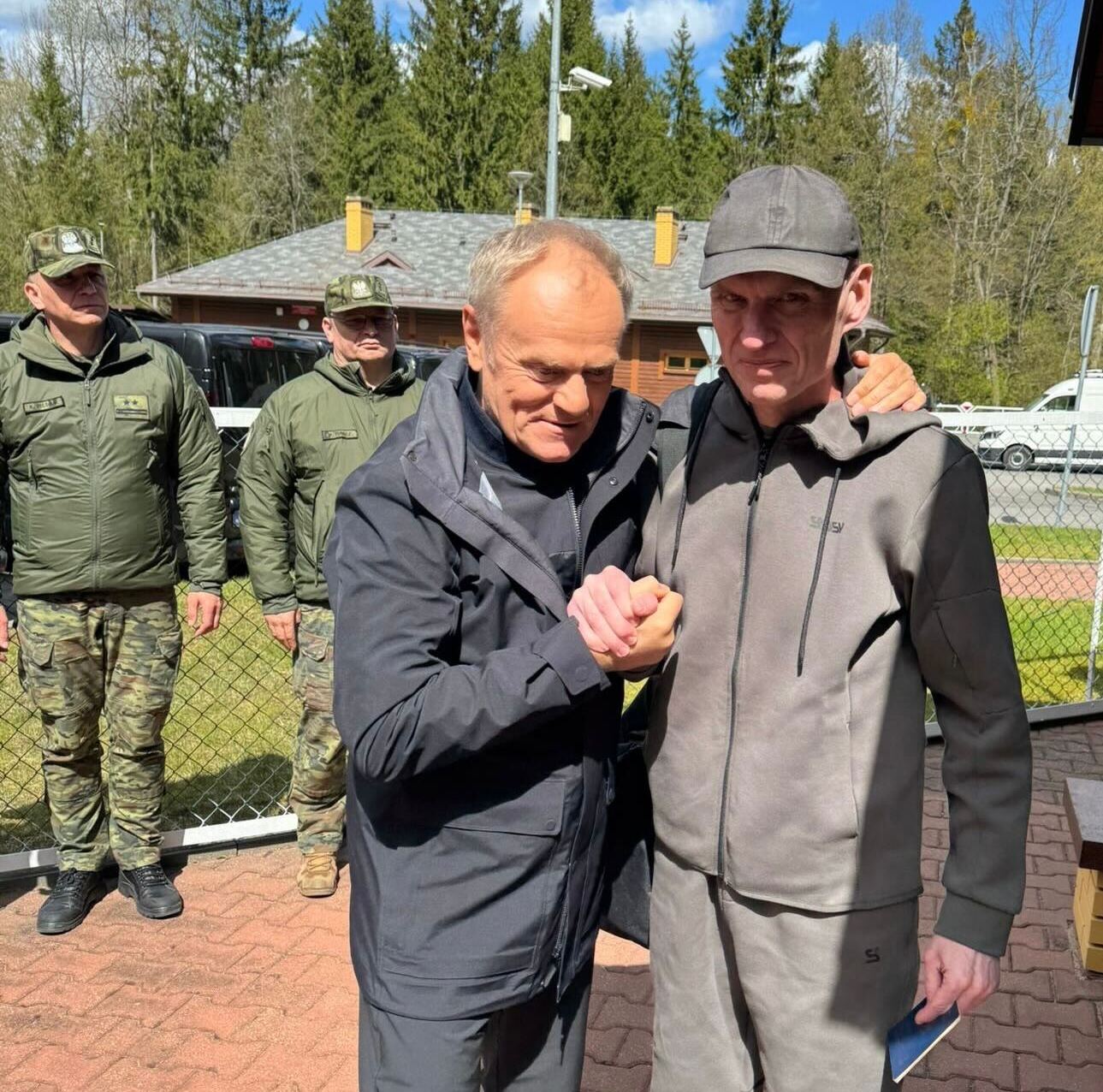
The Belarusian State Security Committee (KGB) and Poland’s Intelligence Agency (Agencja Wywiadu) exchanged prisoners in a five-for-five swap at the Polish-Belarusian border on Tuesday afternoon. The detainees were citizens of several countries, and the entire diplomatic effort took between one and two years.
Citizens of Russia, Belarus and other Commonwealth of Independent States (CIS) countries were extradited to Belarus. Among them was Russian archaeologist Alexander Butagin, who had been conducting archaeological work in occupied Crimea since 2014 and exporting the finds to Russia. He was detained in Poland at the end of last year.
Belarusian Pole
Shortly after 1 p.m. on 28 April, Polish Prime Minister Donald Tusk announced on social media that Andrzej Poczobut, a representative of the Polish minority in Belarus, had returned to Poland. Tusk described the process as a complex two-year diplomatic operation marked by dramatic twists and turns. Belarusian President Alexander Lukashenko said it had taken one year.
“It was possible thanks to the great work of our services, diplomats and prosecutors, as well as thanks to the great help of our American, Romanian and Moldovan friends. I thank you all on behalf of Andrzej Poczobut and on my own behalf”, Tusk added.
Lukashenko’s office thanked Russia’s Federal Security Service (FSB) and said representatives of seven countries had been present during the talks.
The activist, a member of the Polish minority in Belarus, had been in detention since his arrest in 2021 and in a penal colony since 2023 for allegedly inciting hatred and rehabilitating national socialism. Both the accused and international observers dismissed the charges as politically motivated and linked to his efforts to preserve the Polish minority in western Belarus.
Polish President Andrzej Duda also thanked US President Donald Trump for helping arrange the exchange, while Lukashenko said that Poczobut’s mother had personally asked him to include her son in the swap. Polish Foreign Minister Radoslaw Sikorski said the released Pole needed time to recover, describing him as starving and exhausted. He added that it was too early to speak of warmer relations.
The Archaeologist and the Soldier’s Wife
Russian media reported that two Russian citizens were extradited from the Polish side of the border to Belarus, one of them being Butagin. Poland’s Internal Security Agency (ABW) detained him on 4 December 2025 in his hotel room in Warsaw.
Shortly before his detention, Butagin had been lecturing at a university in the Netherlands and was waiting in Warsaw for a flight to Belgrade. An ABW spokesman confirmed to Statement that the arrest had taken place “at the request of the District Prosecutor’s Office in Warsaw in connection with a request for international legal assistance from the Ukrainian side”.
The second Russian citizen was the wife of a Russian soldier stationed in the occupied part of Moldova, Transnistria, a narrow strip of land between the Dniester River in the west and the Moldovan-Ukrainian border in the east.
Although the territory is internationally recognized as part of Moldova, it has functioned as an unrecognized state closely tied to Moscow since the 1990s, when separatists were backed by Russia. Russia still maintains around 500 “peacekeepers” there, among them the husband of the released Russian woman.
Russian state news agency TASS reported that the woman had been arrested in Chisinau in 2025 and convicted of bribery. Moldovan President Maia Sandu said Chisinau had handed over Russian citizen Nina Popova and former deputy head of Moldova’s Information and Security Service (SIB) Alexander Balan, the latter previously accused of treason in favor of the Belarusian KGB.
In exchange for the two Russians, two Moldovan citizens were extradited to Poland. Russian media described them as Moldovan intelligence officers who, according to the Russian FSB, had entered Russia in 2025 using false documents “in order to carry out intelligence operations”. Sandu confirmed that the released Moldovans had been sent to Moscow as agents.
Belarus has previously released political prisoners, and exchanges involving political detainees and intelligence agents between Russia and the West have also occurred. On 28 April, however, the first direct prisoner swap between Belarus and Poland took place, with several other countries playing key roles behind the scenes.