

When people speak of a global currency, many still think of the petrodollar: the US dollar anchored in the global oil trade. Despite America’s vast debt and chronic budget deficits, the dollar’s position remains remarkably strong. The reason is simple: the world still has compelling incentives to hold dollars.
The traditional oil link, however, is beginning to loosen. A symbolic turning point came when Saudi Arabia started accepting payment for its oil in Chinese yuan. Just a few years ago, such a move might have triggered severe US sanctions, if not outright military pressure.
Why did that not happen this time? The answer is pragmatic. Forcing dollar payments today would risk unnecessary geopolitical conflict, which Washington no longer needs. The United States has developed a far more powerful and subtle mechanism to sustain global demand for its currency: its capital markets.

A Magnet for Global Wealth
Where the world once needed dollars to keep its economies running, it now needs them to generate returns. The US stock market, best captured by the S&P 500, has become the deepest and most attractive pool of capital in the world.
It accounts for roughly 60% of global market capitalization. For international investors, whether European pension funds, Gulf sovereign wealth or Asian billionaires, access to sectors such as artificial intelligence, cloud computing and global megacaps, including the “Magnificent Seven”, runs through Wall Street.
To invest in companies such as Apple, Microsoft or Nvidia, investors need US dollars. The dollar has effectively shifted from commodity backing to technology backing.
This dynamic is particularly striking in times of crisis. Even amid major energy disruptions, such as a blockade of the Strait of Hormuz, US equity markets have shown resilience, with many indices trading above their levels at the start of the year. Part of the explanation lies in expectations around artificial intelligence, with roughly $600bn invested in the sector this year alone.
Yet this raises a key question: where is China’s role in this global reallocation of capital?
The Limits of the Chinese Alternative
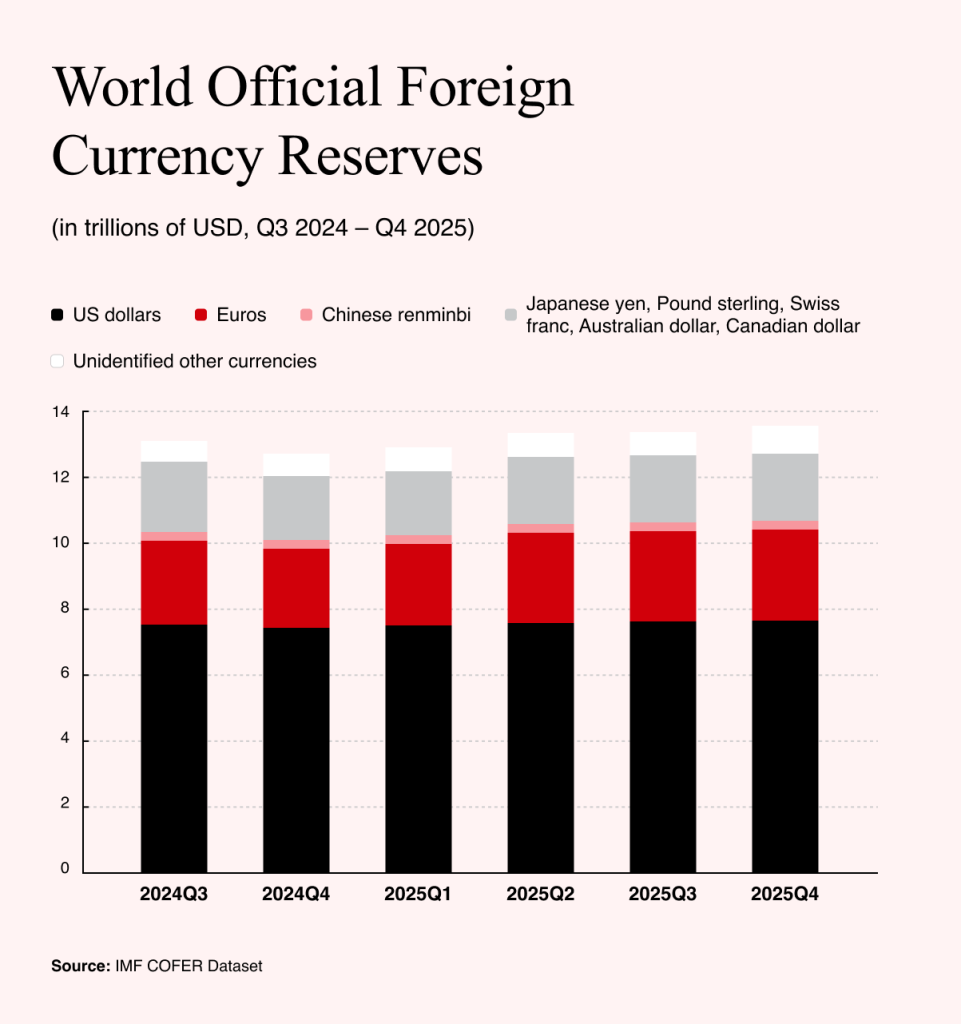
At first glance, the growing use of the yuan in commodity trade might suggest an emerging challenger to dollar dominance. But the composition of global foreign exchange reserves tells a more restrained story.
De-dollarization is advancing faster in rhetoric than in reality. While the dollar’s share has edged lower, it remains the dominant reserve currency. By contrast, the renminbi accounts for only about 1% of global reserves.
The reason is structural. A reserve currency must be more than a medium of exchange. It must also function as a store of value and provide access to deep, liquid and predictable financial markets.
Here, China faces fundamental constraints. The yuan is not fully freely convertible, and the financial system remains shaped by capital controls, political oversight and limits on cross-border capital flows.
China may play a central role in global trade, but it is not yet a destination for global capital on the same scale. Paying for goods in yuan is one thing. Holding it as a strategic reserve, or investing savings in Chinese markets with confidence, is another.
Cheap Stocks, Expensive Risks
On the surface, Chinese equities appear attractive. The CSI 300 trades at a price-to-earnings ratio of around 13.8, compared with roughly 20 for the S&P 500. China’s economy, even with slower growth, continues to expand faster than the United States'.
In theory, faster growth combined with lower valuations should present a compelling opportunity.
The challenge lies elsewhere. Investors are not buying growth alone. They are also buying legal certainty, regulatory stability and confidence in property rights. Crucially, they want assurance that the rules of the game will not change abruptly.
This is where China faces a structural disadvantage. The boundaries between state, regulator and market remain blurred. Policy shifts, such as crackdowns on technology platforms, private education or real estate developers, have shown how quickly entire sectors can lose value.
As a result, lower valuations in China do not simply reflect opportunity. They also represent a risk premium tied to institutional uncertainty.
Trust, Not Just Growth
This highlights the fundamental divergence between the United States and China. America has built a financial system that attracts global capital. China has built a formidable industrial and technological base.
But it has not yet created capital markets that command the same level of trust.
Until that changes, economic growth alone will not be enough. Capital does not flow only to returns. It flows to systems where the rules are clear, stable and credible.