
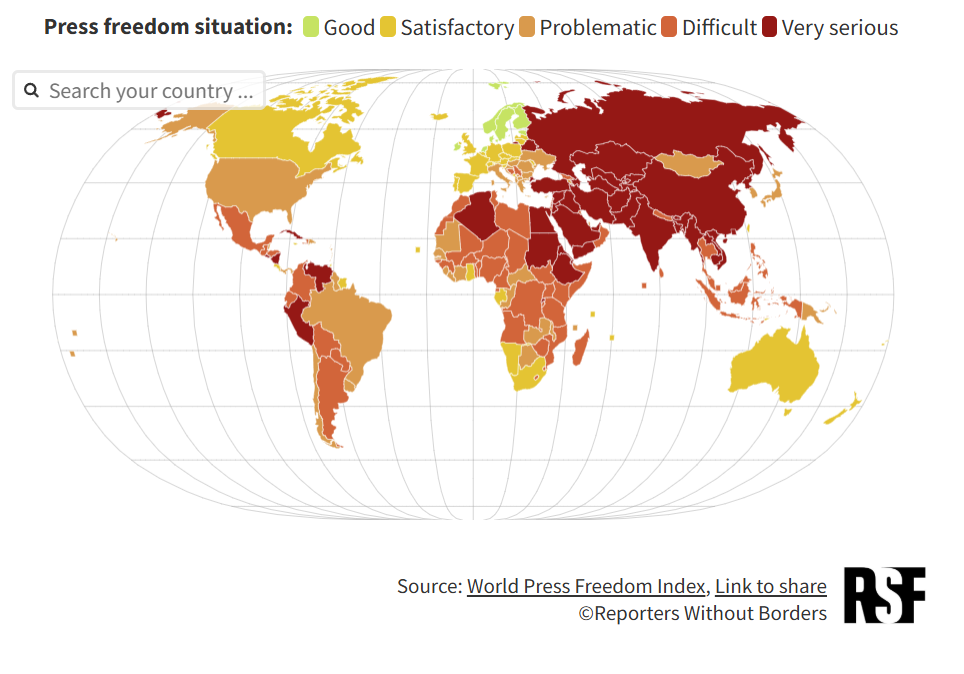
Global press freedom has fallen to a new low in 2026. In the latest ranking by Reporters Without Borders (RSF), more than half of all countries are classified as “difficult” or “very serious” for the first time since the study began 25 years ago. Independent journalism is thus becoming the exception rather than the norm worldwide. According to RSF data, only 1% of the global population now lives in countries with a genuinely free and diverse media landscape.
Armed conflict is a central driver of the decline. In the Gaza Strip, more than 220 journalists have been killed since October 2023. Israel has fallen to 116th place, while the Palestinian Territories rank 156th. Journalistic work is also associated with significant risks in Sudan (161), Iraq (162) and Yemen (164). In those regions, reporting has become one of the most dangerous professions.

State Repression and Legal Constraints
At the same time, conditions are deteriorating further in authoritarian states. Russia ranks 172nd and is systematically targeting independent media. Numerous journalists are in detention, while others operate under intense pressure in exile.
The situation is even more severe in China, which is ranked 178th. Around 120 media workers are imprisoned there, often in connection with politically sensitive reporting. Turkey (163) also uses legislation to prosecute journalists. Charges such as “disinformation” or “insulting the president” are regularly used as a basis for criminal proceedings.
The legal environment is also worsening worldwide. In 110 out of 180 countries, laws have been tightened or selectively used against the media. Even countries long regarded as stable are coming under increasing pressure. Japan ranks 62nd, the Philippines 114th. Georgia has fallen to 135th after tightening legislation on “foreign influence”. Niger has recorded the sharpest decline, dropping to 120th place. Military regimes and armed groups there have severely restricted free reporting.
Democratic Systems Under Growing Pressure
The negative trend is increasingly affecting democratic states. The United States has fallen to 64th place under President Donald Trump. RSF points to a more confrontational relationship between politics and the media, as well as attacks on journalists in the field. Structural decisions, such as cuts to international media services, are also affecting global information freedom.
Conditions are deteriorating in Latin America. Argentina ranks 98th, El Salvador 143rd. In both countries, an increasingly aggressive stance by political leaders toward the media is shaping the environment for journalistic work.
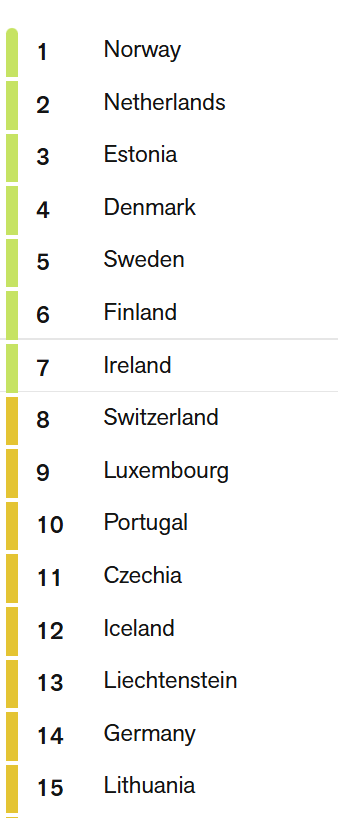
Germany ranks 14th, slipping further in the standings. Conditions are still classified as “satisfactory”, but are strained by growing polarization, increasing hostility and structural weaknesses. These include a lack of political responses to the market power of major platforms and the absence of reforms to strengthen independent media.
Isolated improvements remain the exception. Syria has risen to 141st place following the fall of the Assad regime, but remains in a critical situation.
Overall, the 2026 ranking shows a clear trend: press freedom is losing ground worldwide, driven by violence, political interference and increasingly restrictive legislation.