
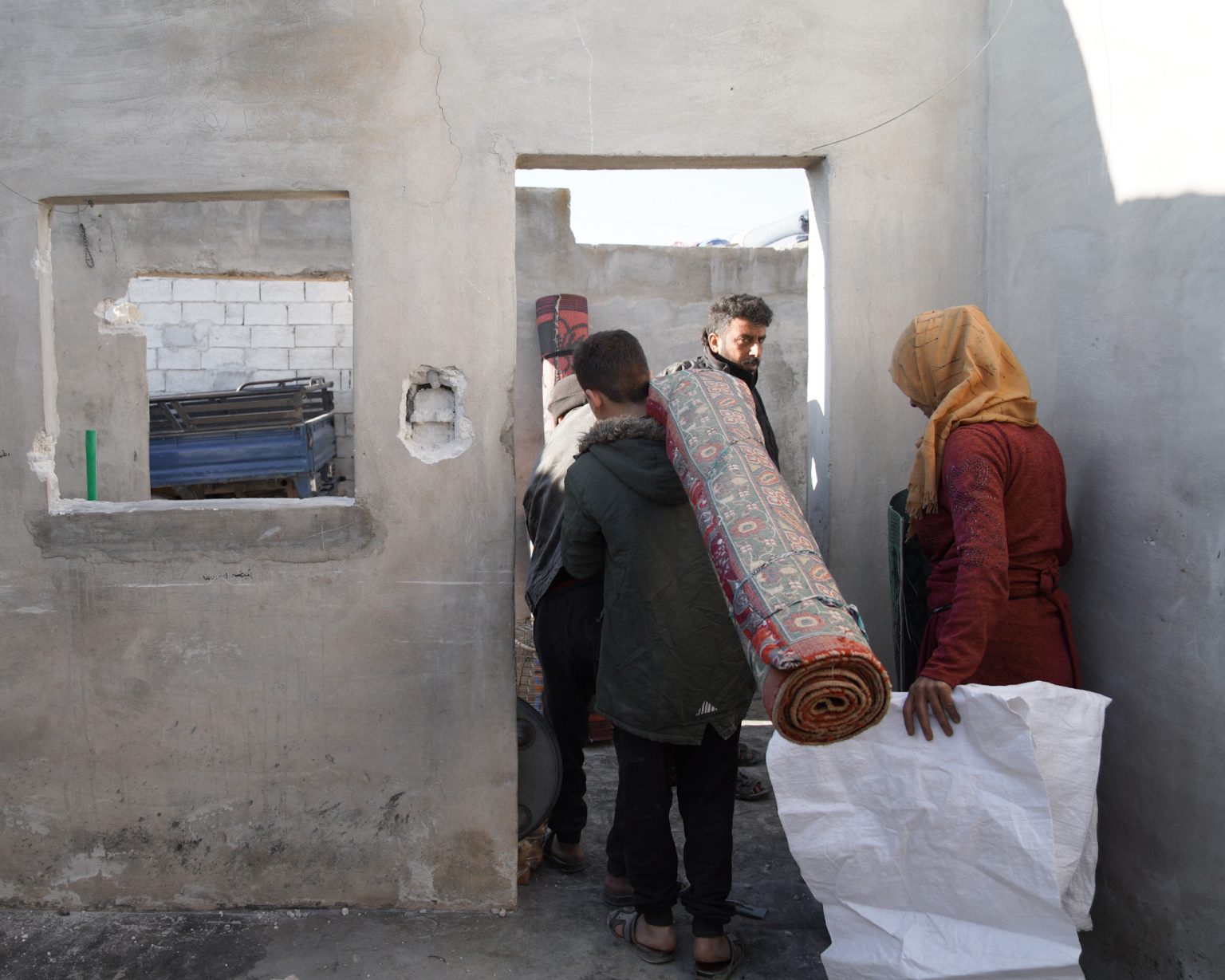
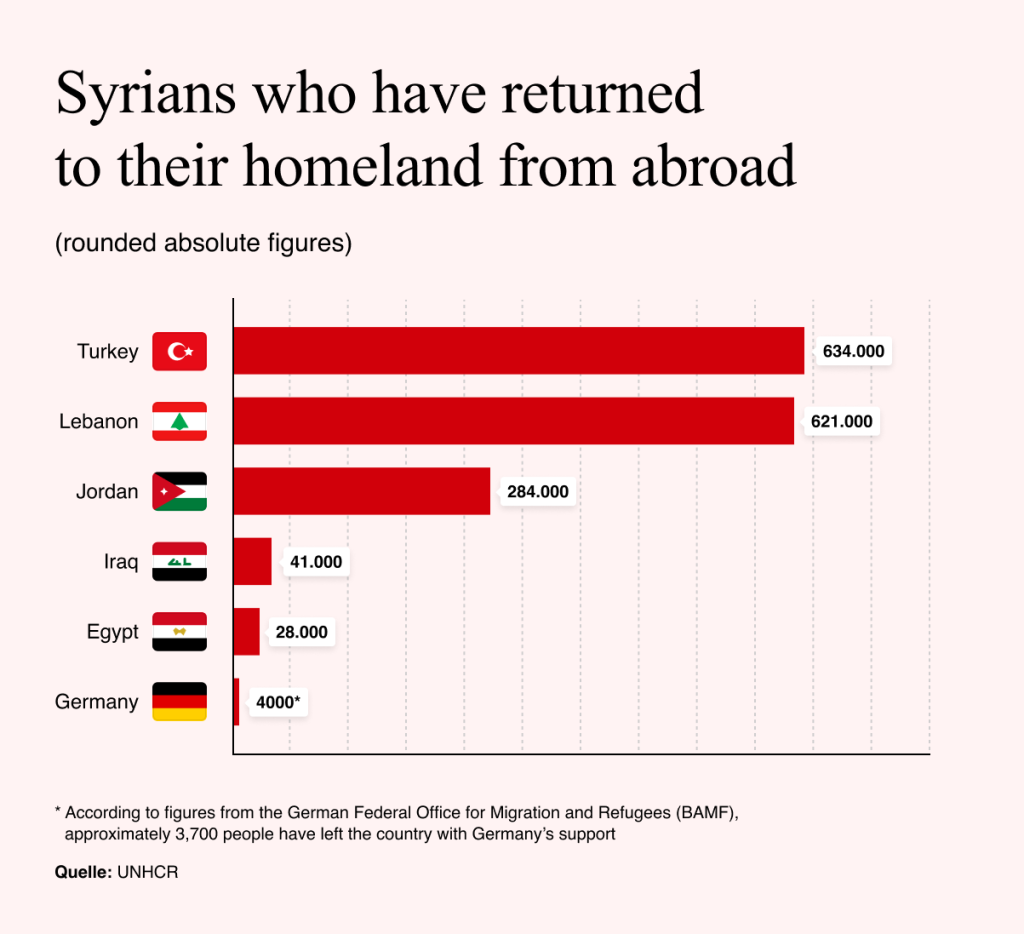
Eighteen months after the fall of Bashar al-Assad, going back to Syria is no longer a theoretical question. It is already happening, especially where Syria is close by. The UN refugee agency (UNHCR) estimated in early 2026 that more than 1.3 million Syrians had returned from abroad since 8 December 2024. At the time, it listed more than 440,000 registered returnees from Turkey, 437,586 from Lebanon, 178,000 from Jordan and 6,988 from Iraq. Later reports put the total by the end of April 2026 at about 1.63 million returnees, including almost 640,000 from Turkey, about 630,000 from Lebanon and around 285,000 from Jordan.
Those figures are first of all a geographical reality and only indirectly a political one. People living in Turkey, Lebanon or Jordan can assess and carry out a return more quickly. For them, inspecting family property, visiting relatives or returning in stages is a far more realistic option.
UNHCR explicitly describes the development as a phase of facilitated voluntary return, not as a return campaign. In its recommendations, the organization generally insists that the return of war refugees must take place gradually and be based on informed, free decisions. Earlier UNHCR plans for 2025 had already anticipated up to 1.5 million returnees from Jordan, Lebanon, Turkey, Iraq and Egypt.
Poverty and Little Hope
Lebanon shows particularly clearly how the dynamic has changed because of political conditions. For years, the country hosted a very large Syrian refugee population, while political and economic pressure also grew. The Associated Press reported in the summer of 2025 that UNHCR in Lebanon hoped for at least 200,000 returnees by the end of the year under a new return program. The program included free transport and modest financial assistance. The figure has now risen to more than 600,000, despite the continuing difficult situation in Syria, including destroyed infrastructure, poverty and unstable security conditions.
Germany has so far played only a minor role in the wider movement back to Syria. In the UNHCR overview, the Federal Republic is not listed separately at all, but only included in a collective category of other countries, because the numbers are barely statistically significant compared with those from neighboring states. According to German figures, only around 3,678 Syrians voluntarily returned from Germany to Syria in 2025.
For those in Germany, returning is not a short journey across a nearby border, but a high-risk life decision, especially given the financial security provided by German welfare benefits. Studies on willingness to return point to security concerns, a lack of job opportunities in the home country and the question of whether families can build a viable existence in Syria at all. UNHCR surveys cited security and the ability to earn a living as central obstacles to voluntary return.
No Pressure to Leave Germany
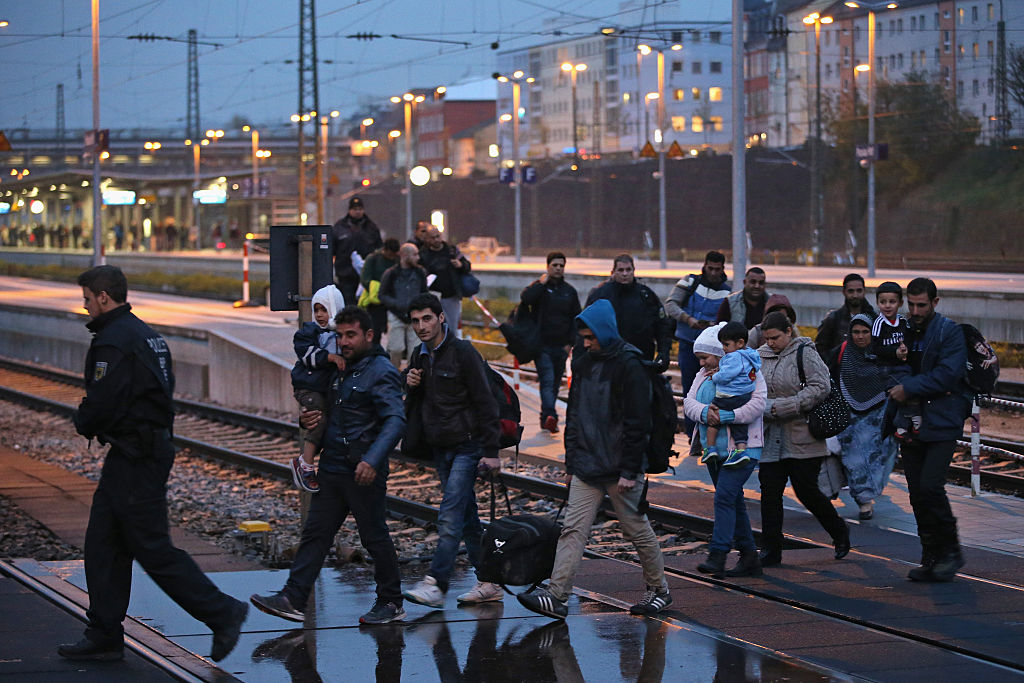
More than one million Syrians now live in Germany, although the German public was once told that the refugees admitted under the Merkel government would eventually go back. Many have been in the country since 2015 and 2016, when Germany’s borders were opened to uncontrolled immigration. A large share of those who arrived during that period have legal protection status. Some have jobs, children attend school and others are in training or at university. That is the official version repeatedly invoked in the debate.
Yet almost half of Syrians in Germany, around 480,000 people, still receive Bürgergeld welfare benefits and remain dependent on the country’s social system. Even among the almost 41% of Syrians who are employed, a large share still receives state support because they work in mini-jobs or low-skilled occupations.
The unemployment rate among Syrian nationals is 37%. That is significantly higher than the average for people from other main asylum countries, which stands at 29.9%. Syrians are also strongly represented in crime statistics. In 2025, Syrians and Afghans were recorded as suspects almost 10 times as often as Germans.
Numerous Syrians already have a German passport. In 2024, 83,150 people of Syrian origin were naturalized in Germany. Syrians therefore accounted for around 28% of all naturalizations, making them the largest group. In total, around 252,500 people of Syrian origin acquired German citizenship between 2011 and 2024. Since naturalization was made easier in 2021, the number of Syrians becoming German citizens has risen sharply. That has two consequences. First, offenders from that group no longer appear as foreigners in the statistics. Second, their return can take place only voluntarily.
In response to a parliamentary question, the federal government said that by the end of August 2025, the Central Register of Foreigners had recorded only 4,633 Syrian nationals as having moved abroad since 8 December 2024. That does not necessarily mean that all of them went to Syria.
Under the Reintegration and Emigration Program for Asylum-Seekers in Germany and Government Assisted Repatriation Program (REAG/GARP), 1,872 voluntary departures were supported between December 2024 and August 2025. According to the federal government, there were no deportations to Syria in that time. That assessment is consistent with further reports from November 2025, according to which only around 1,000 Syrians voluntarily returned from Germany in the first half of 2025.
Empty Promises
The political debate in Berlin has meanwhile intensified because, in purely legal terms, the refugee status of Syrians in Germany is obsolete after the end of the war in Syria, since the reason for flight, namely war, has ceased to exist. Chancellor Friedrich Merz said after the end of the Assad regime that many Syrians no longer had a permanent reason for asylum and should help rebuild their country. The Guardian described that line as part of a new, tougher return policy.
Yet the chancellor’s announcements have led to no concrete action. That became even clearer after his foreign minister, Johann Wadephul, returned from Damascus citing instability and poor living conditions, effectively ruling out the return of Syrians on humanitarian grounds. The German minister did not say who was supposed to rebuild the country if nobody returned.
The political culmination of the debate over the return of Syrians from Germany then came with the visit of Syria’s transitional president, Ahmed al-Sharaa, to Friedrich Merz in Berlin on 30 March 2026. The federal government said afterward that Germany wanted to support Syria on its path to stability and growth. Merz pledged more than €200m ($230m) in reconstruction aid for the current year, including support for water supplies and hospitals. At the same time, reconstruction, economic cooperation and return issues were to be addressed jointly. In return, the Germans received no binding commitments from Syria’s new ruler.
A Chancellor, a President and a Dispute
International media reported that Merz had announced that Germany and Syria wanted to cooperate on the return of hundreds of thousands of Syrian refugees. According to reports at the time, Merz saw Syrian refugees as having an important role in rebuilding their country. The political expectation was that up to 80% of Syrians living in Germany could return by 2030. In purely arithmetical terms, that would be more than 800,000 people.
That exact figure became a point of dispute the very next day. Al-Sharaa later publicly contradicted the account. The Syrian president described Merz’s remarks as an exaggeration and emphasized that any return depended on reconstruction, investment and jobs in Syria. People must not simply be sent back if there were no viable living conditions.

That left the grand signal on returns as little more than an unfulfilled task and German wishful thinking, with no increase in political pressure. The result was limited to political coordination, reconstruction aid, economic cooperation and talks on returns. What was missing, however, was a robust mechanism by which hundreds of thousands of Syrians could go back from Germany within a few years.
So far, the federal government has relied above all on voluntary departures, financial support, case-by-case reviews and the prospect of later deportations for criminals or people without a right of residence. International reports also show that European states are reassessing asylum decisions but continue to treat returns to Syria with extreme caution. The stated reason is always that safe and lasting conditions must first exist there.
A Divided Reality
The reality of Syrian returns therefore lies precisely between two narratives. In the region around Syria, a visible movement home has begun. For many people in Turkey, Lebanon and Jordan, the fall of Assad has been the moment to risk going back. In Germany, by contrast, the phenomenon has so far remained marginal. The legal hurdles to deporting people against their will are high. Many Syrians are said to have strong ties to Germany. Syria itself is regarded by the German government as a devastated country that may be raising new hopes, but does not yet offer the stability needed to support returns on a mass scale.
For Germany, the issue is therefore primarily a matter of political will, which the current government is not articulating. No incentives are being created. Nor is any appropriate political or legal pressure being built. Only the opposition Alternative for Germany (AfD) is raising the need to send back large numbers of Syrians.
Since the chancellor’s announcements have not been followed by action from lawmakers or the administration, the return of Syrians from Germany remains little more than a political narrative, one that is not reflected in the numbers.