Europe today is a regulatory and bureaucratic power. It is retreating from world markets and from the world stage, exporting less and importing more. The effects are beginning to show in our standard of living. Asia is catching up.
Twenty years ago, western Europe could match the United States in living standards. That is no longer true. We are becoming an open-air museum, the sick man of the planet. Understanding what made us, by a huge margin, the most successful civilization in history and the best place to live that mankind has ever known is therefore the first condition for any return to that position.
Roughly a thousand years of economic growth have made Europe extraordinarily wealthy, added about 40 years to our life expectancy and spared most of our children from dying before their parents.
Hundreds of millions of Europeans survived, populated entire continents and lifted European society as a whole out of the abject poverty that has been the eternal fate of mankind. We exported our economic and political model to much of the world. The question is: why Europe?
For Marxist historians, Europe's unusual economic growth was the product of the spontaneous advance of science combined with the primitive accumulation of capital. We supposedly grew rich through imperialism, the slave trade, the expropriation of small farmers and the exploitation of the domestic working class.
The real reason Europe became rich is simpler: business on the old continent faced the fewest political restrictions. As the French sociologist Jean Baechler writes, capitalism in Europe was born out of political anarchy. The bureaucrats might call it chaos.
The Roots of Western Prosperity
The fall of the Roman Empire left no single power capable of dominating the continent for any sustained period. The British economic historian David Landes argues that although geography played a role, the true key to Western development was the Catholic Church, which made Europe a unified civilization built on Latin Christianity.
Yet the old continent was also radically decentralized. It evolved into a patchwork of kingdoms, principalities, city-states, ecclesiastical dominions and other political entities. This fragmentation created a system of divided and competing powers and jurisdictions that gave its inhabitants greater capacity to defend their property rights against political authority.
Permanent exposure to the rivalry of competing monarchs taught rulers a hard lesson: expropriation, confiscatory taxation or the blocking of trade carried a price. They were also forced to reckon with the prosperity of their rivals, which was often the direct result of capital and capitalists migrating to neighboring kingdoms. The possibility of emigration, made feasible by Europe's geographical compactness and cultural proximity, gradually transformed the state into a shackled predator.
According to the legal historian Douglass North (1981), property rights became much more clearly defined over time, allowing owners to retain most of the benefits of investment and improvement.
For the British-Australian economist and historian Eric Jones, this greater freedom to dispose of one's own property is what enabled the sustained development of market-tested innovations. Those innovations are what produced the extraordinary wealth of the West and its technological lead over the rest of the world.
Render unto Caesar: The Separation That Changed Everything
The primary spiritual element of the European Middle Ages was Latin Christianity, whose moral contributions included the relaxation and eventual abolition of slavery in Europe and later in its colonies.
Against the standards of the ancient world, equality within families increased dramatically. The idea of a rational God whose creation is also rational and knowable gave rise to modern science. No less significant for the emergence of capitalism was the concept of natural law, including the legitimacy of the right to resist an unjust ruler.
The American legal historian Harold J. Berman (1974) argues that the canon law of the Church was crucial to the formation of Western legal systems. In Berman's view, it was Christianity that taught Western man what a modern legal system looks like. The Christian God is the God of the covenant, who has voluntarily bound himself to men by covenant and by his own laws. If God himself is bound by law and covenant with men, why should Caesar stand above the law?
The Economics of Envy
Among the factors in the rise of the West most often overlooked by economic historians, the American historian Ralph Raico singles out the relative absence of institutionalized envy in Western culture: envy of successful people or groups embedded in social rules, norms or policies.
The sociologist Helmut Schoeck devoted much of his writing to the pervasiveness of envy in human societies. Its anti-economic consequences, whether socially accepted or actively encouraged, are difficult to quantify.
Anthropological studies, Schoeck argues, demonstrate how damaging institutionalized envy can be to economic and technological growth. Western culture has been able to suppress it to a certain degree. Why it succeeded where others did not is not entirely clear, but Schoeck's answer is Christianity: a faith that forbids envy.
Schoeck considers it one of Christianity's greatest achievements, though an unintended one, that it provided man for the first time with supernatural beings who could neither envy nor ridicule him. This freed man to take risks in innovation. That said, the apparent difference in the degree of socially accepted envy in other Christian cultures, such as Russia, may suggest that the mere presence of Christian belief is not an adequate explanation.
Here I would differ from Schoeck. In Russia, imperial power prevailed over spiritual authority, and Russian merchants and manufacturers paid the price. They lacked a powerful institutional ally willing to challenge the state, even if only out of self-interest and in pursuit of its own power.
The state had an effective instrument for dealing with wealthy businessmen who might, in time, threaten the power of the tsar and the bureaucracy: institutionalized envy. In both Russia and China, the state actively encouraged it, but directed it exclusively at entrepreneurs.
In my view, the factor that reduced the level of envy in society and thereby created an important, perhaps necessary, precondition for economic growth was Christianity. Not Christianity in any form, but an institutionalized Christianity, financially and politically independent of the emperor, with the Pope recognized as a head of state: Latin Christianity.
The Oxford historian Tom Holland writes in Dominion that the people of the ancient world found the idea of God dying an ignominious death reserved for the lowest profoundly shocking. So shocking, in fact, that early Christians did not depict the body of Christ on crosses. The Olympian gods, muscular, perfect and sexually potent, were the ones who put enemies on crosses, not the ones who hung there.
Depictions of Christ on the cross did not appear until the 5th century AD. Before and long after, the image that dominated the churches of the late Roman Empire and the Romanesque period was the Pantocrator: Christ as judge and ruler of the world.
The image of Christ as a suffering man, martyred and bleeding, in pain and agony, is a Western invention of the Gothic period. In the East, the figure on the cross has never been a living man in agony but a dignified incarnate God who suffers. This small difference in artistic convention symbolized something far larger, with consequences that reached deep into the political and economic development of both halves of Europe.
Holland writes that the very manner of Jesus' death changed the world. Even the last among men has value. In the eyes of God, a beggar or even an executed sinner may carry more value than an emperor. The emperor is not God. He too is a sinner who can end up in hell. The Roman Empire was divided into a western and an eastern part, and so was the Church.
The Byzantine emperor was the representative of God on earth. In temples such as Hagia Sophia, the imperial throne was positioned accordingly, presenting the emperor as God's deputy and the empire as an earthly reflection of the heavenly hierarchy. In the Western tradition, the emphasis fell elsewhere: on Christ as sacrifice, with authority derived from the cross rather than from the emperor.
The transformation was slow, but Eastern Christianity eventually became what Emperor Constantine the Great had intended when he issued the Edict of Milan in 313. Its culmination came not from a Byzantine emperor but from the Russian Tsar Peter the Great, who at the beginning of the 18th century effectively reduced the Russian Orthodox Church to one of his imperial ministries. This was entirely in keeping with historical precedent. In all the great empires of the past, spiritual and temporal power were combined and imperial authority was unlimited.
Western Christianity succeeded in separating spiritual and temporal power. The instrument of that separation was the papacy, and its consequence was a civilization unique in the history of mankind. State power, the power of the emperor, had for the first time been given an equal rival.
The Subversion of Imperial Power
The key difference, then, was the relationship to the emperor. Lord Acton, in A History of Liberty in Antiquity, writes that Constantine the Great expected to strengthen his throne when he placed Christianity on an equal footing through the Edict of Milan in 313. The religion had astonished the world with its power of resistance, and Constantine wanted that power behind him. He established his seat of government in the East with a patriarch of his own choosing, the better to secure that support. No one warned him that by exalting Christianity he was tying his own hands and surrendering the privileges of emperors.
From the standpoint of the autocrat, Latin Christianity is the most politically subversive religion in history. The Polish and Czechoslovak communists, as well as today's Chinese and North Korean rulers, could speak to that.
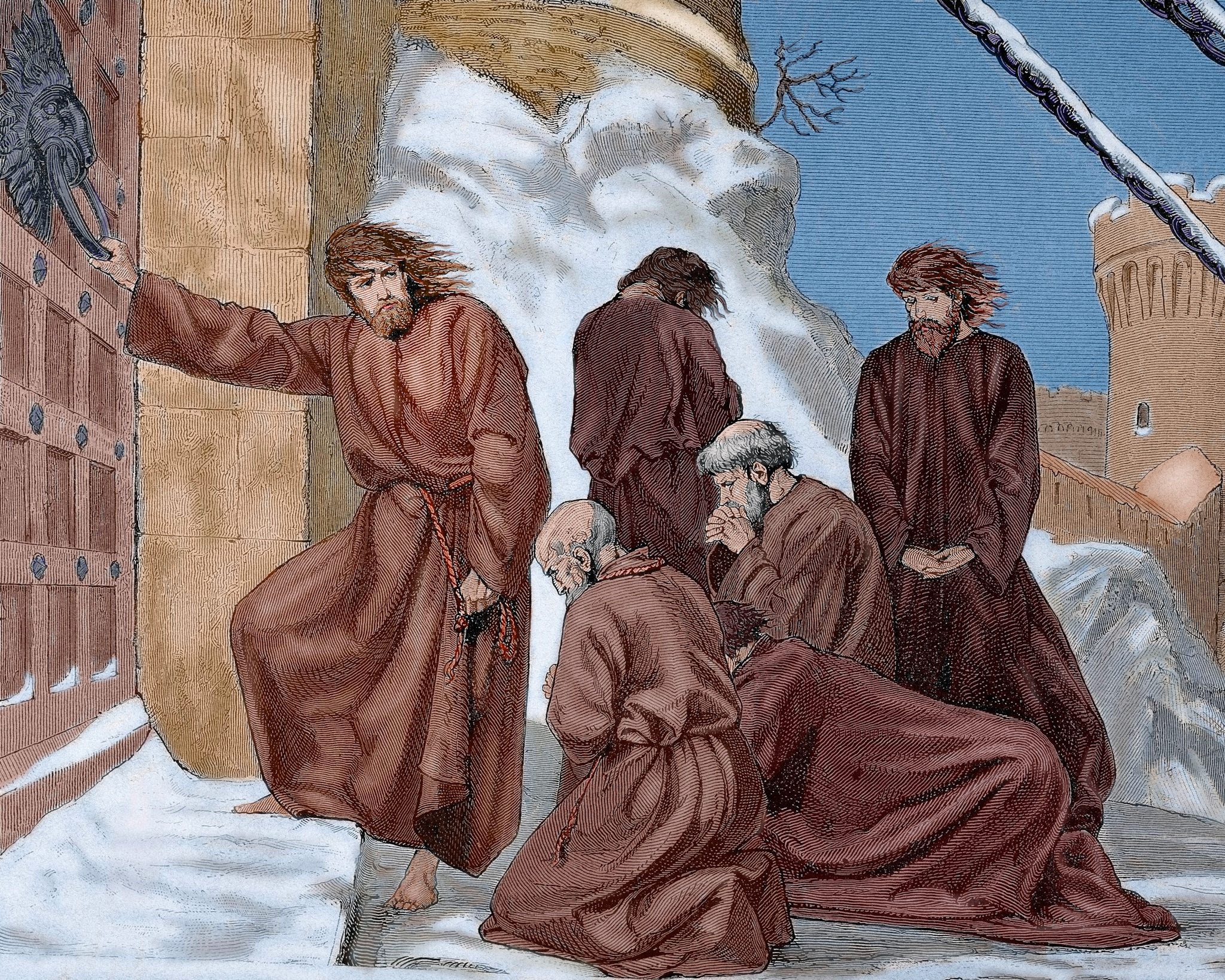
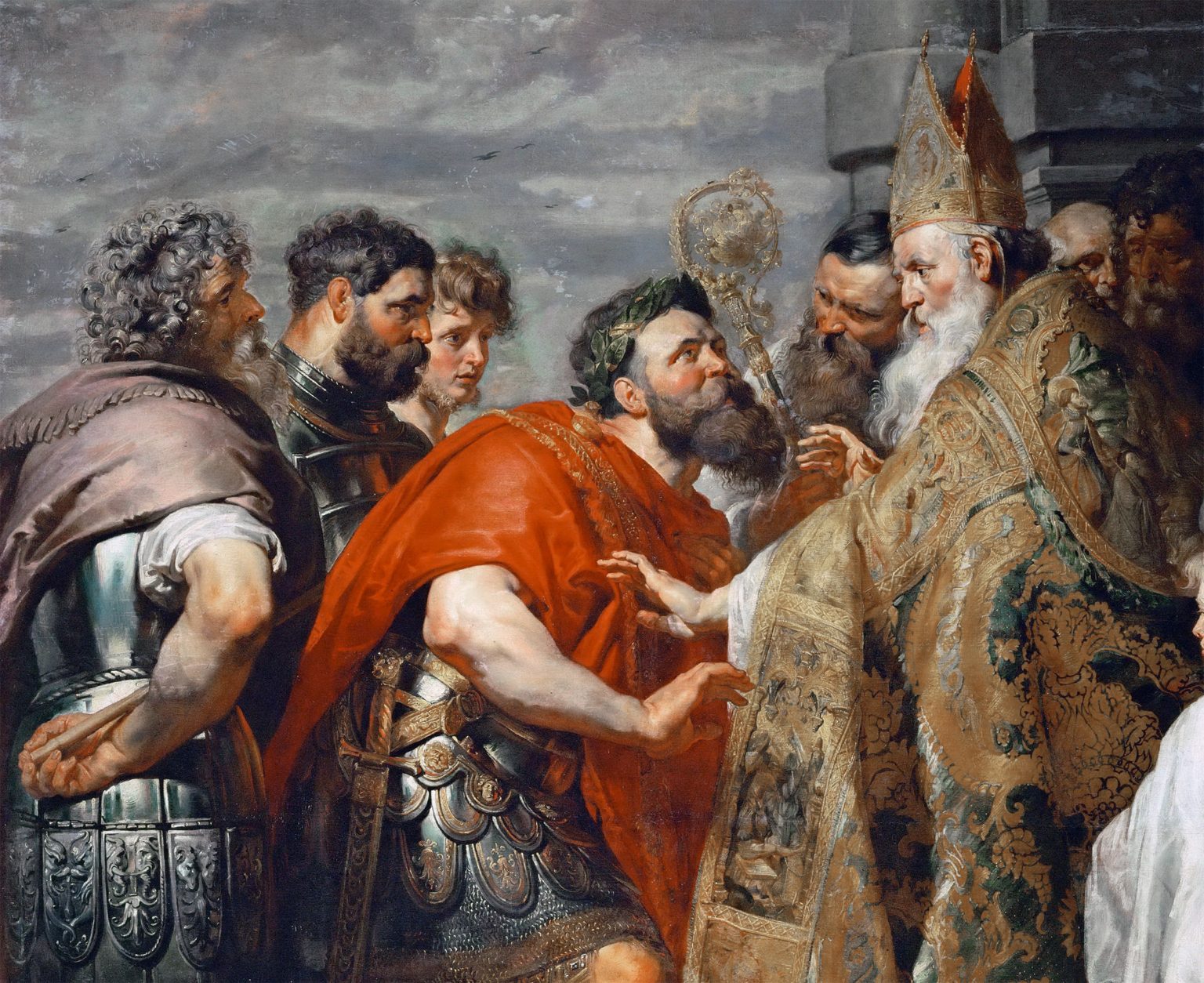
It did not take long for that subversive character to manifest itself. In 390, Constantine's successor, Emperor Theodosius the Great, ordered the massacre of thousands of innocent people in Thessaloniki. Nothing unusual in that: emperors did this routinely in the ancient world. What was unusual was the reaction of the Bishop of Milan, St Ambrose.
On the emperor's return to Milan, St Ambrose publicly rebuked him and barred him from the church. Theodosius had an army. Ambrose had a counter-weapon of considerably greater force. "Whose sins you forgive will be forgiven; whose sins you retain will be retained", Jesus told the apostles.
And this held for their successors, the priests and bishops. Theodosius backed down. The emperor publicly repented. A mass murderer he may have been, but that was unremarkable at the time. He was emperor. He was also a devout Christian who feared hell. Somewhere here, state power begins to be limited. This is where the modern West begins. It would take centuries, but the states of the West would gradually, very slowly, become shackled predators.
The Middle Ages Were Anything But Dark
Rome fell. The Catholic Church stepped into the void, constructing a system of administration on the Roman model. Latin became the language of the Church, of scholars and of diplomacy and administration across the continent. Roman law and the canon law derived from it became the foundation of European legal systems.
The result was a unified Western European civilization, shaped by the Catholic Church. Its priests and prelates became confessors and counselors of European kings and educators of future rulers, and they did not allow those kings to forget that the anointing that made them monarchs did not make them gods. Kings by the grace of God they may have been, but sinners they remained.
At my communist elementary school, and later in high school, I was taught that the Middle Ages were dark. It was a lie. They were anything but dark. Double-entry bookkeeping, which made it possible to run large international companies efficiently, was unknown to the ancient world.
The widespread adoption of the originally Roman concept of limited liability was another achievement of the supposedly obscure Catholic Middle Ages. Without it, high-risk maritime trade would never have developed to the extent it did, nor would large private manufactures have arisen.
The ability to test high-risk innovations in the market depended on limiting risk, and it was limited liability that made this possible. Those innovations are precisely what have made us all wealthy and added 40 years to our lives.
The Legal Foundations of Prosperity
Hernando de Soto, the economist, writes that the network of legalized property relations gave the West the means to generate additional value from assets beyond their immediate physical characteristics. The example he gives is straightforward: a house or apartment in which one lives can, thanks to the legal certainty of ownership, also serve as collateral for a business loan.
The consequence, says de Soto, is a considerable advantage over the rest of the world: the capacity to give assets and physical property a second economic life. That legal certainty of property is a legacy of the so-called Dark Ages. The West is the only civilization in history in which citizen and subject alike have gradually gained security of life and property.
Russian and Chinese billionaires could explain what happens when that security is absent. The Russian oligarchs are very rich. A number of them, however, have fallen out of windows. Mikhail Khodorkovsky became a multi-billionaire through his relationship with the "tsars" and the bureaucracy, and through the appropriation of state assets. He then made the fatal error of believing he could stand up to the sovereign tsar.
He ended up in prison, then in exile, stripped of most of his assets. What remained was only what he held in the West. The tsar giveth and the tsar taketh away. Jack Ma, the owner of Alibaba, offers a Chinese variation on the same theme. He simply disappeared for several months. When he reappeared, he was relieved to be alive, and the emperor allowed him to keep his company. For now.
It is with regret that I write that even this pillar of our prosperity is being challenged by today's European elite. Russia is undoubtedly the aggressor and I hope it will lose in Ukraine.
Nonetheless, attempts to confiscate Russian assets in the West undermine the legal certainty of ownership that Europe has built up, slowly and gradually, over nearly two millennia. Our prosperity and our freedom rest upon it.
Should today's European elites succeed in this course, the loser will not be Vladimir Putin. Within a few years, property rights in Europe may be as insecure as they are today in Russia and China. For all that, I am proud of Slovakia for standing up in defense of the real West, whatever the motives of our government.
The article draws on a number of works, including Ralph Raico's The European Miracle, Lord Acton's essay The History of Freedom in Christianity, Eric Jones's The European Miracle, Tom Holland's Dominion, Richard Pipes's Russia under the Old Regime and Property and Freedom, and Hernando de Soto's The Mystery of Capital.
Hyde Park is a forum for free discussion. The opinions expressed do not necessarily reflect Statement’s editorial line.
The argument continues in a second part titled How the Struggle Between Popes and Kings Shaped Civil Liberties.