
Spain is taking its own path on migration policy. While many governments in Europe and elsewhere are talking about tighter border controls, faster returns and limits on irregular immigration, Spain is now moving in the opposite direction.
The left-wing government of Prime Minister Pedro Sanchez has launched an extraordinary regularization process for foreign nationals. According to Madrid, around 500,000 migrants without regular residence status are to be given the opportunity to live and work legally in Spain for an initial period of one year.
The measure is aimed at people who are already in the country. Applicants must have entered Spain before 1 January 2026, prove uninterrupted residence for at least five months and have no relevant criminal record. Those admitted will receive a temporary residence and work permit valid in any sector and anywhere in the country. According to the government, the application period runs until the end of June 2026.
An Act of Order
Madrid presents the plan as an act of order. Those affected are already in the country, the argument goes, working in homes, fields, tourism or care, and should be brought out of the shadow economy. Migration, the government says, strengthens the labor market, secures contributions and helps an aging society.
That reasoning may sound pragmatic, but it ignores the fact that the rule of law does not consist only of pragmatically managing the status quo. It also requires credibility. Anyone who retrospectively turns illegal entry or illegal residence into regular status sends a signal that will be understood far beyond Spain.
That is precisely the political core of the conflict. An amnesty creates order in the short term by establishing legality. In the long term, however, positively sanctioning illegal entry will only attract more migrants with the same expectations. Anyone who sees a European state turning irregular residence into legal status after only a few months will hardly assume that it will remain a one-off exception.
The government denies that there will be such a pull effect and points to cut-off dates and deadlines. Political experience shows, however, that deadlines deter only when the state enforces its rules permanently and visibly.
Administration at the Limit
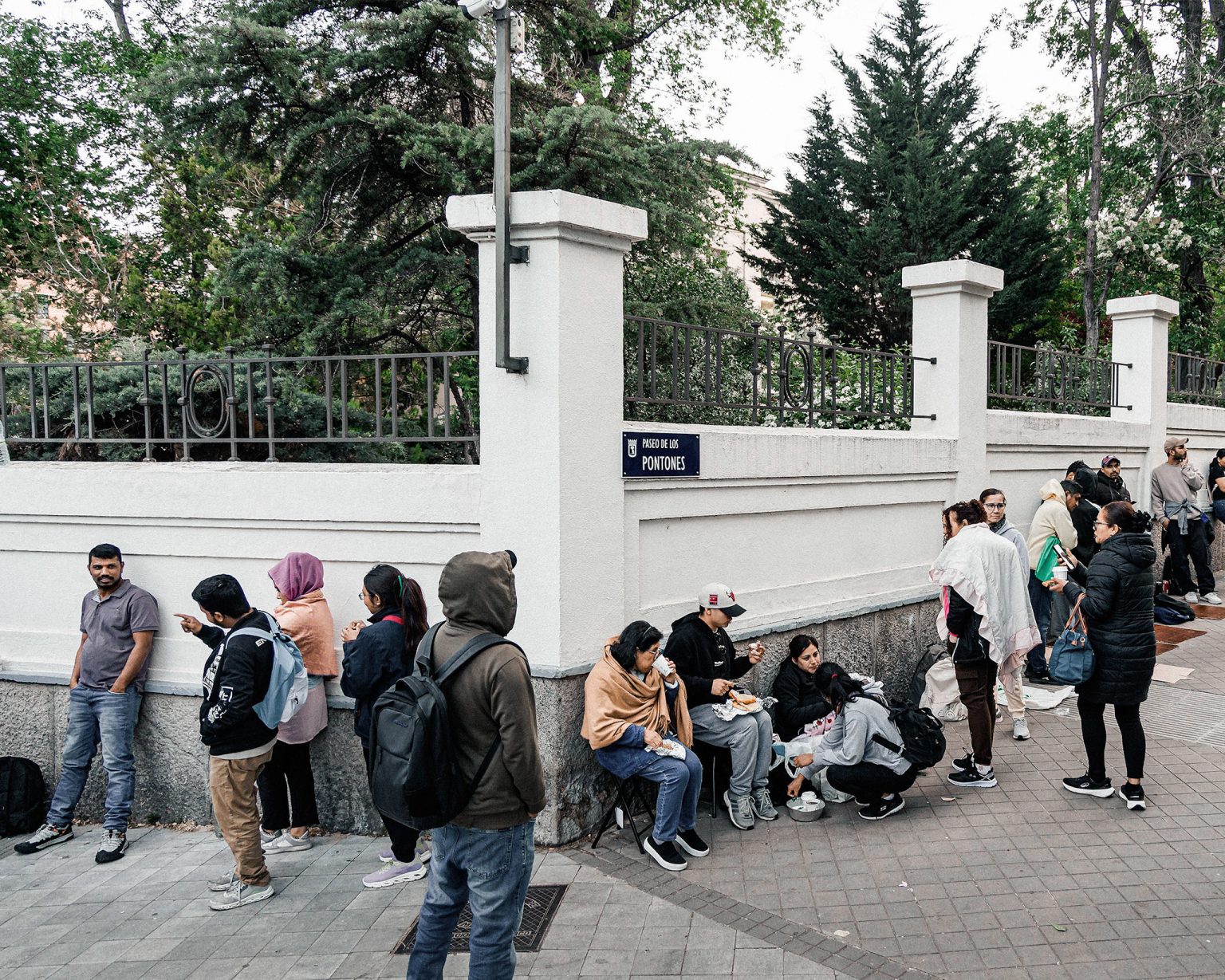
The first weeks under the new rules already show that the administration is under heavy pressure. Media reports describe long queues, including outside Moroccan and Algerian consulates, as applicants seek birth certificates, criminal record extracts and other documents. At the Moroccan consulate in Madrid, more than 1,000 people are said to have applied for documents in just a few hours on a single day. The problem was foreseeable. A state that launches hundreds of thousands of procedures within a short period must expect overload.
The number of potential applicants is politically sensitive. Officially, the figure is around 500,000 people. The Associated Press, however, reports that experts estimate the number of people who may actually qualify and are currently living illegally in the country at up to 840,000. That range alone shows how difficult the state apparently finds it to quantify the scale of the problem precisely. Nor is it clear what will happen if more than 500,000 people now apply.

Even if supporters point out that Spain’s economy is in better shape than many of its neighbors and that the country needs workers, the objection remains that labor shortages do not justify a migration-policy gamble. People who are needed should be allowed to come legally, verifiably and on the basis of clear criteria. Spain is replacing integration with arbitrary legalization. An orderly immigration policy would have to begin at the border, not at the counters of overwhelmed authorities.
Responsibility for the EU’s External Borders
Spain’s decision also comes at a time when citizens across Europe are visibly losing trust in political promises. Illegal migration will be limited and the European Union’s external borders will be protected. That is the promise made across the continent. Governments insist that smugglers will be fought and procedures accelerated. Yet when images from Spain show waiting lines, new special programs and a government presenting as progress what was previously treated as illegal, it amounts to a blow to the rule of law.
As an EU country, Spain’s responsibility does not end at its own national borders. Anyone with legal residence status in an EU member state also enjoys freedom of movement within Europe. The fact that European partners cannot rely on knowing to whom Spain grants legal status is an incalculable risk for everyone.