

Emmanuel Todd is one of the best-known and most widely discussed sociologists and demographers. The French scholar became famous in 1979 with his book La Chute finale (The Final Fall), in which he predicted the collapse of the Soviet bloc with remarkable accuracy.
That earned him a reputation for unusual foresight and, as he now says with a smile, turned him into a “certified prophet”. His reasoning was not based on military or geopolitical analysis, but on social indicators: rising infant mortality, alcoholism and suicide.
Todd thereby showed the difference between power and viability. The Soviet Union had an army, nuclear weapons, ideology and global influence. But when basic indicators of health, education and social cohesion point in the opposite direction, external power can mask internal decay only for a limited time.
Today we face a similar question. Fertility rates are falling almost everywhere. Yet that in itself need not be evidence of social decay. It may be linked to urbanization, contraception, higher living standards, the changing role of women or a welfare state that has freed people from the need to have many children as insurance for old age. The key question, therefore, is not why fewer children are being born, but whether low birth rates are accompanied by a loss of social vitality.
Two very different countries are particularly interesting in this respect: South Korea and Uruguay.
A Powerful Society Too Expensive to Reproduce
South Korea is the best-known case of a fertility collapse. Despite government incentives, including housing support, fertility remains alarmingly low. Most children are still born within marriage, so a recent increase in marriages offers some hope of improvement. Yet even “better times” in the Korean case would mean fertility returning to somewhere near one child per woman, still an extremely low level. In 2025, according to preliminary Korean data, the fertility rate rose to 0.80, while births increased to roughly 254,500.
The Republic of Korea is therefore an ideal test of Todd’s question about social vitality. But we should not be misled by the country’s very low infant mortality rate. Korean health care and institutions function very well, so this is not the familiar Soviet pattern of institutional breakdown.
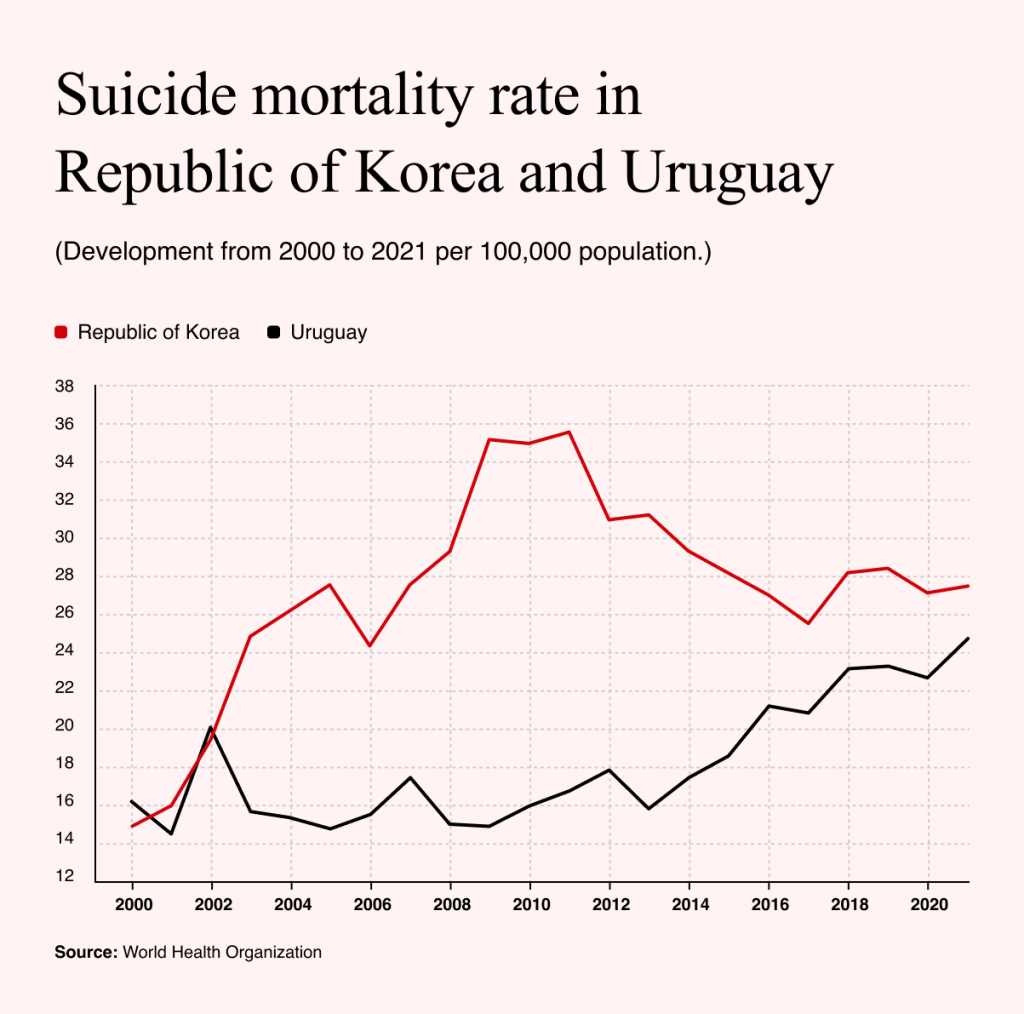
The real Toddian warning signal lies elsewhere: in the extremely high suicide rate. World Bank and World Health Organization figures for 2021 put it at around 27.5 suicides per 100,000 people. South Korea is also one of the countries forced to contend with rising alcoholism.
The case shows that a low birth rate does not have to be a sign of a dysfunctional state. It can be a sign of a society that works so hard that parenthood becomes a luxury, a risk or a psychological burden. Korea is therefore not dying from the failure of its institutions, but from the success of its own model.
The state works, schools work and businesses thrive. Yet life in such an efficient system becomes, for many people, a discipline they do not want to pass on to the next generation.
A Silent Crisis Off the Usual Map of Decline
A less expected but all the more interesting case is Uruguay. It is neither a post-Soviet republic nor a hypermodern East Asian society such as South Korea or Japan. In the Latin American context, it has a reputation as a relatively stable, educated and institutionally advanced country.
That is why its demographic and social profile is striking. Its fertility rate is around 1.4 children per woman, well below the threshold needed for simple replacement.
At first glance, Uruguay does not seem like a country that should be a candidate for a loss of social vitality. There is no visible breakdown of the state, no collapse of institutions and no catastrophic failure of the health system. Infant mortality is higher than in South Korea, Japan or Western Europe, but still not at levels typical of the world’s poorest countries.
The real Toddian warning signal again lies in the extremely high suicide rate. According to the World Bank and the World Health Organization, it stood at around 24.8 suicides per 100,000 people in 2021, close to South Korea’s rate and significantly higher than in most developed Western societies.
Uruguay thus shows that the combination of low birth rates and psychological crisis is not merely a disease of East Asia or the post-Soviet space. It can also occur in a stable, relatively prosperous and outwardly peaceful society.
Uruguay is therefore not a civilizational wreck. Rather, it is an example of a country where social vitality does not collapse outwardly, but quietly fades inwardly. The state functions, institutions hold and public life does not disintegrate. The high suicide rate, however, suggests that a significant part of society is losing the ability to translate stability into personal hope.
A Loss of Internal Energy
In South Korea, the process is almost intuitively understandable. A society oriented toward performance, competition, education, careers and disciplined productivity eventually begins to consume its own human material. Vitality is lost not because institutions fail, but because the life organized by those institutions is too exhausting for many people.
A person who has spent a lifetime racing through a system of constant pressure does not necessarily rebel. He may simply stop wanting to pass that race on.
Uruguay shows a different, quieter type of problem. Researchers have linked the country’s high suicide rate to aging, loneliness, the loss of social bonds and particular vulnerability among older men. Yet there is no single accepted explanation for why such a stable country has such a high suicide rate.
The same underlying question can be asked in many European countries. This is not about dramatic collapse, state failure or the breakdown of basic services. The system is still working. It simply seems that something less measurable but fundamental is gradually draining out of society: the will to carry on.
It is no coincidence that Emmanuel Todd called his recent book La Défaite de l’Occident, or The Defeat of the West. His question is not merely geopolitical, but anthropological: what happens to a society that has retained power, institutions and wealth, but loses its internal energy and its capacity to reproduce itself?
The question, then, is not simply whether birth rates can be raised. The real question is whether society can shake off its chronic fatigue and rebuild a sense that the future is not merely an obligation, a cost or a risk, but also a promise. If so, low birth rates may be only a passing phase of a new modernity. If not, we may not be heading for a spectacular collapse, but for a much quieter process: the gradual extinction of societies that still function, but know less and less why.