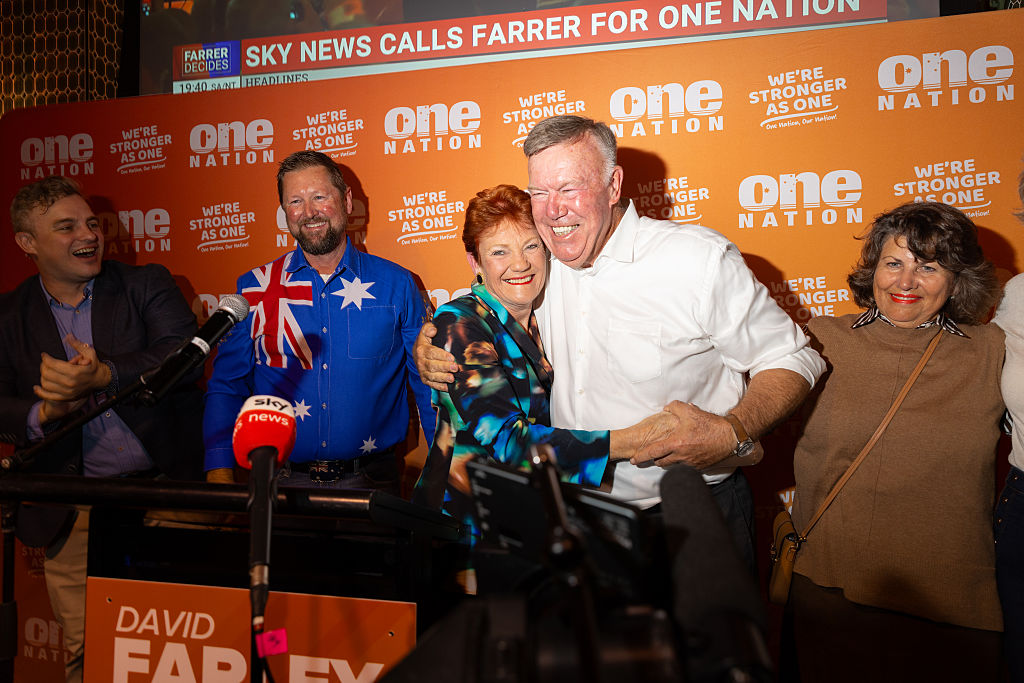
The right-wing One Nation Party scored a major political victory by winning its first-ever lower house seat in the Australian parliament, as the nation sees political disaffection rise over migration, the economy and housing.
One Nation’s David Farley won 57.4% of the two-candidate-preferred vote in the Farrer by-election on 9 May, taking the large regional New South Wales seat from the Liberal Party for the first time in 77 years.
Farley told supporters after the election win that One Nation had "reached the end of its beginning, we're going through the ceiling".
“What are we doing tonight? We're like a mason, with a chisel, and a hammer and we're re-carving the letters into the Australian democracy”, said the farmer and agribusiness owner.
One Nation party leader Pauline Hanson posted on X that the election win shows "The people of Australia will not be forgotten”.
Fighting Mass Migration
“One Nation will fight for you on the floor of Parliament”, she wrote on Saturday, 9 May. “We will fight to lower cost of living, end net-zero and stop mass migration.
“None of the other parties havre [sic] represented you and have tried to divide Australia.
Only we believe in running politics as One Nation under one flag for the benefit of Australians, not other countries.”
While Hanson previously held a seat as an independent in the 1990s, this is the first time the party will have a representative in the lower house of Australia’s parliament, the House of Representatives.
Hanson lost her re-election bid after forming the party, but has since returned to the parliament as a senator in the upper house or Senate. One Nation has four senators in total.
The election was the first national test for One Nation after it made big poll gains in the South Australian state elections in March of this year.
Although the party failed to oust the incumbent Labor candidate, One Nation won the second-highest number of votes.
This was the first time it had done so in Australia, where two political blocs – the centre-left Labor Party and the conservative Liberal-National Coalition – have traditionally dominated politics.
One Nation is polling second behind Labor and ahead of the Liberal-National Coalition, while Hanson has higher approval ratings than centre-left Prime Minister Anthony Albanese and Liberal leader Angus Taylor.
You might be interested
Migration Will Not Solve Europe’s Demographic Crisis
Voter Dissaffection
The party’s victory comes on the back of growing disaffection among Australian voters, particularly on the right, with the state of migration and cost-of-living in the nation.
Tens of thousands attended anti-immigration protests in Australia in marches in late 2025 and in January 2026, with immigration seen as a growing issue in the country.
The level of immigration was 306,000 people in 2024–2025, with the mainstream conservative Liberal and National parties considering a cut to between 150,000 and 200,000 people.
Hanson’s One Nation is campaigning for a visa cap of 130,000 people and a net overseas immigration level of about 100,000.
Concerns about immigration have surged in Australia since the pandemic, rising by seven percentage points to 13%, according to a 2025 study by research company Roy Morgan. The figure is now close to its pre-pandemic high of 16%.
Another study, based on Australian electoral surveys, indicates that the view that immigration levels are “much too high” has risen sharply in recent years, particularly among supporters of right-wing parties such as One Nation and the Liberal and National parties.