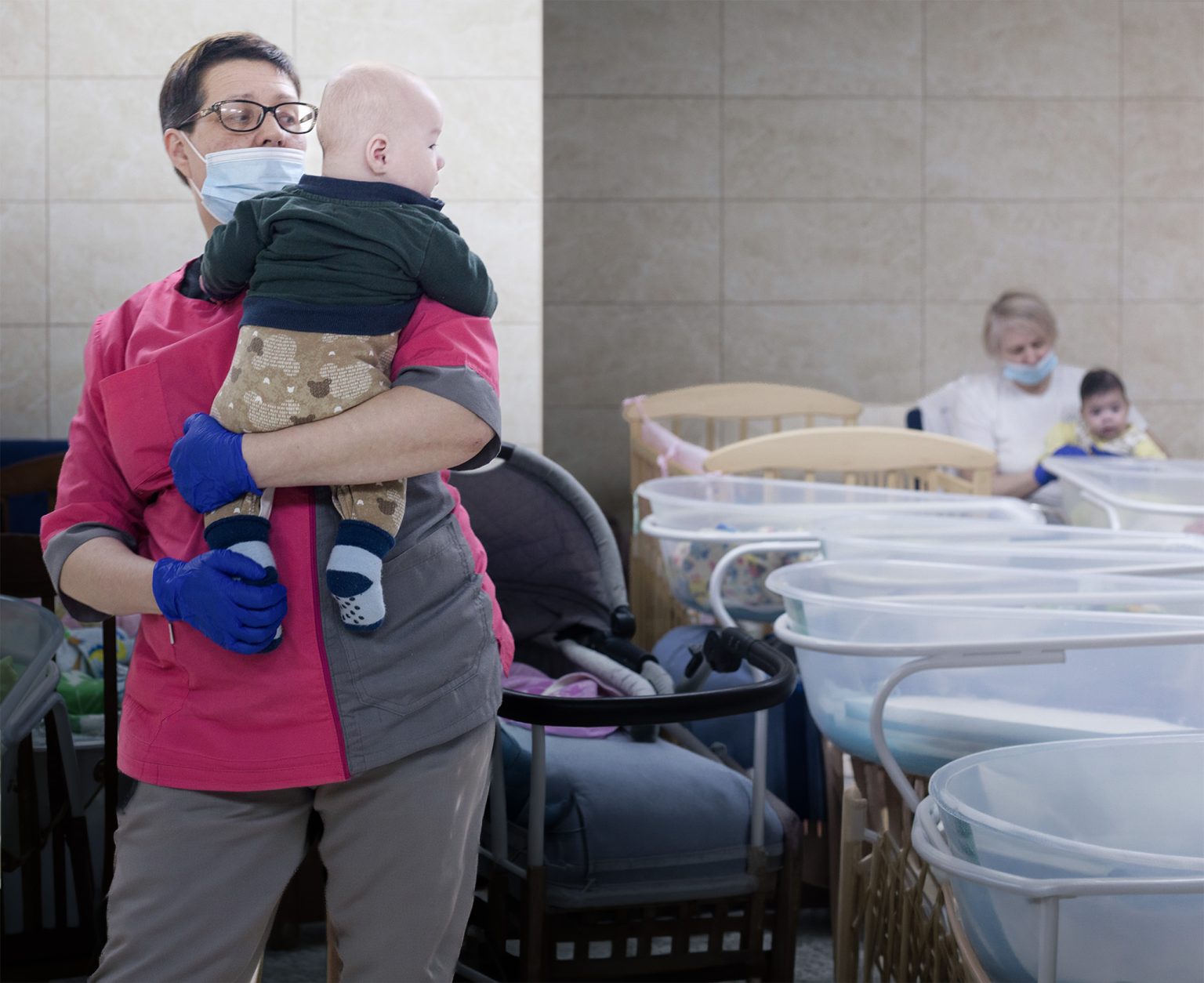
Surrogacy, the practice of a woman carrying a pregnancy for one or two other persons who are the “intended parents” of the child, is currently legal in the country for local and international buyers, with little regulation and accusations of corruption and exploitation.
Surrogacy is illegal in many European Union member states, with the exception of countries like Ireland and Portugal and under special circumstances on Cyprus and in the Netherlands. Great Britain allows so-called “altruistic” surrogacy. It is also legal in the United States and in several African countries, as well as in Mexico and Colombia.
Ukraine's Surrogacy Market
Before Russia’s invasion in 2022, Ukraine accounted for 25% of the global surrogacy market, according to a study by Princeton University. Although the war briefly disrupted the sector, experts say surrogacy activity has returned to pre-war levels.
At present, surrogacy is only lightly regulated in Ukraine, where it is permitted under the country’s Family Code and an order from the Ministry of Health.
However, the government is seeking to restrict the surrogacy industry through Bill 13683, On the Application of Assisted Reproductive Technologies, which is currently at committee stage in the Verkhovna Rada, Ukraine’s national parliament, after being introduced last August.
Through the bill, parliament is seeking to bring the assisted reproductive technologies (ART) industry, including in vitro fertilization (IVF), sperm and egg donation and surrogacy, under government control.
Article 21 of the new bill states that those pursuing surrogacy in the country must be citizens of Ukraine. In cases where one spouse is not a citizen, the couple must have been married for more than three years.
However, the provision of surrogacy is “prohibited” if it is banned in the home country of the non-Ukrainian spouse, if both spouses are non-citizens, for stateless persons and for single people who are stateless or not Ukrainian citizens.
Banning Sex-Selection
The bill also forbids the practice of “the selection of the sex of the future child” except in cases of “a serious sex-linked hereditary disease”.
It requires the parents of the surrogate child to care for him or her in cases where the child is born with a disability or disease, and requires genetic testing of the embryo before its transfer to the surrogate mother. Both practices have been the focus of international controversy after cases of children being abandoned by prospective parents and of parents purchasing children whose genetics do not correspond to theirs.
However, the bill is already meeting with significant opposition within the Eastern European country, where the surrogacy industry is both wealthy and influential. The Ukrainian Association of Reproductive Medicine (UARM), an assisted reproductive technologies (ART) industry representative group, hit back at the bill for making the path to parenthood “harder”.
While UARM President Oleksandr Yuzko claimed the ART industry is regulated “fairly democratically”, he also said that “reproductive medicine” in Ukraine is represented “mainly by private clinics, which set the standards”.
Opposition MPs have also proposed a counter-bill, Bill 13683_1. One of its proponents, MP Maria Ionova, said the bill would “guarantee citizens’ rights” to have a child.
However, a version of the bill seen by Statement shows that it would permit international buyers to pursue surrogacy in the country. Article 14 of an unofficial English translation of the bill states that “foreigners and stateless persons” shall have the right to apply to medical institutions for ART in Ukraine.
The bill does propose some new regulations on the ART industry, such as levying a €1,000 ($1,090) fee on ART health institutions, mandating a link between those pursuing surrogacy and the embryo and obliging parents to accept their surrogate child in cases of “congenital developmental defects” or diseases.
However, unlike the government bill, it permits the export and import of reproductive materials and embryos, permits sex-selective practices and places no age limits on surrogate mothers.
Failed Legislation
Previous efforts to regulate the surrogacy industry in Ukraine have repeatedly failed, according to the international pro-surrogacy organization In Dreams. The most recent came in 2023, after the European Parliament declared surrogacy to be contrary to “the human dignity of women, since their bodies and reproductive functions were used as a commodity”. The parliament also expressed concern about the proliferation of the practice in Ukraine.
In response, the Ukrainian president presented a package of laws that included a ban on surrogacy for foreign couples. The proposal was rejected by a majority in parliament. The existence of a counter-bill suggests “the final legislative outcome, if any, is not yet determined”, an In Dreams spokesperson said.
The moves to ban international surrogacy and regulate the ART industry come amid fears in Ukraine about declining birth rates. The opening of the bill states that its purpose is to regulate the legal and organizational foundations for “increasing the birth rate in Ukraine”.