
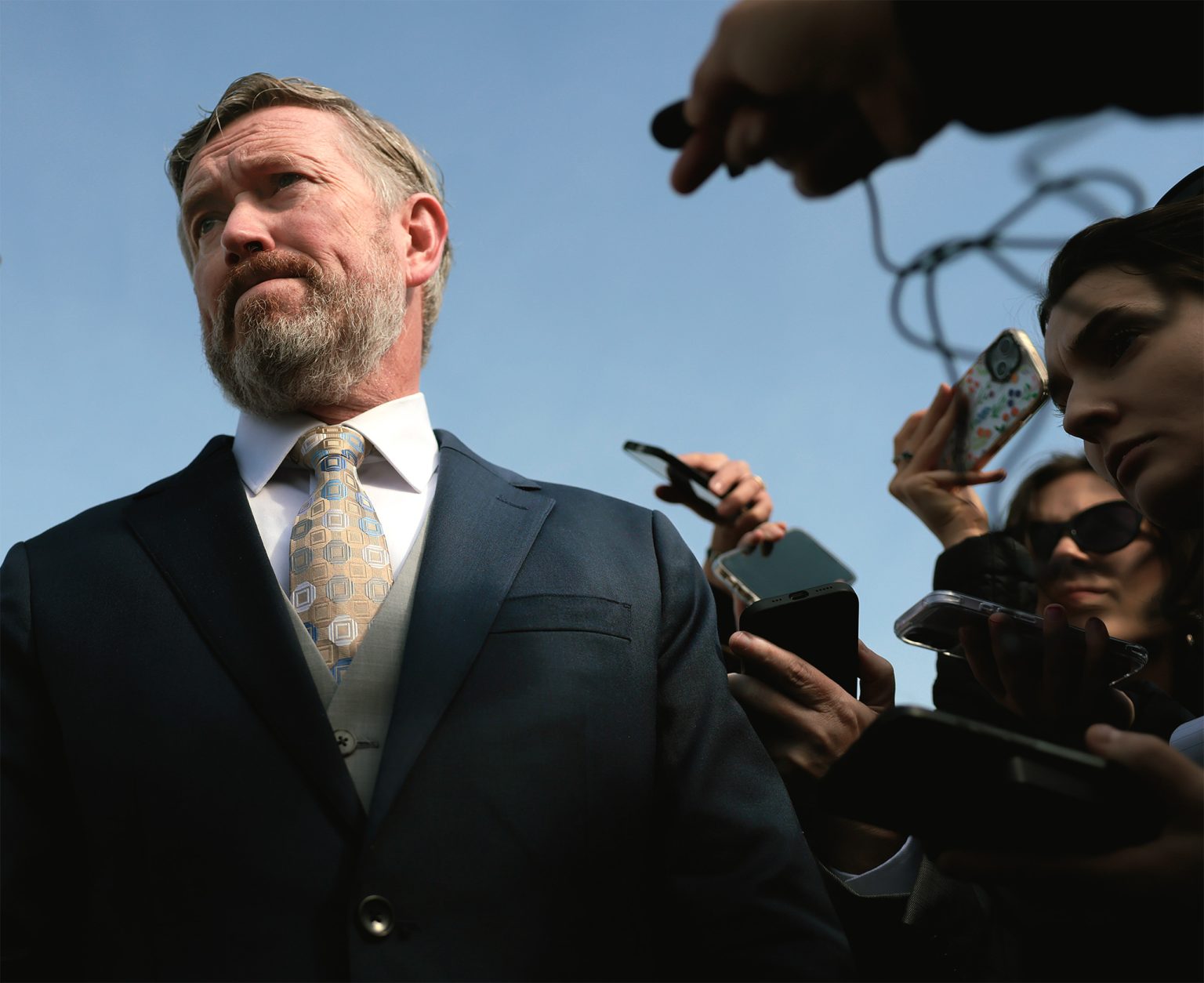
Donald Trump has seen off one of his most persistent Republican critics from the right. Thomas Harold Massie, the representative for Kentucky’s 4th Congressional District since 2012, lost Tuesday’s Republican primary to Ed Gallrein, a former Navy SEAL and farmer who ran as an unwavering supporter of the president.
With 99% of votes counted, Gallrein had won 54.9% to Massie’s 45.1%, according to CNN figures cited by Reuters. The result means Massie is set to leave Congress after seven terms, barring any unexpected political turn. Kentucky’s 4th District is considered safely Republican, making the primary the decisive contest ahead of the general election on 3 November.
A Broader Campaign Against Critics
Massie’s defeat was part of a wider campaign against Republicans who had crossed Trump. The race followed the primary defeat of Louisiana Senator Bill Cassidy, another Trump critic, and losses for dissenting state lawmakers in Indiana. In Texas, Trump also endorsed Attorney General Ken Paxton against incumbent Senator John Cornyn in the Republican Senate runoff, saying Cornyn “was not supportive of me when times were tough”.
Massie had become particularly visible as a critic of Trump’s sweeping budget package, known as the “Big Beautiful Bill”. Alongside a small group of libertarian Republicans and the Democratic opposition, he attacked the bill over spending levels. Elon Musk, then head of the Office of Government Efficiency, also criticized the package.
To Massie’s supporters, the irony was obvious. On guns, transparency, foreign wars and a minimal federal role in the private sector, the Kentucky congressman embodied much of what Trump had promised before the 2024 election. The contradiction became especially clear in the fight over files linked to Jeffrey Epstein. Massie angered Trump by pushing for the release of Justice Department documents tied to the late sex offender, while also opposing the war with Iran and aid to Israel.
Trump responded sharply. In a Truth Social post, he called Massie a “Third Rate Congressman”, a “Weak and Pathetic RINO” and “the Worst ‘Republican’ Congressman in History”. He said Massie “must be thrown out of office, ASAP!” and endorsed Gallrein as “a true America First Patriot”.

From Engineer to Congressman
Thomas Harold Massie grew up in Vanceburg, Kentucky. Before entering politics, he was already known in certain scientific and technology circles.
While studying electrical and mechanical engineering at the Massachusetts Institute of Technology (MIT), Massie worked on the university’s Galaxy solar car, which competed in the 1990 GM Sunrayce. In 1993, he founded the start-up SensAble Technologies with his wife, Rhonda. The company developed technology that allowed users to feel digital objects on a computer screen.
Massie’s official congressional biography says the company raised more than $32m in venture capital, created 70 jobs and obtained 29 patents. In 2010, he changed course and was elected Lewis County judge-executive. Two years later, he entered Congress after serving in local office.
His district, Kentucky’s 4th Congressional District, stretches across northern Kentucky and along 261 miles of the Ohio River. In a country where congressional boundaries are regularly redrawn according to population, the district became Massie’s political base. He won election after election from 2012 onward.
That kind of local staying power mattered because Massie never behaved like an ordinary party loyalist. Even before Trump returned to the White House, he had built his career on saying no.
Contradictions in the Grand Old Party
Massie was one of the few government officials who relied less on major political action committees than on individual donors. That made him an unusual figure in a Republican Party increasingly shaped by expensive primary battles, billionaire donors and highly organized outside groups.
Trump, meanwhile, presented himself in both terms as a man of the people. Yet his financial and political networks tied him closely to the millionaire and billionaire class, a point often made by his Democratic opponents.
The Democrats have their own wealthy donors, of course. But in the recent past, it was traditionally the Grand Old Party (GOP) that most openly represented the interests of Wall Street. Trump changed the party’s rhetoric. At least verbally, he placed himself on the side of American workers and farmers.
Massie rode parts of the same wave, but with a more authentic effect on his own voters. He opposed Republicans and Democrats alike when he believed they violated his principles on spending, war, surveillance or federal power. That reputation earned him the nickname “Mr. No”.
A Long Record of Dissent
His opposition was not limited to domestic policy. In 2017, Massie questioned the conclusion that Syrian President Bashar al-Assad had ordered the chemical attack in Khan Sheikhoun, arguing that such an attack would not have served Assad’s interests.
Massie also broke with Trump over the president’s effort to build a wall on the border with Mexico. Trump declared a national emergency in 2019 so he could redirect money from the Pentagon budget without congressional approval. Massie was among the Republicans who voted with Democrats in an unsuccessful attempt to override Trump’s veto of a resolution blocking the emergency declaration.
Over the years, he also voted against a resolution condemning the pro-Palestinian Boycott, Divestment and Sanctions movement and the Hong Kong Human Rights and Democracy Act. He also opposed expanded special immigrant visas for Afghan allies of the US military and $1bn in funding for Israel’s Iron Dome missile defense system.
In 2022, Massie was the only House member to vote against a resolution condemning antisemitism, saying he objected because the measure promoted internet censorship and threatened First Amendment rights.
The Costliest House Primary in US History
The most striking feature of the Kentucky race was its cost. Reuters reported that the Massie-Gallrein contest became the most expensive House primary in US history, with $32m in advertising expenditure. The total surpassed the $25m spent in the 2024 New York race in which Democratic Representative Jamaal Bowman was defeated.
The scale of the spending showed how far an internal party contest in a safely Republican district had moved beyond ordinary local politics. The Republican Jewish Coalition, the American Israel Public Affairs Committee and a Trump-aligned super PAC funded by pro-Israel donors put more than $15m into defeating Massie, according to Reuters. The ads sought to portray him as disloyal to Trump and the party.
A Referendum on Israel
Massie described the campaign in stark terms. Speaking to ABC News before the vote, he said the race had “turned into a referendum on whether Israel gets to buy seats in Congress”. Asked what he meant, he said: “That’s where all the money comes from, and it will be a referendum on foreign policy, whether Israel gets to dictate that by, you know, bullying members of Congress, and I’m the one they haven’t been able to bully, so they’re putting all the brunt, the force on me.”
The Republican Jewish Coalition rejected the charge. In a statement to ABC News, its chief executive, Matt Brooks, accused Massie of “antisemitism and bottom-of-the-barrel nativism at a time when Jew hatred is on rise”. He added: “The RJC stands with those who will combat antisemitism like Captain Ed Gallrein, and against those who foment it.”

Foreign Wars and Trump Loyalty
For Trump, Massie’s opposition to the Iran war appears to have been one of the decisive breaks. Yet on foreign policy, the congressman also reflected a current on the American right that is increasingly skeptical of new US military commitments in the Middle East.
Gallrein, by contrast, made loyalty to Trump the core of his campaign. On his website, he presented himself as a “Trump-Endorsed Conservative” and used the line: “This is Trump Country. It’s time we had a Congressman who acts like it.”
That message worked. Gallrein cast himself as a team player who would reliably back Trump, in a state the president won in 2024 with 64.5% of the vote. After his victory, Gallrein told supporters: “Now my focus is on advancing the president’s and the party’s agenda to put America first and Kentucky always.”
The Limit of Saying No
The outcome was not only a defeat for Massie. It was a warning to every Republican who believes he can oppose Trump from the right and survive. Massie was not a liberal Republican, not a centrist and not a critic from the old establishment wing of the party. He was a libertarian conservative with deep local roots, a long record of voting against federal spending and a following among voters who distrust Washington.
That was not enough. The result suggests that, in Trump’s GOP, ideological consistency may count for less than loyalty to the president. Massie’s career showed that a congressman could build a brand by saying no to both parties. His defeat shows the limit of that strategy: in Trump country, voters may tolerate defiance of Washington, but not defiance of Trump.