Goods are not necessarily being shipped earlier because they are needed sooner, but because companies are protecting themselves against political deadlines, unstable routes and tight capacity.
The effect was particularly clear in summer 2025 in the case of so-called frontloading. Companies moved goods quickly ahead of planned tariff changes in order to avoid higher duties.
At the same time, new US rules for low-value shipments are shifting trade flows. For years, the previous de minimis model helped Chinese retailers in particular bring low-value goods into the United States relatively easily. If that channel narrows, retailers and logistics companies have to recalculate. Old routes become less attractive, new detours emerge and air freight is used where companies have to buy time.
Who Profits From the New Rush for Speed
The current situation benefits all those able to sell speed, flexibility and reliable handling: cargo airlines, airports, cargo handlers, freight forwarders, express services and specialist logistics providers. If a missing spare part stops production, a medicine is urgently needed or a tariff change could run into the millions, the price of flying becomes a secondary concern.
The decisive factor is no longer the cheapest transport route, but the most reliable one.
The trend is particularly strong in the technology sector. The expansion of data centers and the boom in artificial intelligence are driving demand for servers, chips, graphics cards, racks and sensitive electronic components. These goods are expensive, time-critical and often tied to fixed project schedules.
Anyone trying to bring a data center online by a certain date will not calmly wait for a container that spends weeks at sea. Server racks require special packaging, insurance, rapid customs clearance, tracking and often special handling during transshipment. For air freight, it is an ideal business: high-value goods, tight time windows and limited price sensitivity.
The boom, however, is not evenly distributed. Prices are rising on some routes and falling on others despite higher volumes. The decisive factors are capacity, the type of goods and political pressure along a given route.
Transporting high-value technology goods from Taiwan to North America is a very different business from moving goods from China to the United States, where tariff uncertainty and new rules for low-value shipments are changing the calculation. Air freight grows most strongly where risk, time pressure and goods value come together.
For airports, this is an opportunity. Those that can handle freight quickly, offer reliable customs processes, keep enough space available and provide good connections can attract trade flows.
Liège Airport in Belgium has established itself in Europe as an important hub for e-commerce freight. For retailers, it does not matter whether a package for German customers also lands in Germany. What matters is where the first point of access to the wider single market works most easily for logistics and processing.
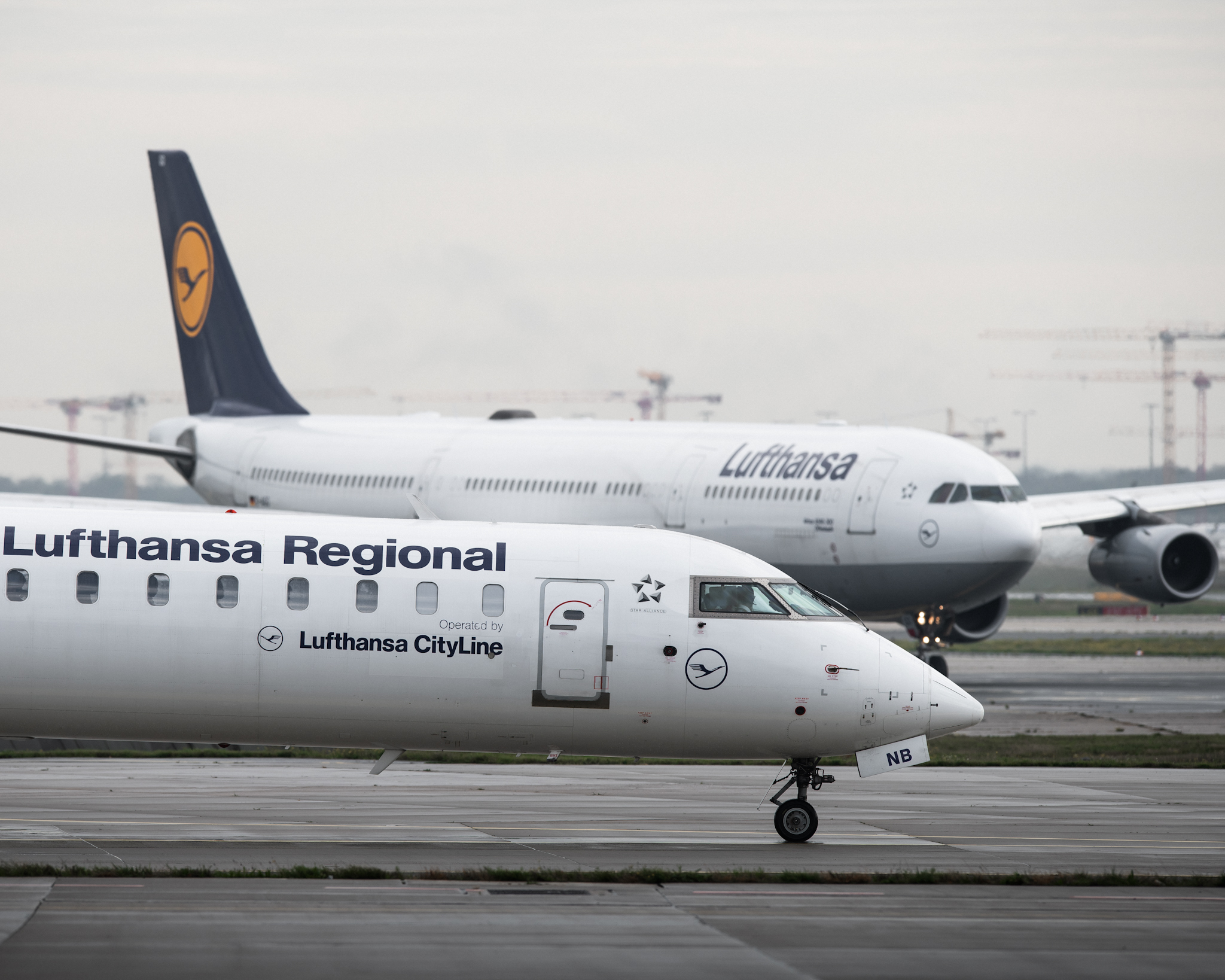
In this environment, Frankfurt Airport should in theory be benefiting massively. It is Germany’s most important air freight hub and is closely tied to industry. Pharmaceuticals, mechanical engineering, IT, vehicle spare parts and high-value components all move through Frankfurt.
Lufthansa Cargo has invested €600m ($650m) in its freight center. Fraport wants to expand the business, and German industry needs fast delivery routes more than ever.
On paper, much speaks in Germany’s favor. In practice, however, a growing share of the business is bypassing German airports.
Why Germany Is Still Falling Behind
According to the German Aviation Association (BDL), air freight volumes in Germany have fallen by 22% since 2010. That is remarkable because around 26% of the country’s trade in goods with non-EU states by value is handled by air. German industry therefore depends on air freight, yet part of the value creation is shifting to nearby foreign hubs.
There is no single reason, but many points of friction. Freight is mobile and seeks the easiest route. In Belgium, for example, the state waives an air navigation fee, according to industry representatives. At the same time, Liège Airport and Belgian customs jointly promote smooth access to the EU single market at logistics fairs. For retailers and freight forwarders, the signal is clear: freight is meant to move through the system quickly.
In Germany, the same process often appears more cumbersome. Industry representatives cite customs, an impractical value-added tax (VAT) system and more burdensome security procedures, among other issues.
Even the use of sniffer dogs can become a location factor. Because their deployment is tightly regulated in Germany, freight is sometimes taken by truck to a neighboring country, checked there and then sent on. That may sound like a detail of administrative practice, but in a business with tight time windows it can help determine whether a location remains attractive. In practice, it means lost time and higher costs.
A further problem is that European Union rules may formally apply everywhere, but their implementation does not have the same effect in every country. If one member state organizes checks more quickly, keeps fees lower or applies procedures more pragmatically, trade flows shift.
For German air freight, this is especially sensitive because it competes not only with Asia, the Gulf and North America, but also with neighbors inside the single market.
Competition does not begin in Dubai or Singapore. It begins in Liège, Amsterdam or Paris.
Geopolitics Adds to the Pressure
Geopolitical factors are also adding to the pressure. Since Russia’s attack on Ukraine, Western airlines have no longer been able to use Russian airspace. For European cargo providers, that has lengthened important routes to Asia. Gulf carriers and Asian competitors can often use their networks more flexibly.
High kerosene prices further intensify the competition, because they increase surcharges and influence capacity decisions.
Another weakness lies in passenger traffic. A large share of air freight does not fly in dedicated cargo aircraft, but in the bellies of passenger planes. If the route network is cut back, cargo capacity shrinks as well. For Frankfurt, connectivity is therefore crucial. But when airlines reduce connections or shift capacity to cheaper locations, Frankfurt loses not only passenger flights, but also appeal for shippers.
For Germany, this is more than a problem for airports. Companies that handle freight through foreign hubs give up part of the value creation and make industrial supply chains more dependent on locations beyond their direct control. This affects above all industries that rely on fast spare parts, sensitive electronics and time-critical components. Air freight is no longer a niche issue for freight forwarders. It has become part of industrial infrastructure.
The new boom shows how profoundly global trade has changed. Speed is becoming insurance against political risks, unstable sea routes and fragile supply chains. Germany ought to benefit from this development. Instead, a substantial share of the business risks ending up where handling, costs and procedures are better coordinated and more efficient.
The demand is there. The question is whether Germany can still hold on to it.