
The Hungarian elections in April mattered not only for Hungarians themselves, but also for the further course of the war in Ukraine. Viktor Orban had long blocked the EU’s €90bn ($106bn) aid package for Kyiv.
His challenger, Peter Magyar, built his program on a promise that Hungary’s time as the EU’s most obstructive member on collective decisions would come to an end. That is what happened. Hungary has stopped blocking the EU loan. The question is whether such a huge sum will be enough and who will ultimately pay for it.
Europe Picks Up the Bill
In its new program, the International Monetary Fund envisages a total international support package for Ukraine of around $136.5bn (€116bn) over two years. Ukraine’s own budget gap for the basic operation of the state in 2026 is around $52bn (€45bn).
The European Union is expected to provide the €90bn already mentioned over two years. This is a crucial point, because without the EU, the Ukrainian state could no longer function today. In practice, it amounts to the effective completion of Trump’s policy, which elegantly leaves Europe to finance the civilian lifeline keeping Kyiv afloat.
This is an extremely uncomfortable situation for Europe. In 2022 and 2023, the United States was the main driver of aid in both areas, civilian and military. But bitter political battles in Washington mean that American civilian aid has essentially dried up. For the EU and its people, the main burden will now be borne by European taxpayers.
The EU will, of course, borrow on the financial markets to finance the aid. Thanks to its top credit rating, it can do so far more easily and cheaply than Ukraine could on its own.
There is, however, a catch. To make the aid politically viable at home, it is formally described as a loan that Ukraine will repay from future war reparations. That may look good on paper, but for the model to work, there would have to be either a fundamental change in the balance of power or an internationally enforceable political and legal settlement. A scenario in which Moscow voluntarily and quickly pays reparations is extremely unlikely today.
The second option under discussion, financing the loan directly from frozen Russian assets, also collapsed at the EU summit because of fears over legal risks and retaliation from Moscow. Liability therefore rests with the member states in proportion to their gross national income (GNI). Under the logic of EU financing, the biggest economies, above all Germany and France, will carry the heaviest share of the burden. The Czech Republic, Slovakia and Hungary are exceptions, as they are exempt from the liability.
A State Kept Alive by Debt
According to the latest reports from Ukraine’s Ministry of Finance, Kyiv needs $52bn a year simply to keep its state budget alive. This is the minimum required for basic state functions, including the salaries of teachers, firefighters and medics. Without that sum, the civilian sector risks immediate disintegration. On top of that come tens of billions more linked to Ukraine’s existing obligations, including the servicing of older public debt.
Although the European Union has so far created a two-year framework, the annual sum of €45bn is, for comparison, roughly 1.5 times the entire Slovak state budget. Even that applies only if the war does not further destroy the Ukrainian economy.
Any additional revenue shortfall would again have to be covered from foreign sources. In addition, the continuing Iranian crisis in the Middle East risks sending energy and goods prices sharply higher in Ukraine itself.
Here we come to the heart of the matter. Can the European Union finance the operation of the Ukrainian state ad vitam aeternam, in perpetuity? Technically, of course, it can. But the harsh consequences will be felt precisely in the economies of the EU member states. And political willingness to send more money is meeting stiff resistance from voters.
The Military Aid Front Starts to Fray
While Ukraine’s civilian survival depends on the European budget, key military aid projects are beginning to falter. The main reasons are donor fatigue, persistent reports of corruption in military contracts in Kyiv and domestic political changes in European capitals.
This fatigue is deeply structural. Key donors such as Germany and France are struggling with economic stagnation, costly debt and energy shocks, forcing governments into domestic cuts under strict budget rules. Growing public frustration over public finances is then fueling the meteoric rise of skeptical and populist parties across Europe, which regard further funding for the conflict as untenable.
This unfavorable development has been reflected most clearly in the drastic weakening of the Czech ammunition initiative, which since 2024 has been able to provide Ukraine with more than four million rounds of large-caliber ammunition and, at the most critical moments, has covered up to half of Ukraine’s artillery needs. Its current stagnation is a direct sign of the West’s waning appetite to continue massively subsidizing a long war of attrition.
Czech President Petr Pavel recently caused a stir by openly admitting that the key project, though not yet over, is now being kept afloat financially by only nine states. The flight of sponsors has become a serious political flashpoint in Prague.
The desperate attempt to save the crumbling munitions coalition and personally reassure allies is the main reason Pavel is pressing to attend the upcoming NATO summit in Ankara.
This puts the president’s foreign policy activism in a sharp institutional clash with the new Czech government. Pavel’s push to attend the alliance summit comes despite the clear opposition of the new foreign minister, Petr Macinka, illustrating the deep split in current Czech foreign policy.
Questions Over Supply Transparency
Beyond political fatigue, the project has also been affected by serious doubts over transparency. The Czechoslovak Group (CSG), the arms group owned by billionaire Michal Strnad, has been at the center of the criticism, acting as the main private partner in the initiative to buy and refurbish shells in non-NATO countries. The affair also fits into a broader Czech context: the arms lobby has long held an extremely strong position in Prague, and the war in Ukraine has increased its political and economic importance.
In the meantime, the debate over pricing and supply transparency has intensified in the Czech Republic. According to critics, some ammunition could have been procured significantly more cheaply in Turkey, for example, while Western donors were allegedly offered shells through the Czech mechanism at up to €3,200 ($3,800) apiece.
Both CSG and the Czech Ministry of Defense reject the claims of overpricing, saying that the final price includes refurbishment, replacement of components, logistics, insurance, quality control and the risk involved in delivery to a war zone. Doubts have remained, however, and CSG chief Strnad admitted to the Financial Times that some donors had begun buying ammunition directly.
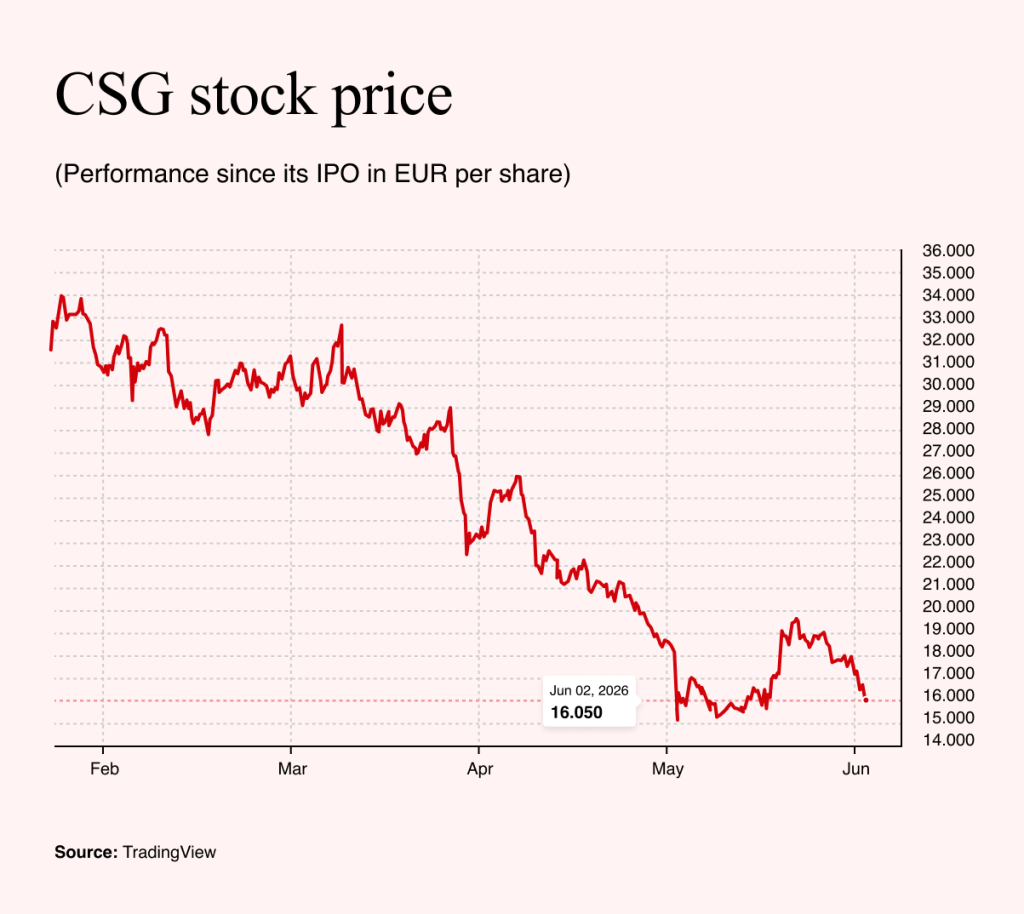
The weakening of the ammunition initiative is also affecting CSG itself. Its stock market story rests on the idea that the European arms business will continue to grow rapidly thanks to the war in Ukraine and NATO rearmament. The sharp fall in the company’s shares therefore shows that investors are beginning to question whether the model is truly sustainable in the long term, especially as questions pile up over prices, margins and donors’ willingness to pay for munitions contracts.
CSG’s stock chart is not a direct answer to the question of how long Ukraine can hold out. But it is a narrower warning indicator: confidence that Europe will continue to fund an expensive war of attrition at the same pace as before is beginning to weaken.
If that confidence fades, Ukrainian guns will not feel it the very next day. But the political and industrial basis on which their supplies depend will begin to fray dangerously.