

The central argument made by proponents of migration is that it is economically necessary. There is not much that can be done about migration, they argue, and in any case it is one of the few ways to keep European economies growing.
The argument rests on a seemingly bulletproof variable: gross domestic product (GDP). If a country takes in more people, the size of its economy will almost automatically increase. New residents work, spend, live, use transport, consume energy and rely on services. Even those who are not employed create additional demand for housing, health care, education, administration, social services and integration programs.
Part of the fiscal cost therefore appears, paradoxically, as economic activity in the national accounts. That is precisely the core of the problem. GDP growth is not the same as growth in prosperity. A Centre for Economic Policy Research study estimates that the recent surge in immigration could increase potential output in EU recipient countries by 0.2% to 0.7% by 2030.
Migration boosts GDP because it adds more people to the economy. But an economy can become larger without making the native population better off. That is the difference between GDP growth and growth in prosperity.
The real question, then, is not whether migration increases GDP. It usually does. The question is whether it increases European prosperity.
There is no automatic answer. It depends on who comes, whether they work, how much they earn, where they live, which public services they use, whether they raise productivity and who ultimately pays the bill.
Pressure on Wages and the Labor Market
The first place where the economic costs of migration become visible is in the pressure on wages in low-skilled occupations. This effect is often concealed by averages.
Migration is not a homogeneous economic category. It involves two very different groups. On one side are highly skilled workers such as doctors, engineers, IT specialists and scientists, who may have above-average productivity and wages. On the other is a much larger group concentrated in low-wage services, logistics, agriculture, construction, cleaning, care and agency work.
It is the latter group that is most exposed to labor market pressure. Some migrants have more formal education than their jobs require, but because of language barriers, unrecognized qualifications or weak bargaining power, they end up in low-value-added occupations. The symbols of this economy are the courier delivering fast food, the warehouse worker, the construction helper and the seasonal agricultural worker.
So far, the model mainly suits two groups: companies, which get flexible and cheap labor, and the urban upper middle class, which gains access to cheap services.
From a white-collar perspective, courier deliveries, cheaper catering, cleaning, care and platform services make everyday life more convenient and less expensive. But the price of that convenience is not spread evenly. It is borne mainly by low-paid domestic workers with weak bargaining power, who compete for similar jobs. Cities, meanwhile, have to absorb the pressure on housing, transport and services. For those workers, migration is certainly not an obvious win.
Here lies the biggest blind spot in the pro-migration economic argument. It is counterproductive to tell people facing such pressures that migration is good for the economy when their own experience points to greater strain on wages, housing and public services. That also explains why anti-immigration parties can count on their support at the polls.

The Cheap Labor Trap
Wage pressure is not the only negative effect of migration on the labor market. A permanent supply of cheap labor from abroad can also slow technological progress and corporate innovation.
Why would a logistics company, food-processing plant or factory invest millions of euros in robotics, software and automation when it can instead hire cheap workers who are easily dismissed if demand falls?
That is the cheap labor trap. Demographic decline, usually the main argument made by migration advocates, could in theory force Europe to move toward a more capital-intensive, productive and technologically advanced economy.
Instead, some European firms are taking the easier route. They are replacing a shortage of domestic labor with cheap imported labor. That keeps low-value-added business models alive even though they would otherwise have to modernize, consolidate or disappear.
The import of cheap labor can therefore become a drag on overall productivity. This is another paradox of migration. Often defended by progressive and liberal forces as a modern and open policy, its economic effect in some sectors can be the opposite. It preserves the old model of cheap labor, low margins and weak investment. It does not solve Europe’s productive underdevelopment. It merely postpones it.
The Hidden Cost of Housing
The third tangible effect on prosperity is felt in the housing market. Rapid demographic growth in Europe’s big cities, increasingly driven by migration at a time of declining natural increase, is colliding with a rigid supply of homes.
Housing, schools, doctors’ surgeries, hospitals and transport infrastructure do not appear overnight. New demand for housing, however, appears immediately. The result is upward pressure on rents, more crowded households and the displacement of the domestic lower and middle classes beyond the boundaries of big cities.
This is where the difference between GDP growth and growth in prosperity is clearest. On paper, higher rents, construction activity, accommodation, social services and public spending on integration can all be recorded as economic activity. In the national accounts, migration therefore again helps the economy grow.
For the ordinary resident, however, the same process means that less of the paycheck remains after rent has been paid. What macroeconomic statistics record as a higher volume of transactions is experienced by households as a fall in disposable income.
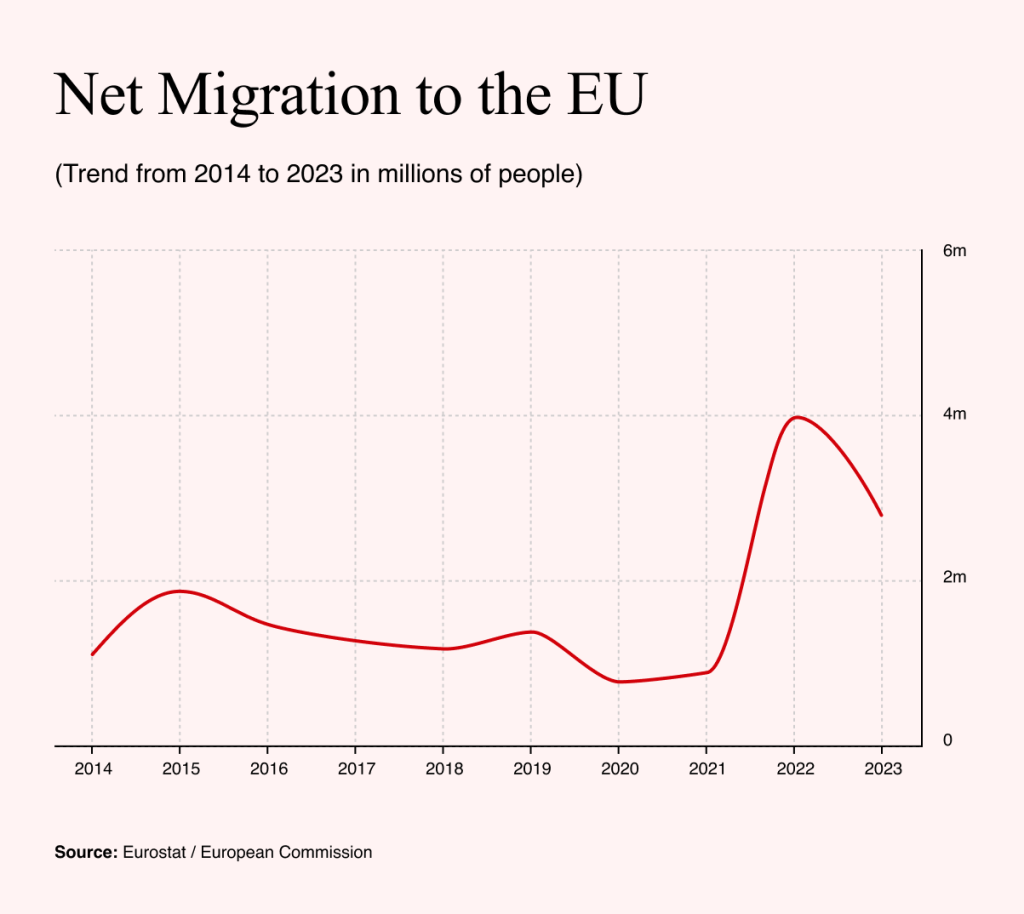
European data show why this pressure is so sensitive. In 2023, the EU had net migration of almost 3 million people and in 2024 issued 3.5 million first residence permits to non-EU citizens. This is not a marginal increase that can be absorbed without cost, especially when it is concentrated in regions with the largest labor supply, precisely where housing is already most expensive and construction is slowest.
Who Pays for Population Growth?
Housing is therefore perhaps the most concrete externality of migration. In the case of wages, there may be long debates about average effects, substitution and the complementarity of workers. With housing, the mechanism is simpler: the number of people can grow quickly, while the number of homes grows slowly.
If a city adds people faster than it adds new housing and public services, the results are not abstract cultural enrichment or net welfare gains. They are higher rents, longer commutes and more pressure on schools, health care and welfare systems.
This is another reason why the GDP argument fails. The national economy may be getting bigger, but the urban middle class may simultaneously be sinking into a lower standard of living. Rising housing prices increase the value of assets held by property owners, developers and investors.
But they take away living space from renters, young families and low-wage workers. In the housing market, migration once again reveals its distributive nature. Some reap the benefits of population growth. Others pay the price. And it is clear which group has an interest in maintaining a positive narrative about migration.
Migration is therefore not a miraculous engine of prosperity, but a distributional shock. It increases the nominal size of the economy while distributing costs and benefits very unequally. The real economic balance of European migration lies in the gap between GDP growth and rising living standards.