The search for meaning is fundamental to our civilization. At the ARC conference, social scientist Arthur C. Brooks offered a vivid account of the crisis of meaning in the Western world.
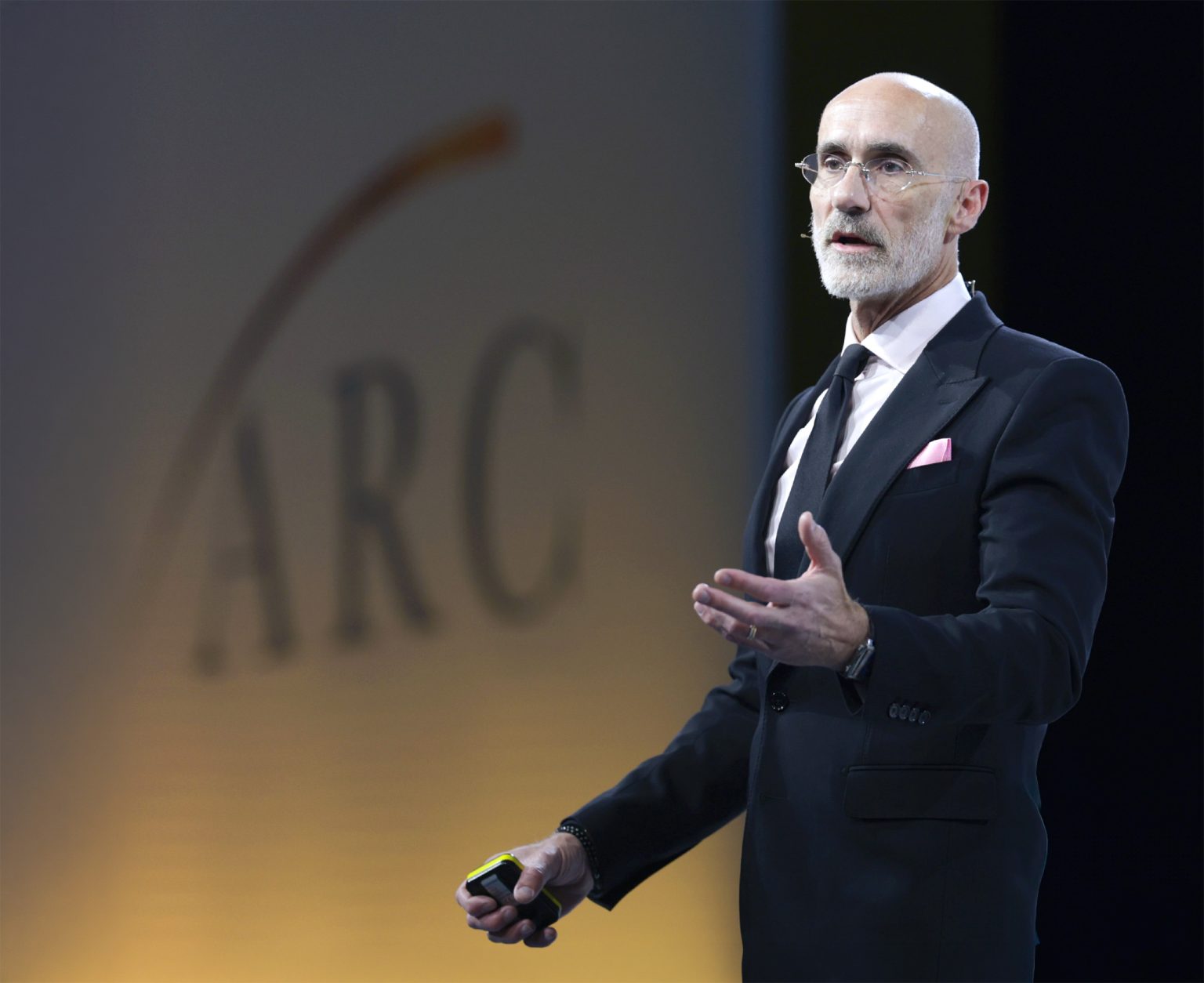
Arthur Brooks addresses the ARC conference on the meaning of life. Photo: The Alliance for Responsible Citizenship
|
Speaking in London at the Alliance for Responsible Citizenship (ARC) conference, Arthur C. Brooks posed two provocative questions during his address in the Our Civilisation Story section. Why am I alive? That was the first, and some listeners might still have been able to answer it off the cuff or from a school catechism. The second was harder. What would I give my life for?
Brooks is an American social scientist, bestselling author and professor at the Harvard Kennedy School and Harvard Business School. His research and teaching focus on happiness, meaning, leadership and human well-being. He combines insights from psychology, neuroscience and philosophy with questions about how to live well.
Brooks opened with a stark diagnosis. The real problem of our age, he argued, was a crisis of meaning. Political, economic and cultural crises were merely symptoms. Returning to his opening questions, Brooks observed that more and more people, especially young adults, no longer knew why they were alive or what they would be willing to sacrifice for.
He described the two questions as decisive. Those who cannot answer them lose orientation and, ultimately, life satisfaction.
In his address, Arthur Brooks combines happiness research, neuroscience and Christian anthropology into a broad diagnosis of the present. His central message is that the West’s social conflicts are ultimately expressions of a deeper crisis of meaning.
From that perspective, political extremism, loneliness, depression and digital dependency appear as symptoms of a culture that has lost sight of the great questions of meaning, vocation and transcendence.
Brooks also set out a definition of happiness. He said it arises from three components: enjoyment of life, satisfaction with what one has achieved and an awareness of the meaning of one’s own existence.
It is precisely that third element, the professor argued, that many young people are increasingly losing. He pointed to studies suggesting that, since around 2008, there has been a sharp rise in the share of young people who regard their lives as meaningless.
Why Screens Hollow Out Meaning
For Brooks, the shift begins roughly with the rise of the smartphone. In his view, digital devices permanently alter our attention. He draws here on the work of the British psychiatrist and neuroscientist Iain McGilchrist.
McGilchrist’s account of the different functions of the two hemispheres of the brain helps explain the effect of screens. The left hemisphere is geared toward information, analysis and problem-solving, while the right is attuned to meaning, relationships, beauty, faith and purpose.
Modern digital media, Brooks argues, almost exclusively encourage left-hemisphere modes of thought and push aside the experiences from which human beings draw meaning. Somewhat provocatively, he says that we are living in a kind of simulation of life. Our world is full of information, but poor in real human experience.
From this observation, Brooks develops one of his sharper claims. The political activism of many young people, especially those drawn to extreme political movements, is a desperate search for meaning and belonging.
Brooks rejects radical ideologies, but warns against merely condemning young activists. If people are deprived of meaning, he suggests, one should not be surprised when they turn to substitute religions or ideological movements. The causes must therefore be treated, not merely the symptoms.
Brooks therefore calls for a more conscious approach to digital media. Specifically, he recommends spending the first and last hour of the day away from screens.
Beyond that, he advocates a far-reaching ban on phones in schools, from primary school to university. His aim is not to abolish technology, but to reorder our relationship with it and, in particular, to protect children from the harmful effects of constant digital exposure.
For Brooks, the search for meaning begins with asking existential questions. Human beings are not distinguished from other living creatures by knowing all the answers, but by asking questions that cannot simply be googled.
Conversations about the meaning of life, vocation, love or faith are therefore not peripheral matters, but expressions of our humanity. His experience as a university teacher, he says, is that many students begin to shape their lives more consciously only when confronted with such questions.
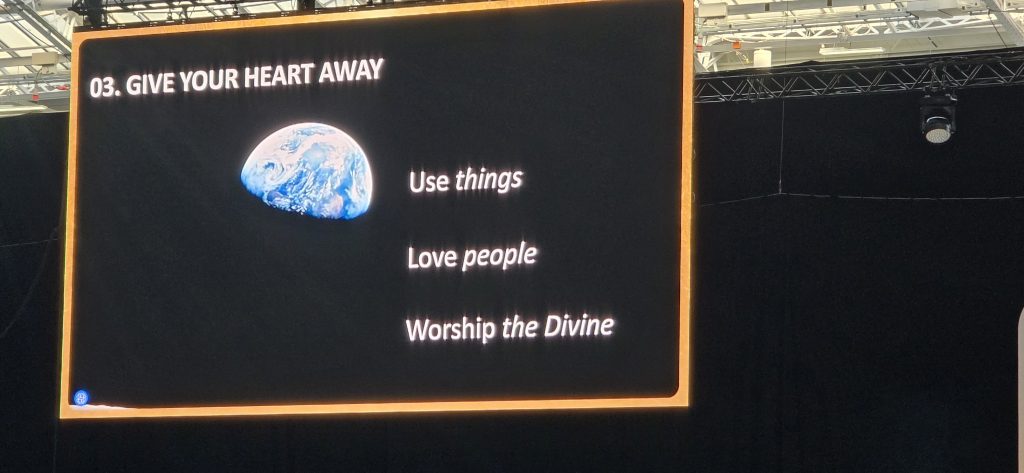
Arthur C. Brooks’s formula for a meaningful life: use things, love people and worship the divine. Photo: Peter Winnemöller
Worship God Alone
Brooks becomes especially vivid when he speaks about his son Carlos. Instead of going straight to university after school, Carlos first worked on a farm and then served in the US Marines. There, Brooks says, he found answers to the fundamental questions of life.
Asked about the meaning of his life, Carlos now answers that God created him to serve others. Asked what he would give his life for, he names his family, his faith, his comrades and his country. Brooks presents the story as an example of how purpose arises through responsibility and service to others.
Brooks contrasted the fashionable formula of modern culture, love things, use people and worship yourself, with a different order. Things should be used, not loved. People should be loved, not used. Worship is due to God alone.
For Brooks, that order is not only an expression of Christian ethics, but also the basis of a fulfilled life. His answer to the great crisis of meaning is not a political reform program.
It is a cultural and personal reorientation: less screen time, more real relationships, more responsibility and the rediscovery of a transcendent order with God at its heart.
Here is placeholder for Article excerpt Here is placeholder for Article excerpt Here is placeholder for Article excerpt Here is placeholder for Article excerpt
Here is placeholder for Article excerpt Here is placeholder for Article excerpt Here is placeholder for Article excerpt Here is placeholder for Article excerpt
Here is placeholder for Article excerpt Here is placeholder for Article excerpt Here is placeholder for Article excerpt Here is placeholder for Article excerpt
Welcome to the comments section of the Štandard daily. Please take note of our guidelines, comments are moderated by us. You can contact the moderators at [email protected].
Participate in the discussion
Comments are available to subscribers only. If you'd like to join the discussion, choose a subscription starting at €6.72 per month.
All comments 0
Register
Comments are available to registered users only. If you'd like to join the discussion, register here.