EU Carbon Tariff Deals Fresh Blow to Ukraine's Steel Industry
The EU carbon tariff, intended to protect European manufacturers, is already taking a toll on war-torn Ukraine. Although the mechanism is still being phased in, Ukrainian steelmakers are losing orders.
EU carbon tariffs are beginning to affect Ukrainian steel producers, which the industry says are losing orders even before the mechanism is fully implemented. Photo: Ukrinform/NurPhoto via Getty Images
|
Since the beginning of the year, Ukrainian steelmakers have been grappling with a new challenge. This time, it was not created by the Russian invasion but by Kyiv's closest ally, the European Union.
In January, the EU's Carbon Border Adjustment Mechanism (CBAM), better known as the carbon tariff, entered its definitive phase. Under the scheme, importers bringing goods into the EU must purchase carbon certificates covering the emissions generated during their production abroad.
The measure primarily targets carbon-intensive industries, including iron, steel, aluminium and cement.
CBAM is closely linked to the EU's Emissions Trading System (ETS). Under the ETS, companies operating in emission-intensive sectors must pay for every metric ton of carbon dioxide they emit.
European authorities allocate some emission allowances free of charge, although these are being gradually phased out, while the remainder are sold through auctions. Companies are then free to buy and sell these allowances on the market.
The drawback of the system is that it increases production costs for European manufacturers compared with competitors in countries that do not impose comparable carbon charges.
CBAM is designed to address that imbalance, at least for goods entering the EU. It effectively levels the playing field by requiring imports to bear a carbon cost similar to that faced by domestic producers. However, it offers no relief to European companies exporting outside the bloc, which must still absorb the full cost of the EU emissions trading system.
In practice, importers must purchase carbon certificates for goods originating in countries where producers are not subject to equivalent carbon pricing. The cost of those certificates is linked to the price European companies pay for emissions allowances under the EU's carbon market.
Ukraine Is Already Feeling the Effects
Since the steel industry, which falls under the CBAM mechanism, is one of the pillars of Ukraine's economy, accounting for roughly 5.5% of GDP, any measure that undermines the competitiveness of local producers has significant economic consequences.
According to the European Steel Association, exports of finished steel products from Ukraine to the EU fell by 17% year over year in the first quarter of 2026.
Ukraine’s largest steelmaker, ArcelorMittal Kryvyi Rih, says the introduction of CBAM cost it orders totaling approximately 300,000 metric tons in the first quarter alone. By comparison, the company exported around 920,000 metric tons of steel products to the EU in 2025 and had planned to increase exports to between 1.2 million and 1.25 million metric tons in 2026.
“ArcelorMittal Kryvyi Rih lost the European market almost immediately. As soon as customers learned about the additional tariff, they canceled all orders for the first quarter of 2026", GMK Center, a Ukrainian analytical and consulting firm specializing in the steel and mining industries, wrote on its website.
An Old Enemy: Bureaucracy
At the same time, Brussels' new carbon tariff has created a paradox.
In 2012, Ukrainian steel pipe manufacturer Interpipe invested around $1bn in electric arc furnace technology to reduce carbon emissions and align its production with EU climate objectives. The investment cut emissions from roughly two metric tons of carbon dioxide per metric ton of steel to just 110 kg.
However, when the European Commission compiled its emissions database for Ukraine, it assumed that all Ukrainian steel producers relied on the traditional, carbon-intensive blast furnace process. As a result, Interpipe's cleaner production method was not reflected in the Commission's calculations.
Despite investing heavily to reduce its emissions, the company now faces the same carbon costs as producers using far more carbon-intensive technology.
“Interpipe is losing its competitiveness not because of carbon-intensive processes, but because of an incomplete directory", Andriy Ostapets, the company's Director of Ecology and Industrial Safety, told Ekonomichna Pravda.
CBAM allows companies to prove that their actual emissions are lower than the Commission's default values and thereby reduce the carbon charge. Under normal circumstances, this verification process would be relatively straightforward.
The growing difficulties facing Ukraine's steel industry have fuelled mounting criticism of the EU's Carbon Border Adjustment Mechanism, with Ukrainian officials and industry groups warning that its economic impact could be far greater than Brussels anticipated.
The European Commission estimated at the end of last year that CBAM would reduce Ukraine's GDP by just 0.01% by 2035. Ukrainian analysts paint a much bleaker picture.
According to GMK Center, the mechanism could reduce Ukraine's GDP by 2.1% as early as 2030 through its impact on the steel industry alone.
Economy Minister Oleksiy Sobolev has issued an even starker warning, arguing that Ukraine could lose up to 6.5% of its GDP over the next decade because of CBAM.
Admittedly, Ukraine's wartime economy is substantially smaller than before Russia's full-scale invasion, making percentage losses appear more severe. Nevertheless, Ukrainian government officials, steel producers and industry analysts have all argued that the carbon tariff is already creating significant problems for the country's exporters.
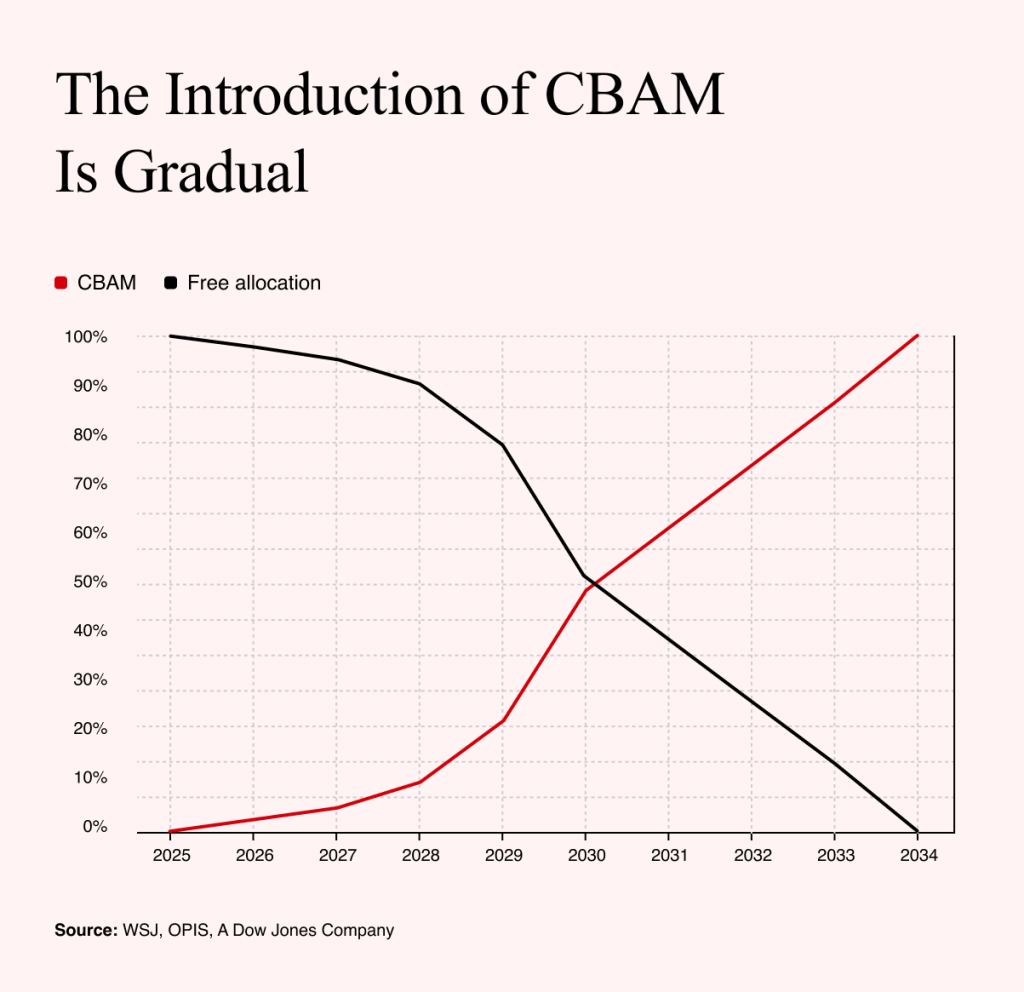
Their concerns come despite the fact that CBAM is still being phased in gradually, with its full financial impact yet to take effect.
Source: WSJ, OPIS, A Dow Jones Company
Why the Impact May Already Be Greater Than Expected
Although only a relatively small share of emissions is currently covered by the carbon tariff, that does not mean its commercial impact is equally limited. Companies negotiating long-term supply contracts already take future costs into account, knowing that the proportion of emissions subject to CBAM will increase each year.
That may help explain why Ukrainian steelmakers are already losing customers, even before the mechanism has been fully phased in.
Another obstacle is the verification of actual emissions. With accredited European inspectors generally unwilling to travel to Ukraine during the war, many companies are unable to verify their actual carbon footprint. As a result, companies with relatively low emissions may still be forced to pay the higher default carbon tariff.
Without that verification, importers must rely on the European Commission's default values, which may overstate the carbon intensity of Ukrainian products and make them unnecessarily expensive on the European market.
One piece of good news may be on the horizon. Although Brussels has so far rejected calls to exempt Ukraine from CBAM, discussions are reportedly underway on allowing accredited European emissions verifiers to conduct remote inspections under exceptional wartime circumstances.
If implemented, such a system could help Ukrainian exporters demonstrate their actual emissions and reduce at least some of the additional costs created by the carbon border tariff.
Placeholder For Topreaded Placeholder For Topreaded
Placeholder
Placeholder
Placeholder For Topreaded Placeholder For Topreaded
Placeholder
Placeholder
Placeholder For Topreaded Placeholder For Topreaded
Placeholder
Placeholder
Placeholder For Topreaded Placeholder For Topreaded
Placeholder
Placeholder
Placeholder For Topreaded Placeholder For Topreaded
Here is placeholder for Article excerpt Here is placeholder for Article excerpt Here is placeholder for Article excerpt Here is placeholder for Article excerpt
Here is placeholder for Article excerpt Here is placeholder for Article excerpt Here is placeholder for Article excerpt Here is placeholder for Article excerpt
Here is placeholder for Article excerpt Here is placeholder for Article excerpt Here is placeholder for Article excerpt Here is placeholder for Article excerpt
Welcome to the comments section of the Štandard daily. Please take note of our guidelines, comments are moderated by us. You can contact the moderators at [email protected].
Participate in the discussion
Comments are available to subscribers only. If you'd like to join the discussion, choose a subscription starting at €6.72 per month.
All comments 0
Register
Comments are available to registered users only. If you'd like to join the discussion, register here.