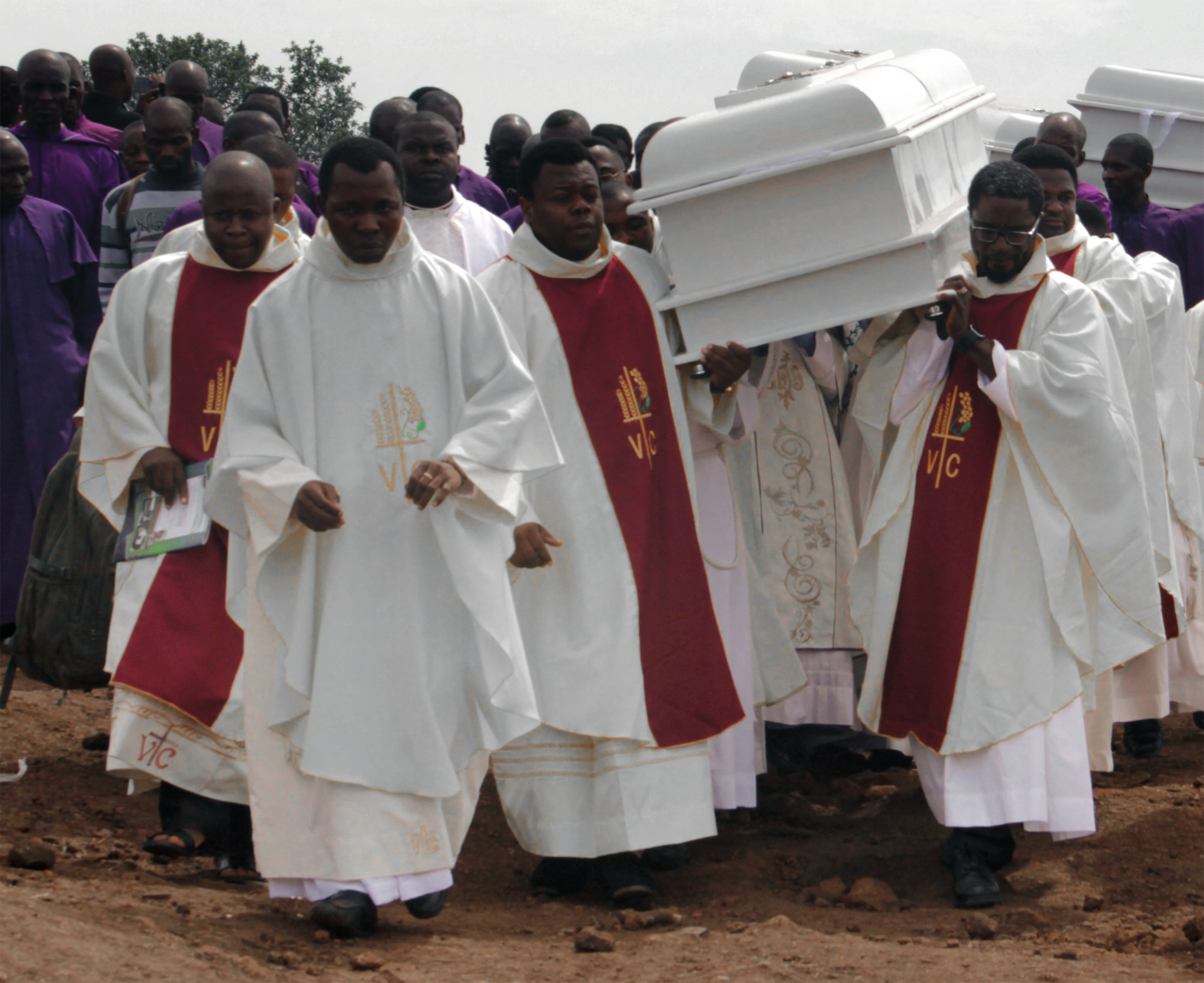
Reducing terrorism and violence in Nigeria to Islamist extremism and the persecution of Christians does not capture the full picture. That is the conclusion of a report by the Observatory for Religious Freedom in Africa (ORFA). The report argues that the country's violence has multiple causes, including conflicts between farmers and herders, Islamist insurgency and, above all, the failure of the Nigerian state to provide security.
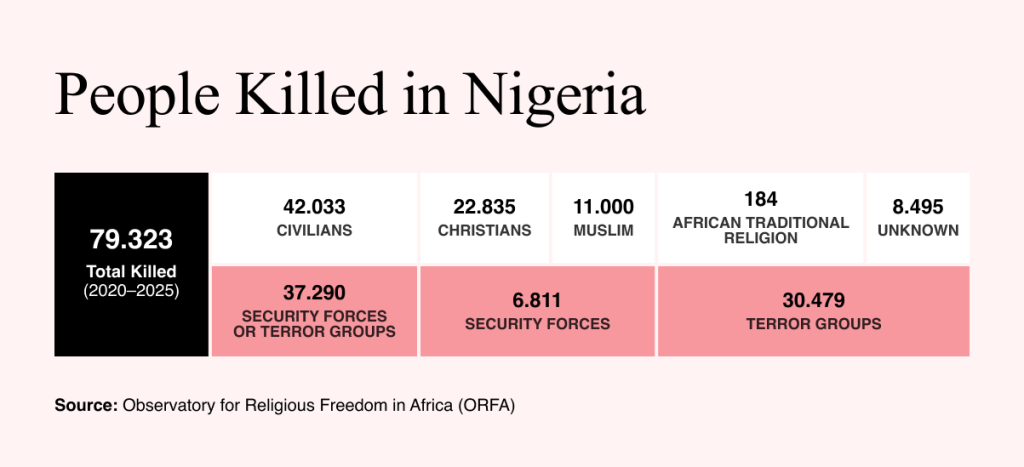
Nigeria is one of the world's most dangerous countries. Christians face widespread persecution, and Open Doors ranks the country seventh on its 2026 World Watch List, describing it as one of the deadliest places in the world for Christians. Yet Christians are not the only victims of violence. A new study by the Observatory for Religious Freedom in Africa (ORFA) provides a more nuanced picture of the country's security crisis. Between 2020 and 2025, Nigeria recorded 79,323 deaths linked to terrorist violence, an average of 36 people killed every day. Of those killed, 42,033 were civilians. The report also documents the kidnapping of 34,773 civilians.
ORFA's findings confirm that Boko Haram and Islamic State West Africa Province (ISWAP) continue to pose a serious threat and that Christians remain the most frequent victims. These findings are consistent with other international assessments of Nigeria. However, the report also argues that the international focus on Boko Haram and Islamic State provides an accurate but incomplete picture. According to ORFA, the largest share of deadly violence against civilians is carried out by armed Fulani militias targeting rural farming communities.
Conflict Between Farmers and Herders
According to ORFA, describing Nigeria simply as a Boko Haram or Islamic State problem fails to reflect reality. The same applies to portraying the crisis solely as a conflict between farmers and herders. Such an interpretation, the report argues, understates the extent of organized, religiously charged violence that increasingly resembles terrorism.
Violence in Nigeria is also driven by state failure, organized crime, disputes over land and regional power struggles. The country is experiencing a multilayered security crisis that disproportionately affects Christian communities.
The report estimates that three quarters of all civilians killed die in assaults on rural villages. Such attacks often involve kidnappings, rape, forced displacement and the destruction of homes and agricultural land.
In this respect, the ORFA report mirrors other descriptions of the violence in Nigeria's Middle Belt, particularly in Benue, Plateau and Southern Kaduna states. There, conflicts between farmers and herders overlap with land disputes, religious tensions, organized crime and Islamist radicalisation. While international attention remains heavily focused on Boko Haram and Islamic State West Africa Province (ISWAP), ORFA broadens the analysis considerably.
Jihadists and Local Militias
According to the report, Boko Haram and ISWAP together account for 12% of civilians killed, with Boko Haram responsible for eight percent and ISWAP for four percent. By contrast, militias classified as “Fulani Terror Groups” account for 44% of civilian deaths.
ORFA summarizes its central argument in the phrase “How the World Misreads Nigeria's Violence”. The report argues that the internationally recognized jihadist organisations are not the deadliest threat facing civilians. Instead, the greatest danger comes from armed Fulani militias and local terrorist networks operating in the Middle Belt and neighbouring regions.
The report also analyses victims by religious affiliation. During the study period, it records the deaths of 28,551 Christians and 13,224 Muslims. Relative to the populations living in terrorism-affected states, Christians were, according to ORFA, 4.4 times more likely to be killed than Muslims.
Open Doors likewise describes Nigeria as the global centre of deadly violence against Christians. According to its 2026 World Watch List, 3,490 of the 4,849 Christians killed worldwide because of their faith during the reporting period died in Nigeria. The London School of Economics has similarly argued that although the conflict is often explained in terms of competition over resources, violence in Nigeria's Middle Belt also has a significant religious dimension.
Christians Face Greater Risks
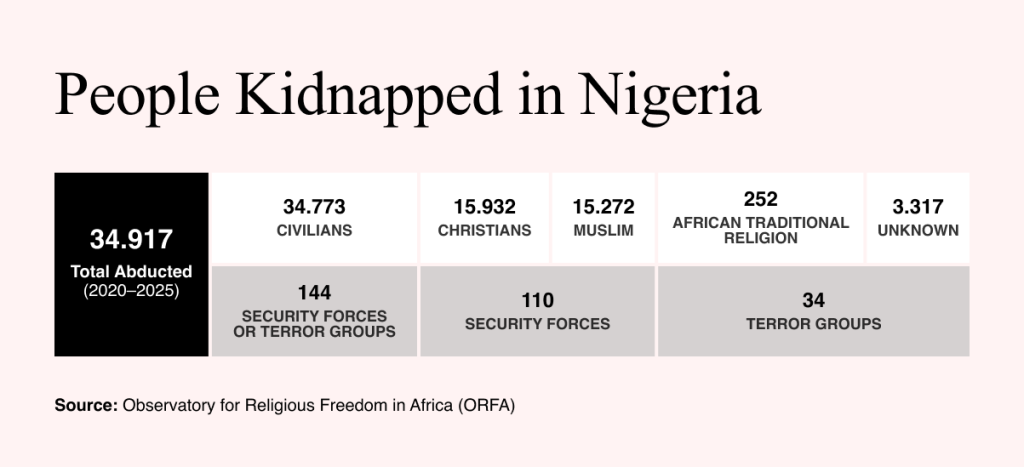
ORFA's findings on kidnappings reveal a similar pattern. According to the report, 43% of kidnappings are attributable to armed Fulani groups, while a further 49% are carried out by unidentified terrorist organisations.
The report describes this phenomenon as “Captivity by Creed”, arguing that hostages are treated differently depending on their religion. Muslims generally pay lower ransoms and are subjected to less violence.
Christians, by contrast, face higher ransom demands and are more likely to experience abuse, execution, forced conversion and, in the case of women, sexual violence and forced marriage. Open Doors similarly reports that Christian women and girls in Nigeria face extreme risks from Fulani militants, Boko Haram, ISWAP and criminal gangs.
Source: Observatory for Religious Freeedom in Africa (ORFA)
Other international observers have reached similarly broad conclusions. The US Commission on International Religious Freedom (USCIRF) also argues that Boko Haram and ISWAP do not explain the full picture. USCIRF describes “systematic, ongoing and egregious” violations of religious freedom in Nigeria and criticizes both federal and state authorities for tolerating or inadequately responding to attacks by non-state actors.
The Religious Dimension
Like ORFA, USCIRF identifies violence by armed Fulani herders alongside Boko Haram and ISWAP. All of the major reports emphasize the regional differences in Nigeria's security crisis. Boko Haram and ISWAP remain militarily significant in the country's northeast.
In the northwest and the Middle Belt, however, bandits, criminal networks, local militias and armed herders play a much larger role. The Council on Foreign Relations describes the situation as a nationwide security crisis rather than simply a religious conflict.
Nazila Ghanea, the United Nations Special Rapporteur on Freedom of Religion or Belief, visited Nigeria from 8 to 19 June 2026. She will present her full report to the UN Human Rights Council in March 2027. In a preliminary statement, she described Nigeria as a highly complex country characterized by religious, ethnic, regional and legal pluralism.
Religion, she argued, remains a fundamental organising principle of Nigerian society, making it impossible to ignore the religious dimensions of the violence. She also criticized the lack of accountability and inadequate investigation of the country's many forms of violence. Ghanea's preliminary findings broadly reinforce the central conclusions reached by ORFA.
These reports show that tackling the violence will require a more granular understanding of what is driving it.