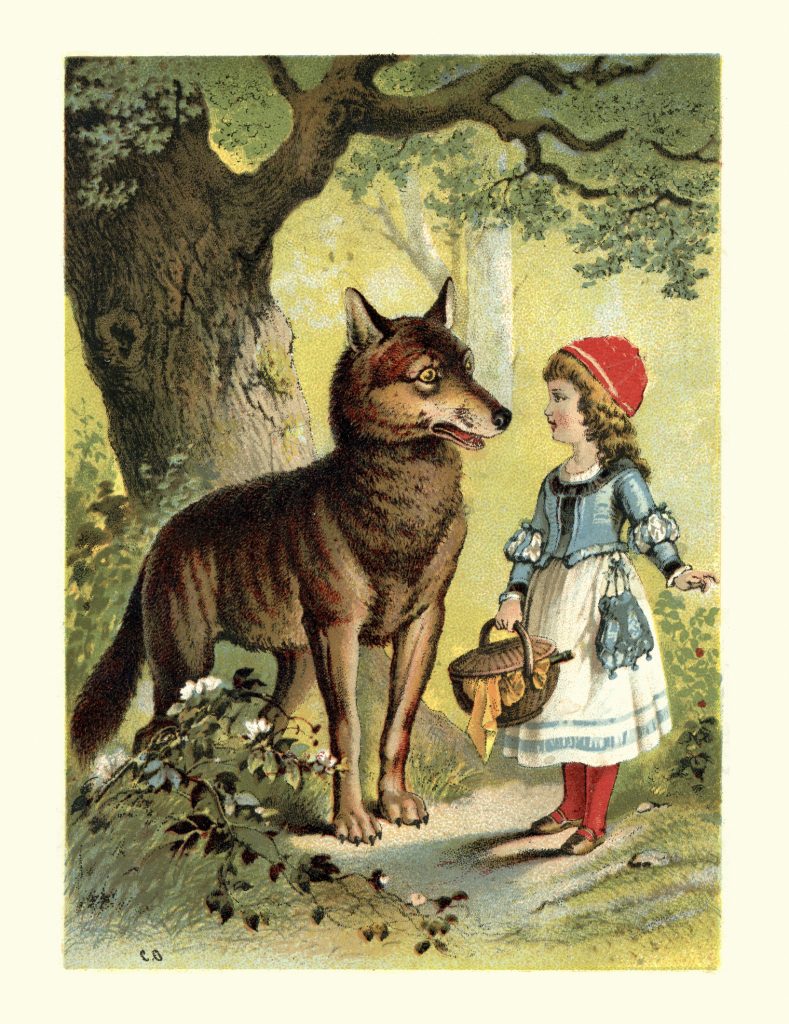
Illustration from a German retelling of "Little Red Riding Hood." Photo: Getty Images
The Wolf at the Door
The wolf is back in Germany. So is the argument over whether the country was right to welcome it. Beyond fables, fairy tales and conservationist romance, the wolf remains a dangerous predator and should be treated as one.
The wolf has been present in Germany again for more than 20 years. Its re-establishment began in 1998, when two animals were sighted in the Muskau Heath in Saxony. In 2000, the first wild wolf cubs were born on a military training ground in Upper Lusatia, also in Saxony.
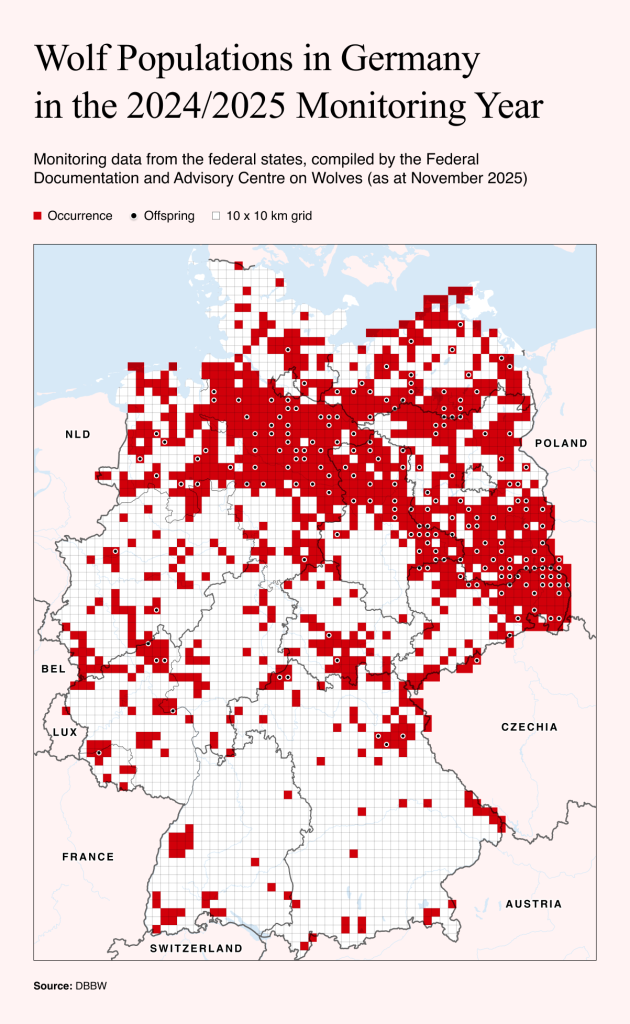
Germany now has 219 wolf packs, 43 pairs and 14 settled lone wolves. That amounts to at least 1,636 wolves across 276 territories. In the most recent survey period, the 2024/25 monitoring year, the population stagnated for the first time, after its growth had already begun to slow.
At European level, wolf monitoring is handled by the Large Carnivore Initiative for Europe. It distinguishes between 10 wolf populations in Europe, some partly isolated from one another and others genetically connected. Germany’s wolves, together with those in western and central Poland, belong to the Central European lowland population. Europe’s total wolf population, excluding the European part of Russia, stood at more than 20,300 animals in 2023. That marked a sharp increase from the 11,200 animals recorded in 2012.
Source: DBBW
The Wolf in Europe
In southern Europe, the wolf is found particularly on the Iberian peninsula, with just over 3,000 animals, and in Italy, where there are around 1,500. Some belong to distinct subspecies, such as the Iberian wolf in Spain and the Apennine wolf in Italy.
Italy’s population is increasingly struggling with wolf-dog hybridization, a specifically southern European problem linked to large numbers of stray dogs. In Germany, the law provides for the targeted removal of hybrid animals, in other words their shooting.
For self-appointed conservationists, the wolf’s reappearance was a cause for unrestrained delight. They quickly secured expanded protection for it across Europe by having the animal included as a “strictly protected” species under the European Union’s Habitats Directive. Hunting was thereby ruled out. Hunters and wildlife biologists were pleased neither by the wolf’s presence nor by the ban on hunting it.
Hunters Remain Critical
The German Hunting Association (DJV) sees a considerable need for further research into how the presence of the wolf affects forests and wildlife. The association is calling for comprehensive wildlife management.
Its aim is to examine systematically the effects of wolves on wild animal populations, the development of wildlife damage in forests and fields in areas where wolves are present and the barrier effect of wolf-proof fences on the migration patterns of other species.
The German Farmers’ Association (DBV) was also far from enthusiastic and from the outset called for an annual removal quota of 40% of wolf offspring to prevent the population from growing without limit. Without population control, DBV President Joachim Rukwied has argued, there is no future in Germany for the grazing of sheep, goats, horses and cattle.
Herd protection and compensation payments, Rukwied says, cannot solve the basic problem. When a wolf pack attacks a herd, hardly a single animal is often left alive. For small sheep breeders in particular, that can threaten their livelihood.
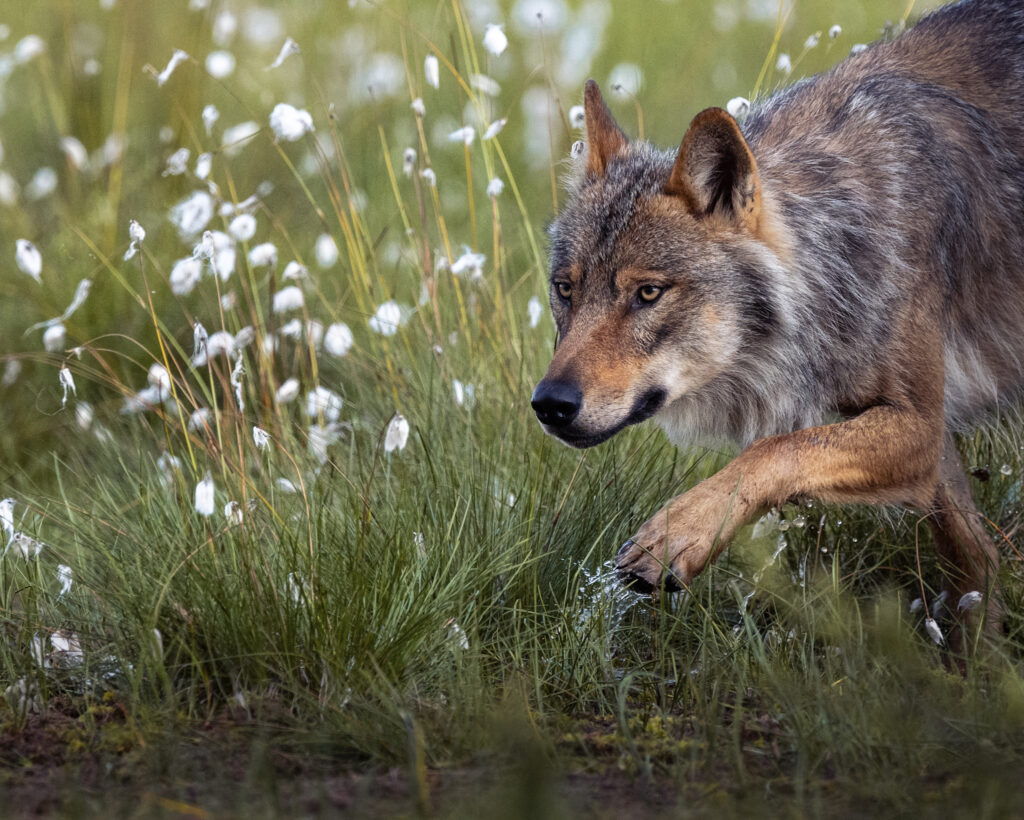
The wolf’s return to settled European landscapes has reopened an old conflict between conservation, farming and public safety. Photo: Carlos A. Carreno/c3.photos via Getty Images
Sheep Farming Under Threat
The Society for the Promotion of German Sheep Farming and the German Federation of Regional Sheep Breeding Associations can put figures on the problem. In 2024, around 1,100 attacks left about 4,300 farm animals dead or injured. That led to costs of €23.4m ($25.1m) for herd protection and around €780,000 ($837,000) in compensation.
Ingo Stoll, a board member, says passive herd protection through fences and guard dogs has reached its limits. Wolves, he argues, are increasingly losing their fear of humans and deliberately approaching villages and paddocks.
Since spring this year, Germany has had a new legal basis for wolf hunting. The Bundestag approved the inclusion of the wolf in the Federal Hunting Act after the EU had downgraded it under the Habitats Directive from “strictly protected” to “protected”. Germany’s notification to the European Commission that the wolf population had reached “favorable conservation status” in the Atlantic and continental regions cleared the way for the change.
Hunting the Wolf
That does not mean the hunt is simply on. The responsible authorities in Germany’s individual federal states must first draw up wolf-management plans. These would envisage a season from 1 July to 31 October. Problem wolves that have overcome reasonable herd-protection measures and injured or killed a grazing animal may, however, now be shot under simplified conditions. In grazing areas where animals cannot be protected, the new law also makes it easier to remove wolves that kill livestock.
Across Europe, approaches to hunting the wolf vary widely. They range from established, sometimes aggressive population control in Switzerland and Norway, through established but legally contested licensed hunting in Sweden and Finland, to countries that have so far maintained strict protection despite having the legal option to loosen it.
Poland and northern Spain fall into that last category. Austria, by contrast, has created legal mechanisms in several federal states for the removal of problem wolves. It has not, however, moved to a general system of regular wolf hunting.
The wolf can pose a danger to humans for the simple reason that it is a predator and feeds on mammals. In late March this year, a wolf made its way into an indoor shopping passage in Hamburg and injured a woman.
In principle, wolves have a natural fear of humans. That limits the danger. According to official figures, 68 people were injured by wolves in Europe and North America between 1950 and 2002, eight of them fatally. Between 2002 and 2020, there were 77 attacks on humans in Europe, including Kosovo, North Macedonia, Ukraine and Belarus. None was fatal.
In 12 cases in Europe and North America, a predatory motive could be established. That means the wolf had lost its natural fear of humans. Human food sources are cited as one cause. These may include open rubbish bins, as well as feeding by residents or tourists.
Through human misconduct, the wolf can gradually lose its natural caution. It begins to tolerate ever smaller distances from people. In the end, it may come to regard man as possible prey.
A Predator Is a Predator
Trying to domesticate a predator is dangerous enough. Romanticizing a wild animal, or treating it with misplaced familiarity, carries its own risk. More specifically, the wolf, like man, is an apex predator: an animal at the top of a food chain, not regularly hunted by any other species.
The result is real competition for the same prey. Man and wolf have hunted the same ungulates since the last Ice Age. From this rivalry arose a cultural demonization: the wolf as a cipher for the unpredictable, hungry wilderness pressing against the edge of the settlement.
Little Red Riding Hood and The Wolf and the Seven Young Goats encode that fear for children and mark the boundary between home and forest, protection and danger. As Master Isegrim in the fable tradition, the wolf ceases to terrify and becomes a comic figure. Defeated by the cunning of Reynard the Fox, force without intelligence is beaten by intelligence without rank. The fable turns animal conflict into social criticism.
Vintage engraving of Little Red Riding Hood and the Wolf, 1898. The tale turned fear of the predator at the edge of the forest into one of Europe’s most enduring childhood warnings. Photo: Getty Images
Master Isegrim
In the work of Aesop and Jean de La Fontaine, one of the great figures of the European fable tradition, the wolf becomes an instrument of social observation. The Wolf and the Lamb does not show the animal itself, but the mechanism of power, which always finds its justification only after the fact. Here, the wolf stands as a mirror of human behavior.
In the modern encounter between man and wolf, these patterns are naturally projected back onto the animal. That happens above all when urban man, distant in space and time, interprets the real predator. And indeed, among a flock of lambs, the wolf is absolute power.
Literary images and real developments once went hand in hand. The wolf was systematically eradicated in Germany by 1850. In Central Europe, only a tiny remnant population survived. For 150 years, the wolf existed only as a story. The animal itself had vanished.
The Wolf and the Bureaucracy
Since the turn of the millennium, the wolf has been returning to the human world. That makes the old question urgent again: how close can man and wolf be allowed to come? NABU-style nature romanticism now stands side by side with the bureaucratic monster of the Habitats Directive. Together, they run up against the realities of agriculture, forestry and threatened herds on pastureland.
Bureaucrats far removed from practical life are only too happy to wish away the rivalry between apex predators. Everything is nature. On the pasture, at the latest, that idea is reduced to absurdity by the sight of bleeding and dying sheep and cattle. This, too, is nature.
There was a reason Germany fought the wolf to the point of eradication. It was the last non-human predator in the wild capable of posing an existential threat to agriculture.
Germany’s forests, it should be remembered, are no longer natural landscapes. Forestry, hunting and game management regulate life in the woods. They are also places of recreation, dominated at least on weekends by the urban species homo sapiens ambulans.
The wolf disturbs the harmony between Germans and their forest. If it spreads unchecked, it will drive man out of the woods as worker, walker and hunter. It will make grazing impossible and become a general safety risk for human settlements too.
Any measured attempt to protect the wolf is therefore also an anthropological question. Man’s habitat deserves at least as much protection as the animal’s. Sensible animal protection means granting the wolf its reserves and keeping humans out of them. The forest claimed by man, then, must be held and defended against the wolf.
On this question, the expertise of hunters and foresters deserves more trust than the fantasies of bureaucrats and conservation NGOs.
Here is placeholder for Article excerpt Here is placeholder for Article excerpt Here is placeholder for Article excerpt Here is placeholder for Article excerpt
Here is placeholder for Article excerpt Here is placeholder for Article excerpt Here is placeholder for Article excerpt Here is placeholder for Article excerpt
Here is placeholder for Article excerpt Here is placeholder for Article excerpt Here is placeholder for Article excerpt Here is placeholder for Article excerpt
Welcome to the comments section of the Štandard daily. Please take note of our guidelines, comments are moderated by us. You can contact the moderators at [email protected].
Participate in the discussion
Comments are available to subscribers only. If you'd like to join the discussion, choose a subscription starting at €6.72 per month.
All comments 0
Register
Comments are available to registered users only. If you'd like to join the discussion, register here.