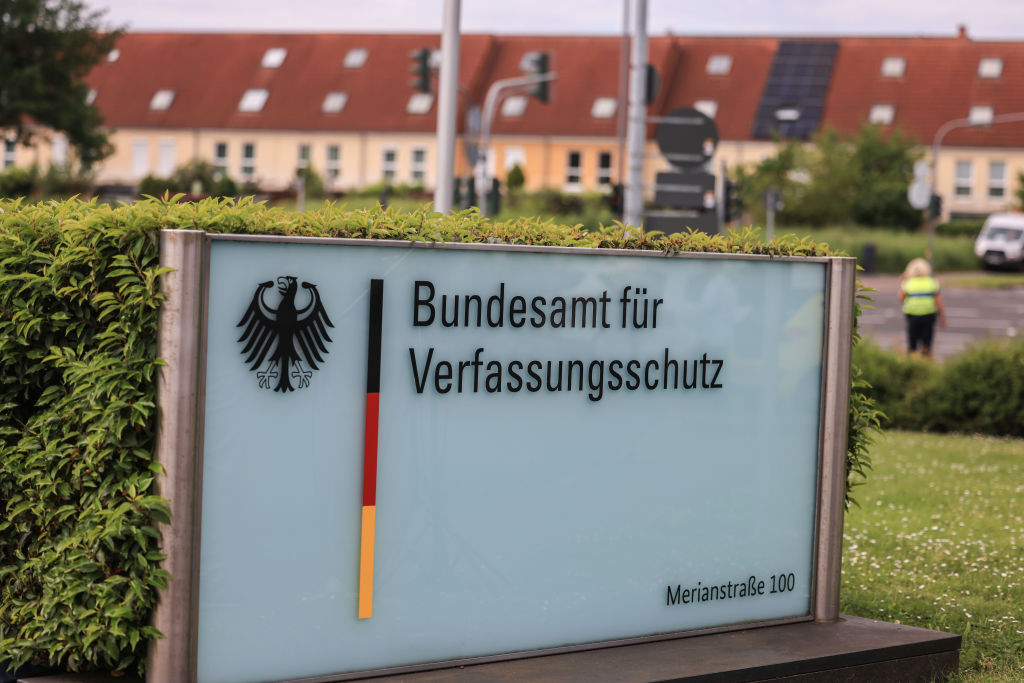
Alexander Dobrindt wants to turn Germany’s domestic intelligence agency from an intelligence-gathering body into an operational force. His draft would permit covert intrusions into homes, computers and communications while weakening the safeguards meant to restrain such powers.
The German Federal Minister of the Interior, Alexander Dobrindt, has presented a catalogue of horrors for the establishment of a German secret police force. Photo: Christian Mang/Getty Images
|
A list of horrors: covert entry into private homes and computers, state interference with technical devices and data, expanded AI-based surveillance and manipulation of communications and, in exceptional cases, the recruitment of minors as informants. These are not measures out of China, Russia or North Korea. They originate in the German Federal Ministry of the Interior. Alexander Dobrindt, the Federal Minister of the Interior, plans to fundamentally restructure the Federal Office for the Protection of the Constitution (BfV). The agency’s tasks and structure are governed by the Federal Act on the Protection of the Constitution (BVerfSchG), which is now set for a comprehensive overhaul.
The minister has presented a 700-page draft bill to that end. At the heart of the amendment is a plan to grant the BfV substantial police powers. Until now, the agency has been essentially an observing and analyzing intelligence service, lacking authority for active hazard prevention and standing outside the law enforcement system. Its statutory mandate is confined to so-called preliminary-stage intelligence gathering, which already permits deep intrusion into fundamental rights.
The BVerfSchG currently draws an important line in Section 8(3): "The Federal Office for the Protection of the Constitution shall have no police powers or powers of instruction." Under the present system, the BfV forwards its findings to the police, public prosecutor's office or other responsible authorities whenever it identifies a concrete danger or a criminal offense, and leaves the decision on operational measures to them. That would no longer hold true under Dobrindt's plans. Instead of confining itself to collecting and analyzing information, the BfV would, under certain conditions, be permitted to intervene covertly in its own right.
Dobrindt is not simply expanding the technical toolkit available to the BfV. He is proposing to change its character altogether, turning it into an agency that observes, assesses and intervenes covertly all at once. This strikes at the heart of a separation of powers designed, not least because of the experiences of the Nazi dictatorship, to keep secret knowledge and the power to intervene from being concentrated in a single agency.
A Sweeping Arsenal of New Powers
The list of proposed changes is extensive. Threats would no longer be merely observed but actively countered. Among the new powers are so-called hackbacks: intrusions into IT systems that could impair technical devices, manipulate data or disrupt communications, potentially affecting servers, mobile phones or computers.
The BfV would also gain the ability to redirect or block data traffic and the transmission of information, including technical signals and program files, and to alter the content being transmitted. In effect, the agency would be permitted to interfere directly with data streams and digital communications within the thresholds and authorization procedures set out in the draft.
A provision still shown in square brackets in the draft would allow BfV staff to covertly enter private homes and install listening devices or other surveillance equipment. Such entry would normally be subject to prior review by the Independent Control Council, while technical surveillance inside a home would require a legality determination by the Federal Administrative Court. In urgent cases, provisional execution would be possible subject to subsequent review. Surveillance and its AI-assisted analysis would expand accordingly, allowing biometric features to be matched against existing databases in real time. Camera operators in public spaces could be required to hand over footage or provide live access.
Critics warn that the proposed overhaul would give the BfV sweeping powers with inadequate oversight. Photo: Oliver Berg/picture alliance via Getty Images
Cameras at train stations, airports, shopping centers and other public locations could be used by the BfV to search for specific individuals, with publicly available images from the internet folded into the analysis. Telecommunications companies would be required to provide specified data and cooperate with interception measures in the cases covered by the draft. These powers would substantially expand the BfV’s capacity to monitor communications, although the most intrusive measures would remain subject to statutory thresholds and independent review.
More Sharing, Less Oversight
Under the proposed changes, data would flow more freely between the BfV, the police and other security agencies. They would also be able to analyze the data jointly using automated systems. Critics regard this as an erosion of the long-standing principle separating police work from intelligence gathering. That separation is enshrined in the same section of the BVerfSchG, which bars the BfV from even asking the police, by way of administrative assistance, to carry out measures it is not itself authorized to perform. German intelligence agencies have long been subject to strict transparency requirements, including extensive parliamentary oversight and far-reaching disclosure obligations. The draft would erode much of that framework.
Among the casualties would be the G-10 Commission, an independent Bundestag oversight body that reviews and approves intelligence-service intrusions into the privacy of correspondence, post and telecommunications. Its functions would pass to the Independent Control Council, which has until now mainly overseen the Federal Intelligence Service (BND), Germany's foreign intelligence agency. The federal commissioner for data protection would likewise see reduced oversight powers over the BfV.
The German Bar Association has sharply criticized the plans, pointing out that oversight is being dismantled at the very moment powers are being expanded, a coincidence it has called troubling.
Never Knowing You Were Watched
Once a covert measure has ended, those affected could in some cases be notified only after a delay or not at all, although certain decisions would require approval from the Independent Control Council. As a result, people might never learn that their homes had been entered, their computers manipulated or their communications monitored, making legal action more difficult.
The draft retains a general ban on recruiting minors as confidential informants but allows an exception for those aged 16 or older if they are deemed indispensable to the investigation of a particularly serious threat. If retained, the provision could permit the authorities to use teenagers against members of their own families.
Taken together, Alexander Dobrindt’s plans amount to transforming the BfV into a secret police and cyber-defense agency, one that would operate outside the classical procedural framework that traditionally governs police work. The shift is twofold: the BfV would gain police-like powers of intervention while remaining subject to intelligence-specific authorization and oversight rather than ordinary police procedures.
A Backlash from All Sides
Criticism followed swiftly, much of it drawing comparisons between the proposed powers and the domestic intelligence services of totalitarian states. Former BfV president Hans-Georg Maaßen has been especially vocal in objecting to the prospect of covertly entering homes to install microphones, cameras or other technical devices. Media outlets and press associations warn that journalists would be left inadequately protected, while internet activists point to the raft of opaque interventions the law would authorize.
Additional intelligence methods not specified in the statute could also be tested for up to four years under a classified internal service directive, provided it is approved by the Interior Ministry and the Independent Control Council and Parliament’s oversight panel is informed. Real-time biometric search capability also risks laying the groundwork for broad tracking of individuals.
Altering or planting information, critics argue, risks corrupting evidence and distorting the context of communications in ways that may be impossible to control. The obligation on private providers to cooperate would effectively turn telecommunications and digital companies into auxiliary arms of the intelligence service.
Taken together, the plans would create a powerful secret police force with sweeping, ill-defined powers and little democratic oversight. Even the legislative process has drawn criticism, since a consultation period of roughly 10 days for a 700-page draft leaves little room for meaningful input from professional bodies or civil society groups.
Placeholder For Topreaded Placeholder For Topreaded
Placeholder
Placeholder
Placeholder For Topreaded Placeholder For Topreaded
Placeholder
Placeholder
Placeholder For Topreaded Placeholder For Topreaded
Placeholder
Placeholder
Placeholder For Topreaded Placeholder For Topreaded
Placeholder
Placeholder
Placeholder For Topreaded Placeholder For Topreaded
Here is placeholder for Article excerpt Here is placeholder for Article excerpt Here is placeholder for Article excerpt Here is placeholder for Article excerpt
Here is placeholder for Article excerpt Here is placeholder for Article excerpt Here is placeholder for Article excerpt Here is placeholder for Article excerpt
Here is placeholder for Article excerpt Here is placeholder for Article excerpt Here is placeholder for Article excerpt Here is placeholder for Article excerpt
Welcome to the comments section of the Štandard daily. Please take note of our guidelines, comments are moderated by us. You can contact the moderators at [email protected].
Participate in the discussion
Comments are available to subscribers only. If you'd like to join the discussion, choose a subscription starting at €6.72 per month.
All comments 0
Register
Comments are available to registered users only. If you'd like to join the discussion, register here.