Record growth has put Palantir back in the spotlight, but politics, competition and an extraordinary valuation cloud its future.
From its very inception, Palantir has stirred strong emotions and maintained a certain air of mystery around its activities. The company’s very name, derived from Tolkien, embodied this: a magical object from Middle-earth that allowed its user to see or communicate across great distances.
It was known from the start that Palantir worked with US intelligence agencies. Its reliance on the duo of Peter Thiel and Alex Karp also made clear that this was a carefully crafted model for influencing not only American politics, but society as a whole and global events. Thiel helped propel JD Vance’s political rise, while Karp has long supported the Democratic Party. No new US president could escape the company’s influence. It was not just technological prowess, but this systematic approach that gave the entire project its weight.
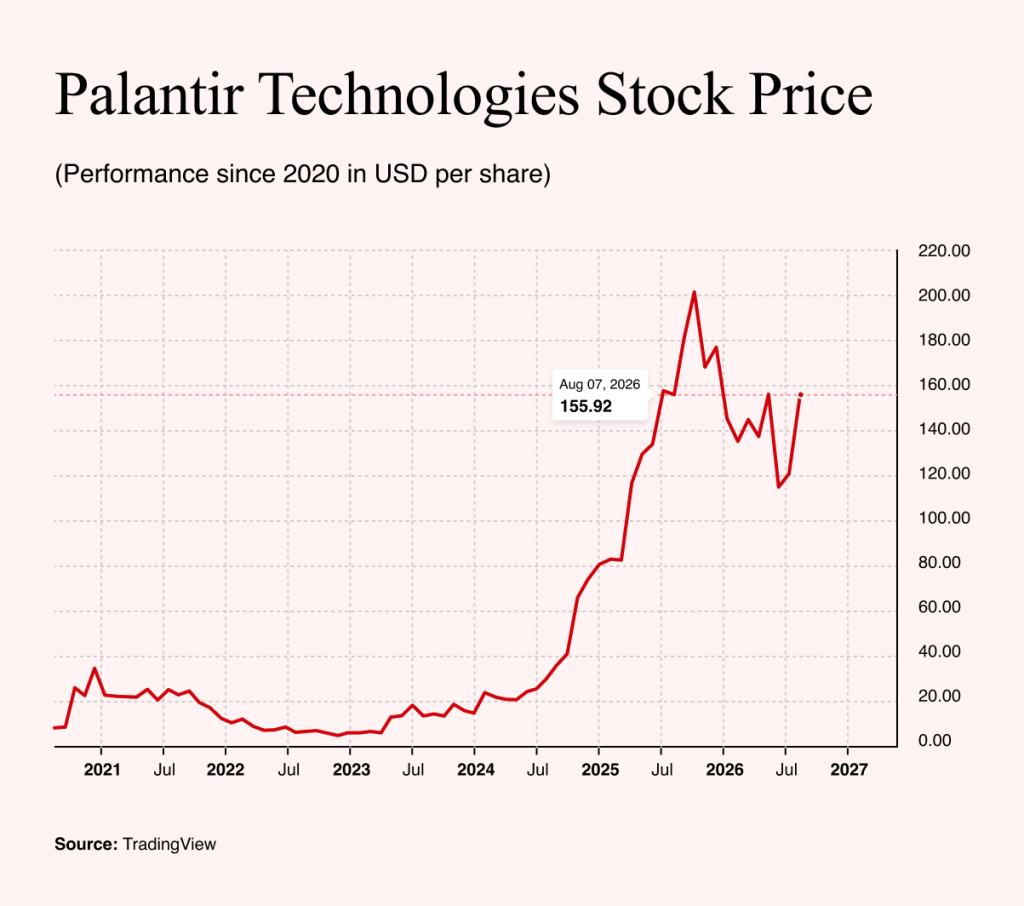
In September 2020, the company went public on the New York Stock Exchange. After the initial excitement, as is typical with any initial public offering (IPO), the shares gained approximately 200%. From 2021 through 2023, however, a downturn set in as the company became the subject of speculation, primarily because no one knew what it actually did and it offered its services mainly to intelligence agencies.
From a traditional investor’s perspective, this was not an entirely trustworthy business model, as it relied on government contracts. Palantir therefore sought to convince investors that its services could also be applied in the private sector to analyze complex corporate problems.
With the advent of generative AI, the market’s understanding of Palantir changed. The allure of intelligence work faded. Suddenly, Palantir looked more like a conventional provider of data processing for AI. Its shares skyrocketed from $20 to an all-time high of $198, a gain of nearly 900%. No wonder Palantir won over investors and gained enormous popularity after turning many of them into millionaires.
It seemed that the story was not going to end anytime soon. The shares were severely overvalued and ranked among the most expensive on the market.
Source: TradingView
The turning point came in 2026. Palantir fell as low as $106 in June, representing an annual decline of more than 40%. No one doubted that the shares were undergoing a correction. Even at that price, a price-to-earnings ratio of around 100 left the valuation exceptionally high. The bottom was nowhere in sight.
The decline in Palantir’s popularity among investors had several deeper causes beyond its expensive fundamentals. The first was the company’s significant involvement with the White House. Palantir’s services were used in Venezuela, Iran and the Gaza Strip, as well as in the deportation of migrants. It was not merely that the company supplied the technology, but that it also strongly defended these policies. Neither Palantir’s management nor its employees can plausibly claim that providing technology for such purposes is politically neutral.
The company’s objectivity was supposed to rest on a balance between Thiel and Karp. But Karp underwent a political about-face. As recently as 2024, he said he would vote against Trump. Since then, Karp has declared Palantir to be “anti-woke” and, above all, has taken pride in the fact that its technology is used to kill America’s enemies.
Of course, the question remains: who defines and determines who is an enemy of the United States? That shift has had consequences. The company must now contend with the departure of engineers who do not share these values. In the long run, staff can certainly be replaced. Yet internal tensions are not the only concern for investors.
The second challenge is far more serious, as it threatens the very essence of the company. Michael Burry articulated the objection well when he noted that Anthropic would soon be eating Palantir's lunch. The objection is almost childishly simple, but it goes to the heart of Palantir’s business model: what, exactly, will Palantir know that the language models themselves do not?
Karp responded by saying that there will always be a layer between the data and the language model. He is right about that, but it misses the point. This layer will exist, yet companies are already developing alternatives that will compete directly with Palantir at very low prices. Language model developers could also acquire a company offering such a solution and integrate it themselves. Karp's answer was therefore not particularly convincing.
And so he pressed the point further, warning of the risk that enormous power could become concentrated in the hands of the companies managing AI models. Here, too, he is right: the risk is real and will only grow as these companies become more powerful. But it is a double-edged sword. How much oversight does Palantir itself have over the data it handles?
Is this not like the thief shouting, “Catch the thief”? AI sovereignty is important, but will Palantir really ensure it? If so, we would not be seeing both the German and French intelligence agencies walk away from the company. The latter recently opted for the domestic French company ChapsVision precisely because of concerns over data control and sensitivity.
Palantir nevertheless managed to fend off these attacks on the very core of its business with impressive second-quarter 2026 results. The company raised its full-year revenue outlook to approximately $8.15bn after reporting staggering growth for the quarter.
Palantir’s revenue rose 93% year on year to $1.94bn, as both its government and commercial businesses accelerated in the United States. Profit increased 55% to $1.06bn. The company therefore continues to expand at a remarkable pace while maintaining massive margins.
The shares jumped by tens of percent on the news. Even this significant gain, though, was not enough to put them in positive territory for the year. Palantir remains down about 7%.
The rally undoubtedly pleased shareholders, but it has once again put Palantir in a bind by pushing its valuation to extremely high levels. That is a major risk.
It is not that the company is unable to deliver strong financial results or solid fundamentals. The greater concern stems from questions about the long-term sustainability of its business model. Given that the current valuation already assumes an almost flawless future trajectory, this is a significantly bigger problem than Palantir’s present financial performance.
Placeholder For Topreaded Placeholder For Topreaded
Placeholder
Placeholder
Placeholder For Topreaded Placeholder For Topreaded
Placeholder
Placeholder
Placeholder For Topreaded Placeholder For Topreaded
Placeholder
Placeholder
Placeholder For Topreaded Placeholder For Topreaded
Placeholder
Placeholder
Placeholder For Topreaded Placeholder For Topreaded
Here is placeholder for Article excerpt Here is placeholder for Article excerpt Here is placeholder for Article excerpt Here is placeholder for Article excerpt
Here is placeholder for Article excerpt Here is placeholder for Article excerpt Here is placeholder for Article excerpt Here is placeholder for Article excerpt
Here is placeholder for Article excerpt Here is placeholder for Article excerpt Here is placeholder for Article excerpt Here is placeholder for Article excerpt
Welcome to the comments section of the Štandard daily. Please take note of our guidelines, comments are moderated by us. You can contact the moderators at [email protected].
Participate in the discussion
Comments are available to subscribers only. If you'd like to join the discussion, choose a subscription starting at €6.72 per month.
All comments 0
Register
Comments are available to registered users only. If you'd like to join the discussion, register here.