Africa's Richest Man Bets on China as America Looks Inward
Aliko Dangote says China offers businesses what America increasingly does not, underscoring Beijing’s growing influence across Africa.
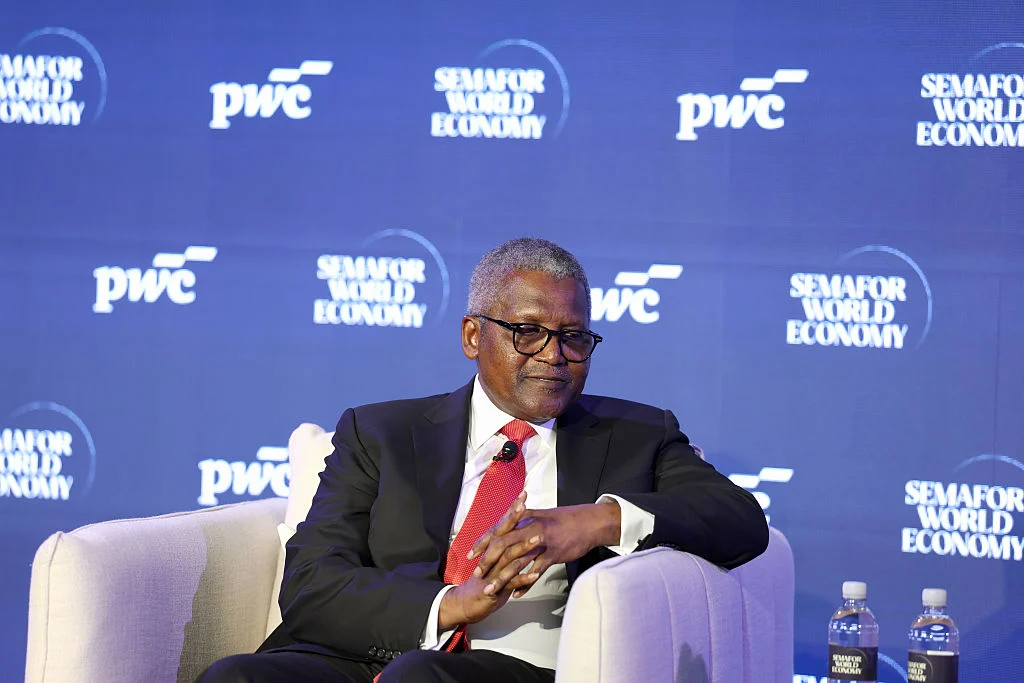
Nigerian industrialist Aliko Dangote has spent almost 40 years building a business empire on the African continent. Photo: Tasos Katopodis/Getty Images for Semafor World Economy
|
While speaking at a business conference, Aliko Dangote, Africa’s wealthiest person, was asked about China’s presence on the continent and whether America should be concerned. His response, which caused a stir as video of it spread across social media, demonstrated just how successfully the Asian nation has deepened economic ties with Africa.
Though he did not say it outright, for Dangote, listed by Forbes as one of the 100 richest people in the world, China is a more attractive business partner than the US, offering better financial incentives and high-quality goods, quickly and at scale.
The global superpower has made investment in Africa a policy priority, strengthening ties through loans and development financing.
As the US turns more inward, China is seizing the moment to further cement its position, implementing an expanded zero-tariff policy in May this year, while offering artificial intelligence models at a much more affordable rate than American competitors.
But while businesses and governments deepen ties with China, America’s wealth and freedom are still what inspire many of Africa’s citizens, as indicated by emigration patterns.
Given the communist nation’s interest in asserting its authority as a global power, it remains to be seen whether desires for greater wealth and freedom and deeper ties with China can coexist.
Africa’s Richest Man
If the comments had come from anyone other than Aliko Dangote, it is unlikely they would have garnered much attention.
But the business achievements and insight of the Nigerian entrepreneur make him hard to ignore. With a net worth of around $26bn (€22.3bn), he ranks 86th on Forbes’ list of wealthiest people at the time of writing.
That puts him just ahead of Palantir founder Peter Thiel and just behind Jeff Bezos' ex-wife, MacKenzie Scott.
Dangote has spent almost 40 years building his fortune, largely through ambitious projects to build the infrastructure needed to turn Africa’s wealth of raw materials into manufactured products.
In 2013, he announced plans for an oil refinery to tackle Nigeria’s fuel crisis, which began production in January 2024. His fortune shot up from $13bn (€11.2bn) to $24bn (€20.6bn) between 2024 and 2025, as investments in the refinery and a fertilizer plant paid off.
At almost 70 years old, Dangote shows no signs of slowing down. With plans in the pipeline for another refinery, this time in Kenya, at a cost of up to $17bn (€14.6bn), he continues to be a major player, shaping the business, economic and political landscape of the African continent.
Overall, he plans to invest a massive $45bn (€38.6bn) between 2026 and 2030, as his business group expands across sectors.
It should be clear that Dangote is not necessarily a natural ally of the Marxist-inspired Chinese Communist Party, but as his comments at the Semafor World Economy Summit highlight, he finds himself increasingly doing business with China.
As Dangote describes it, turning to China has as much to do with a lack of attention and interest from America as it does with the Asian nation itself.
The relationship between China and Africa arises out of a situation where “everybody sort of abandon you and somebody is coming to you to say, 'OK, fine, let us partner’”, Dangote said.
What China offers, in his eyes, is long-term financing that spreads the burden for businesses, and quality products produced more quickly and at a larger scale than the US and other Western nations.
People are really “underrating” China, Dangote warned.
Dangote's comments at the Semafor World Economy Summit about doing business with China caused a stir.
China’s Africa Investment
It is not the first time the Nigerian businessman has reflected on China’s dominance in African business.
In May this year, when asked which global power – Europe, the US or China – is doing most to help businesses in Africa, Dangote stated bluntly: “It’s China.”
The financial flexibility offered by its state-backed firms makes China more attractive to businesses, he said, while its Belt and Road Initiative has seen Chinese lenders and contractors pour billions of dollars into large-scale industrial projects. Meanwhile, Europe and America have become more cautious about investing in developing economies.
As America under President Donald Trump engages in tariff wars and deprioritizes diplomatic ties with African nations, its major competitor is ramping up its bid to deepen economic ties with the continent.
For instance, in December 2024, it offered 33 of Africa’s least-developed countries zero-tariff access to Chinese markets. In May 2026, it expanded its zero-tariff rule to a further 20 African countries.
For the continent’s burgeoning middle-income economies, such as Kenya, South Africa and Nigeria, it is a gift that offers them a chance to increase exports, international economist Lauren Johnston told Deutsche Welle.
China has now been Africa’s biggest trading partner for 16 consecutive years, with bilateral trade reaching a record $348bn (€298.9bn) in goods in 2025, according to China’s General Administration of Customs.
Africa bought roughly $225bn (€193.2bn) worth of products from China in 2025, including solar panels and electric vehicles, while African companies are also increasingly adopting Chinese AI. Meanwhile, the Asian nation gains access to Africa’s abundant raw materials.
Innocent Aid or a Debt Trap?
However, China’s investment in the continent does not come without strings attached, many critics say, and it has been accused of using aid and trade as “debt-trap diplomacy”.
The Belt and Road Initiative in particular is treated with suspicion in the US and its major allies, viewed as a predatory, opaque enterprise and as a threat to Western interests. In 2019, US Secretary of State Mike Pompeo accused China of using debt-trap diplomacy, calling it a neocolonial approach that should not be tolerated, and the issue continues to be debated.
Critics point to the example of Hambantota port in Sri Lanka. After the Sri Lankan government was unable to service Chinese loans on the development, the port was leased to a Chinese state-owned company for 99 years in 2017 for $1.1bn (€940m).
Critics argue the arrangement came as a result of Sri Lanka’s inability to service its Chinese loans, but this account is disputed, with other analysis suggesting the payment was used by Sri Lanka to meet other debt obligations.
With little in the way of funds from the Chinese private sector, the Chinese state is the underwriter of the initiative. However, the Chinese government has never published detailed information about the size and terms of Belt and Road loans, which London-based think tank Chatham House argues is fueling “confusion and mistrust”.
The African Dream
While China is increasingly the partner of choice for African businesspeople, the fact is that America and the West more generally remain the cultural reference point for much of Africa. As immigration statistics show, Europe and America are still the destinations of choice for a majority of Africans seeking a better quality of life, while surveys of preferred destinations favor the West.
American cultural influence is also deeply felt across the continent. Nollywood – Nigeria’s film industry, whose name echoes Hollywood – is one example, as is the interplay between jazz and traditional African music.
Equally, Dangote’s comments indicate that he does not desire dependence on China, and he has welcomed signs earlier this year that America may be taking a renewed interest in Africa’s economy.
However, the African billionaire’s statement should serve as a warning to America that if it remains too focused on internal matters, it risks ceding its place as the leader of the free world – with China more than willing to step into the breach.
Placeholder For Topreaded Placeholder For Topreaded
Placeholder
Placeholder
Placeholder For Topreaded Placeholder For Topreaded
Placeholder
Placeholder
Placeholder For Topreaded Placeholder For Topreaded
Placeholder
Placeholder
Placeholder For Topreaded Placeholder For Topreaded
Placeholder
Placeholder
Placeholder For Topreaded Placeholder For Topreaded
Here is placeholder for Article excerpt Here is placeholder for Article excerpt Here is placeholder for Article excerpt Here is placeholder for Article excerpt
Here is placeholder for Article excerpt Here is placeholder for Article excerpt Here is placeholder for Article excerpt Here is placeholder for Article excerpt
Here is placeholder for Article excerpt Here is placeholder for Article excerpt Here is placeholder for Article excerpt Here is placeholder for Article excerpt
Welcome to the comments section of the Štandard daily. Please take note of our guidelines, comments are moderated by us. You can contact the moderators at [email protected].
Participate in the discussion
Comments are available to subscribers only. If you'd like to join the discussion, choose a subscription starting at €6.72 per month.
All comments 0
Register
Comments are available to registered users only. If you'd like to join the discussion, register here.