Birmingham's Flag War Is Britain's Culture War Distilled
When one sees a British flag flying in Britain, does one see a symbol of patriotism or of hate and shame? No question distills the country’s culture war better than that one, it seems.
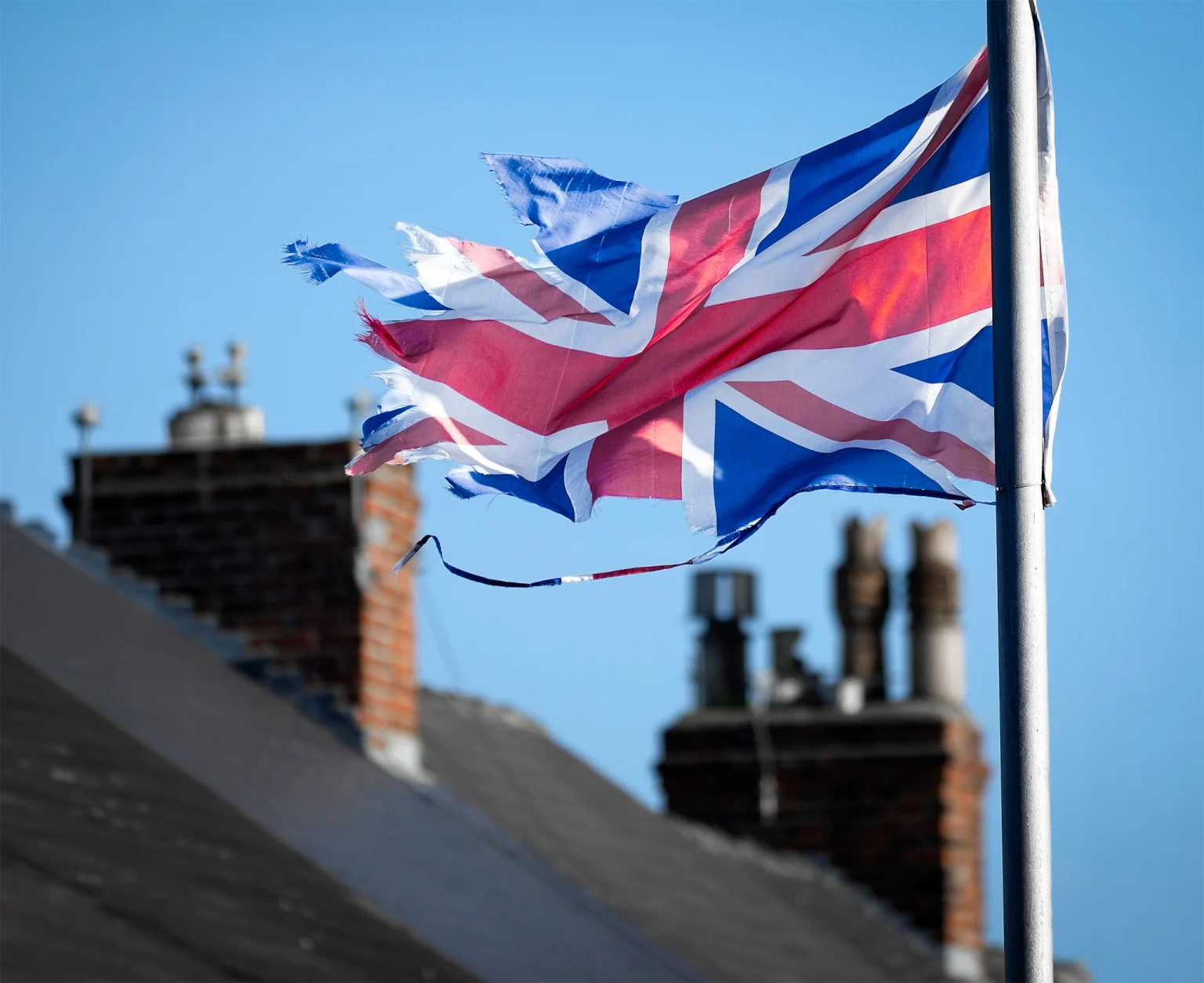
A fight over Britain's flag has broken out in Birmingham – the latest front in the country's ever more bitter culture war. Photo: Christopher Furlong/Getty Images
|
In the UK’s second city, Birmingham, the local council is set to spend taxpayer money doing something that, at first blush, may seem incredible: it is employing council workers to travel the streets of the city removing the national flags of England and the United Kingdom.
The council – which is run by an alliance of left-wing parties – says that the reason for the de-flagging campaign is entirely benign and connected to public safety, because flags erected without authorization on lamp-posts risk obscuring road signs and other supposedly essential amenities. Yet a great many Britons see something more sinister. As one asked on social media: where is the campaign to take down Palestinian flags?
The recent preponderance of the two flags at issue – the St George’s flag of England and the Union Flag of the United Kingdom – can be directly linked to a right-wing campaign initiated last year called Operation Raise the Colours.
Raise the Colours – But for Patriotism or Something More Sinister?
That campaign, which has urged Britons to fly the flags in public spaces, says that the aim of its actions is to promote and renew a sense of patriotism and British national pride. Opponents, by contrast, note that there is an overlap between supporters of the campaign and those staunchly opposed to immigration. They assert that the true purpose of flying the British flags is to “mark territory” and make immigrants feel unwelcome. The flags, they say, are being flown to denote so-called “whites-only” areas and promote a racialized version of English nationalism.
So who is right?
On the face of it, both sides have points. From the perspective of the council, it is not in dispute that the flags in question have been erected illegally and without the correct permissions. Most laws in most countries governing the use of the national flag place restrictions on when and how it can be flown, and the UK is no different in that respect.
However, right-wing campaigners horrified by the council are entirely correct to point out that for years – before even the start of the current conflict on 7 October 2023 – leftist elements have flown Palestinian flags openly in British cities and towns to similarly “mark territory”, without much, if any, political reaction.
The Legacy of Thornberry's Tweet
There is a further culture-war element to the dispute, which is that some years ago the St George’s flag became a political touchstone when the Labour MP Emily Thornberry sent a tweet from the northern town of Rochester which her opponents took as a form of class snobbery, showing an English terraced house flying the flag and with a white van – commonly understood to denote a working-class income – parked outside.
Thornberry’s tweet was a seminal moment in the Labour Party’s perceived loss of the British working classes, who over the next few years defected first to the cause of Brexit, and then Boris Johnson, and now finally Nigel Farage and Reform. That mass defection of working-class voters has been linked by multiple political scientists and observers to a perceived hostility by the left to patriotism and national sentiment and a related snobbery about the white British working classes.
A Culture War Battle over Symbols
The current problem, therefore, is as much political as it is legal. Notably, in parts of the UK where local councils are run by Conservatives or by Farage’s Reform councillors, the apparent public safety issues around flying the flag are not a concern for the council.
Yet for the right, culture-war instincts are also apparently hard to suppress. In July, Staffordshire Council, controlled by Reform, began a process to forbid councilors from wearing all political symbols – except, of course, for the national flags or other patriotic clothing. While the left-wingers in Birmingham take down national flags, right-wingers in Staffordshire propose to ban wearing Palestinian scarves at council meetings.
In the end, the great Birmingham flag war is not going to meaningfully alter the lives of any citizen. But it is, perhaps, a keen insight into the political fault line dividing Britain and indeed a great many other Western countries. Some look at their own national flag and feel pride and desire to see it everywhere as a reminder of what their countries perhaps once were. Others look at it and feel shame at precisely the same thing: what their countries once were.
In the End, a Proxy Fight
The left, it appears, much prefers the modern de-imperialized Britain, where Englishness is just one identity among many and the diversity of the country is emphasized by a sort of quasi-Palestinian identity. The right wishes to remind everybody that the first word in the country’s name is “Great”.
From this rather petty dispute, almost every other political issue follows: predicting a person’s view on whether the flags should be taken down or left up almost certainly provides a meaningful insight into their views on immigration, welfare spending, Israel and Palestine, transgender rights, free speech and whether Jason Arday was a martyr or a fraud.
In that sense, the Birmingham flag wars are the British culture wars distilled. It is just one battle in an intractable conflict that will not soon be resolved.
Placeholder For Topreaded Placeholder For Topreaded
Placeholder
Placeholder
Placeholder For Topreaded Placeholder For Topreaded
Placeholder
Placeholder
Placeholder For Topreaded Placeholder For Topreaded
Placeholder
Placeholder
Placeholder For Topreaded Placeholder For Topreaded
Placeholder
Placeholder
Placeholder For Topreaded Placeholder For Topreaded
Here is placeholder for Article excerpt Here is placeholder for Article excerpt Here is placeholder for Article excerpt Here is placeholder for Article excerpt
Here is placeholder for Article excerpt Here is placeholder for Article excerpt Here is placeholder for Article excerpt Here is placeholder for Article excerpt
Here is placeholder for Article excerpt Here is placeholder for Article excerpt Here is placeholder for Article excerpt Here is placeholder for Article excerpt
Welcome to the comments section of the Štandard daily. Please take note of our guidelines, comments are moderated by us. You can contact the moderators at [email protected].
Participate in the discussion
Comments are available to subscribers only. If you'd like to join the discussion, choose a subscription starting at €6.72 per month.
All comments 0
Register
Comments are available to registered users only. If you'd like to join the discussion, register here.