
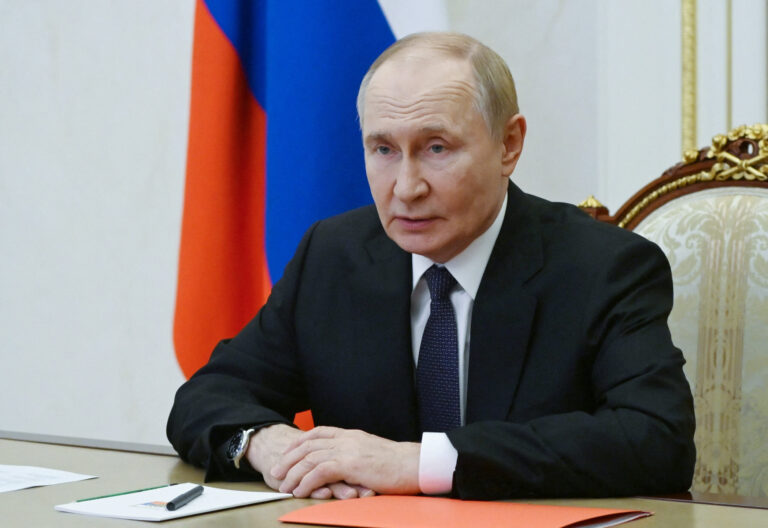
Peace negotiations between Russia and Ukraine have once again reached an impasse. Kremlin spokesman Dmitry Peskov said on Friday that it would be “more accurate to speak of a pause.”
He addressed his remarks to journalists in Moscow, pointing out that no immediate results should be expected. “You can't look through rose-colored glasses and expect the negotiations to yield immediate results,” Peskov said.
He added that while negotiators had the ability to communicate through unspecified channels, this served more to maintain contact than to actually advance the peace process.
Moscow accuses Europe
The statement comes at a time when the war in Ukraine has been going on for more than three and a half years and shows no signs of abating either on the front lines or in diplomatic efforts.
At the same time, Moscow accuses European countries of preventing real progress with their “militaristic stance” and the continuation of sanctions.
In contrast, Ukraine and its allies point out that it is precisely Russia's ongoing attacks that undermine the credibility of any peace declarations by the Kremlin.
US President Donald Trump, who returned to the White House after his inauguration in January 2025, has been trying to act as the main mediator since his first days in office.
His initiative included a series of meetings with Ukrainian President Volodymyr Zelensky and a significant summit with Vladimir Putin in Alaska on August 15.
In addition to personal meetings with both heads of state, Trump also held several telephone conversations with the Russian president, in which he advocated direct negotiations between Putin and Zelensky.
Diplomatic efforts
The Ukrainian side has repeatedly called for a face-to-face meeting between the presidents to discuss a ceasefire and an end to hostilities.
Zelensky proposed Kyiv as the venue for the talks, while Putin suggested Moscow and repeatedly questioned the usefulness of such talks without a clear agenda.
The Kremlin also expresses doubts about the authority and legitimacy of the Ukrainian president. According to Putin, the summit should be the culmination of real progress, not its beginning.
The diplomatic efforts were not only conducted at the bilateral level. Three rounds of negotiations between delegations from Russia and Ukraine had already taken place in Istanbul, but they had not led to an agreement on a ceasefire.
Beyond the borders
Fighting continues throughout Ukraine, regularly claiming civilian casualties. Just recently, an incident on September 10 caused a stir when a Russian drone violated Polish airspace during an attack on Ukrainian territory.
European representatives condemned this as a dangerous escalation and proof that the conflict could easily spread beyond Ukraine's borders.
Trump also reacted irritably to this development and expressed his dissatisfaction with the stalemate. In his opinion, some European leaders are declaring their support for his peace initiatives on the one hand, but on the other hand are slowing down the process by prolonging the war through their policies.
In the United States, this has reopened the debate about the extent of Washington's involvement, whether a compromise acceptable to all sides can be found, and how far the American president is willing to go.
Security guarantees
The Russian side insists that legally binding security guarantees are crucial to any agreement. According to Peskov, Moscow can no longer accept verbal assurances.
Russian rhetoric once again calls for the creation of buffer zones and more comprehensive de-escalation on the part of Kyiv and its allies.
However, Kiev claims that the ongoing attacks on civilian targets, including the recent attack on Kiev, which resulted in civilian casualties, prove that Moscow is not serious about peace.
Meanwhile, European leaders hold differing positions. Some politicians are skeptical of Trump's efforts, seeing them as posing the risk of territorial concessions or other compromises that could weaken Ukraine.
Others, however, argue that without direct dialogue between Putin and Zelensky, the war cannot be ended.
Humanitarian crisis and economy
According to the latest report by the United Nations (OCHA), around 12.7 million people, or about 36 percent of Ukraine's population, will need humanitarian aid in 2025.
Between June and July 2025, hospitals, water and heating networks, and residential buildings in suburban areas were damaged; the civilian population is increasingly dependent on humanitarian aid, especially with the onset of winter (UN OCHA – Snapshot).
From an economic perspective, the International Monetary Fund (IMF) asserts that despite extensive and ongoing sanctions against the country, Russia has been able to mitigate their impact through domestic policy measures and a focus on energy exports (IMF).
Nevertheless, the IMF points to a slowdown in growth of Russian GDP, suggesting that economic pressure is mounting.