
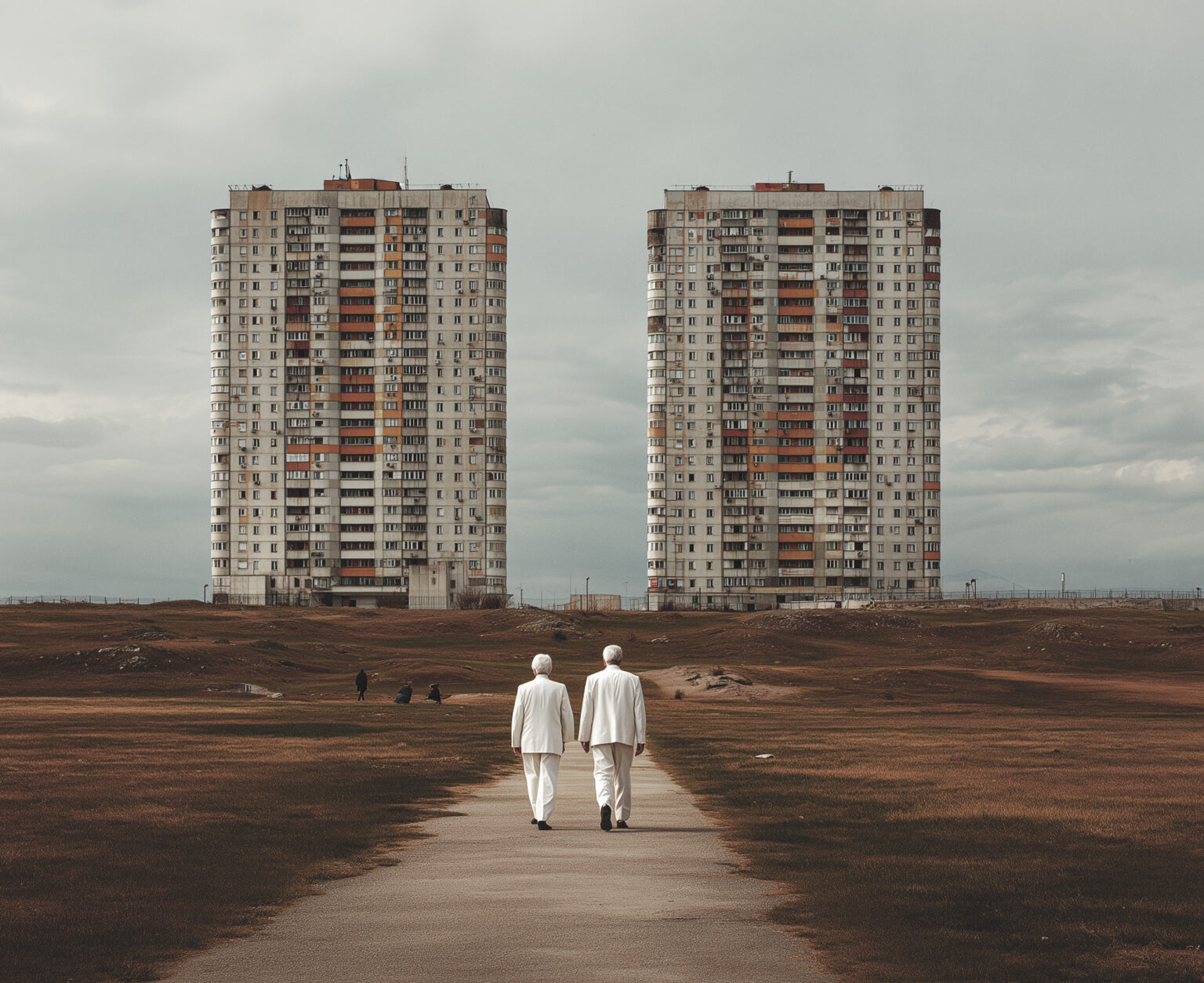
They were the luckiest generation in modern history: the baby boomers, born between 1946 and 1964—in Germany, even stretching until 1969. As children of the postwar recovery, they enjoyed unprecedented access to jobs, housing, higher education, and cultural self-confidence.
They stormed the streets in 1968, dreamed of Woodstock, and later moved into detached homes with subsidised mortgages. They shaped Europe’s prosperity and the liberal order. Yet as they retire in large numbers, their grip on wealth and institutions casts a long shadow. The legacy they leave behind is both dazzling and fragile.
From Emancipation to Entrenchment
The boomers grew up in a time of expanding economies, cheap credit, and rapid social change. Their parents rebuilt after the war; while they inherited rising factories, generous welfare states, as well as a belief in progress. For decades, this seemed like a success story without end. Boomers became the backbone of Europe’s middle class, holding secure jobs in industry, government, and academia.
But the habits of abundance hardened into structures of exclusion. What was once emancipation became entrenchment. Housing policies that had once opened doors now protect existing homeowners. Labour markets became less open, favouring those with permanent contracts. Those who once marched for freedom ended up institutionalising protection for themselves.
The numbers tell the story. In Germany, over 60% of private property is held by those above 60, according to the Bundesbank, while the country faces a shortage of some 700,000 affordable homes. In Britain, house prices have quadrupled since the 1990s, thanks in part to Thatcher’s ‘Right to Buy’ policy—a windfall for older owners, a barrier for the young. Millennials speak bitterly of a ‘lost ownership generation.’ In Italy, nearly 16% of GDP goes to pensions—the highest share in Europe—leaving younger Italians juggling precarious jobs with little hope of security. The image is telling: an overflowing banquet table, where the elders have eaten their fill while the young wait in the corridor.
Memory as Power
Culturally, the boomers still own the stage. Radio stations replay their youth anthems, museums curate exhibitions around their icons, and politicians echo their slogans. The United States illustrates the paradox starkly: Joe Biden (b. 1942) and Donald Trump (b. 1946) embody the political dominance of an ageing generation. France still frames its political debates through the lens of 1968. Emmanuel Macron, though younger, often appears as a footnote to a boomer narrative he cannot escape.
The irony is striking: a generation that once derided its parents’ cultural fossils has itself become fossilised—guardians of memories that leave little room for new myths. In music, politics, and public debate, nostalgia functions as a quiet form of power. It reassures the boomers that their story is still the central story, while leaving younger generations searching for a voice that does not sound borrowed.
Caught in the middle is Generation X, born between the mid-1960s and early 1980s. Too young to share the triumphalism of the boom, too old to be digital natives, they occupy an uneasy in-between. In the US, Barack Obama (b. 1961) stands as a transitional figure, bridging civil rights idealism with pragmatic technocracy. Elon Musk (b. 1971) embodies the restless edge of Xers, half countercultural, half capitalist. In Germany, many Gen Xers saw the fall of the Berlin Wall as their defining moment—only to watch the political space be retaken by older boomers and then by impatient millennials.
Their role has been that of the sandwich generation: pragmatic, adaptable, often ironic, but rarely celebrated. Many hold boomer-like privileges such as property, yet they also garner the resentment of younger cohorts who brand them ‘mini-boomers.’ Generation X remains a generation without a clear myth—holding only contradictions.
Europe’s Unfinished House
The European project itself carries a boomer signature. Peace, unity, and prosperity were its core promises—and for decades, it delivered. But as Europe ages, faces migration pressures, and with the spectre of war on its borders, those promises ring hollow. Boomers treated Europe as an insurance policy: they paid in, they profited, they stopped asking questions. What is missing today is not bureaucracy but vision. Millennials and Generation Z, raised in crisis mode, see the gap more clearly than the boomers who built the structure.
The boomer legacy is therefore ambivalent. Without them, no liberal prosperity, no cultural flowering, no open societies. But without reform of their institutions and mindsets, stagnation looms. Housing markets, pension systems, and cultural memory all need renewal. Will boomers loosen their grip? Can younger generations muster the strength to create new myths? Perhaps Generation X, accustomed to being in-between, could serve as bridge-builders—ironic observers who know how to live with contradictions.
The lasting grip of the boomers is both a gift and a burden. Their triumph was to build a house of prosperity; their failure is to still occupy every room. The children stand outside, restless and shivering, while Generation X waits in the hallway with a ring of keys that do not quite fit. The question is not whether the house will endure—but whether anyone will want to live in it when its walls start showing cracks.
Statement
The baby boomers, born after 1945, were history’s luckiest generation: beneficiaries of prosperity, housing booms, and cultural emancipation. Yet their enduring grip on wealth, politics, and memory now blocks renewal. Younger generations face inflated property markets, unsustainable pensions, and nostalgic politics. In the US, Biden and Trump exemplify boomer dominance; in Europe, pensions and housing skew resources. Generation X sits uncomfortably in between, pragmatic but overlooked. Europe itself reflects the boomer paradox: a house once solid, now with crumbling foundations. Without reform, their legacy risks paralysis; yet, new myths might be crafted by those waiting at the door.