
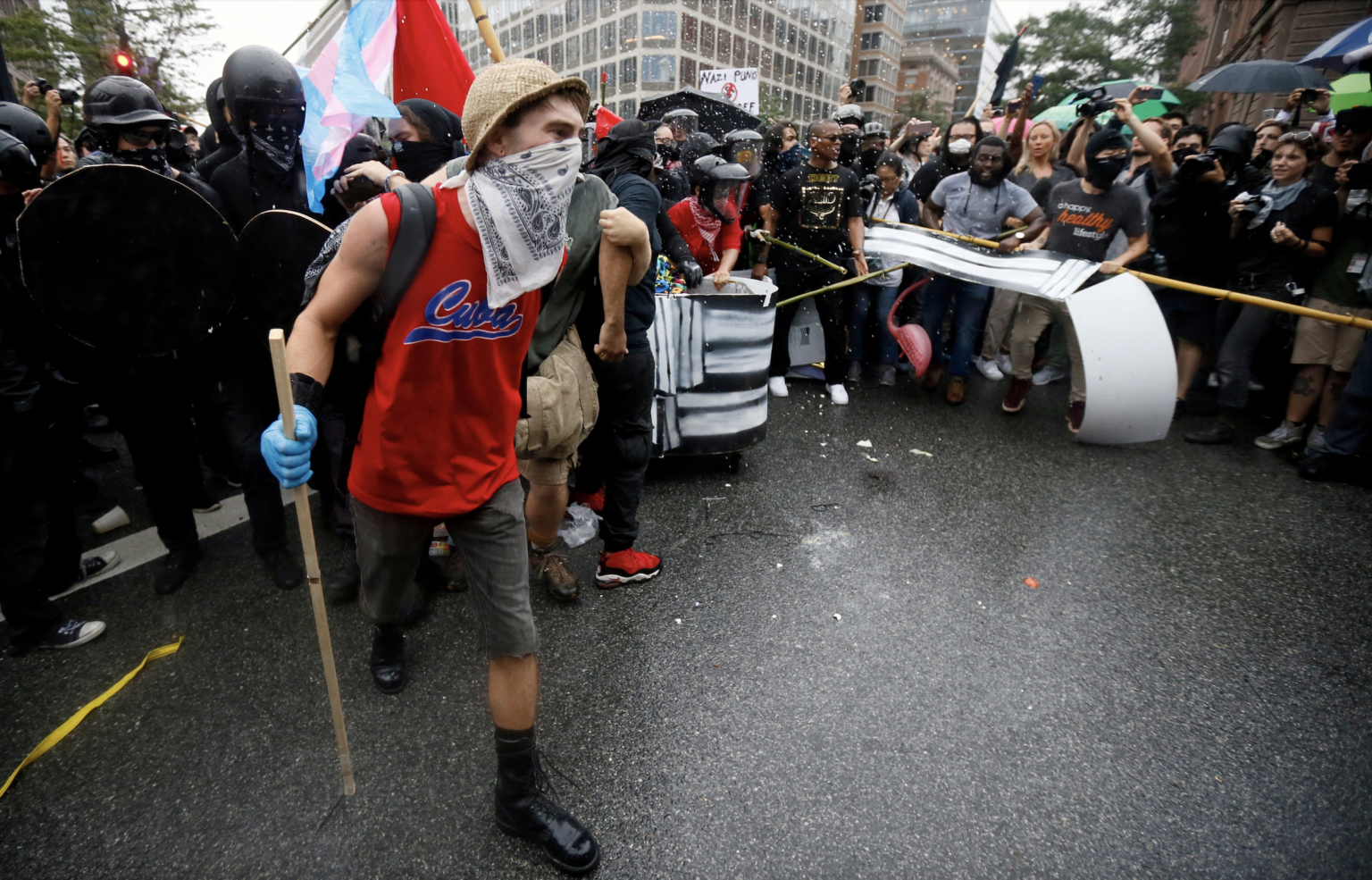
US President Donald Trump signed an executive order on Monday classifying the Antifa movement as a “terrorist organization,” according to the White House.
This came after he announced steps against left-wing groups following the assassination of conservative activist Charlie Kirk. According to the results of the investigation so far, Kirk was murdered by a supporter of radical left-wing ideologies.
The shooter's parents confirmed that he had “moved further to the left” politically. Witnesses pointed out that the assassin, Tyler Robinson, was in a “romantic relationship” with his roommate Lance Twiggs, who is in a “transition” process, and that they had communicated about the murder via text message. The shell casings found by investigators in the wooded area near the rifle used in the attack bore several slogans and symbols directly referencing the Antifa movement.
Trump's 370-word executive order requires “all relevant executive departments and agencies” to investigate, disrupt, and dismantle all illegal activities originating from Antifa or its funders, the White House said.
“Individuals associated with Antifa and acting on its behalf also coordinate with other organizations and entities to spread, promote, and amplify political violence and to suppress lawful political expression.”
Trump had wanted to take this step for a long time
Although US authorities have the power to take action against domestic terrorism, the American legal system does not allow domestic groups to be officially classified as terrorist organizations—unlike foreign organizations such as the Islamic State or al-Qaeda.
During his first term in office, following the Black Lives Matter protests in the wake of the death of African American George Floyd, Trump announced that he would classify Antifa as “terrorist” on a par with al-Qaeda and the “Islamic State.” However, this did not happen at the time.
Classification as a foreign terrorist organization allows law enforcement agencies to arrest or prosecute anyone who supports such a group.
However, this law does not apply to domestic organizations, as it could be abused against political opponents and would violate the First Amendment to the US Constitution, which protects freedom of speech.
Foreign connections
According to a representative of the Department of Justice, however, Trump's order opens up far-reaching investigative and surveillance powers. An unnamed source explained that such a designation would allow the government to more closely monitor the finances and movements of US citizens and to examine the foreign connections of the loose network of groups and non-governmental organizations that the administration classifies as Antifa.
According to the source, the FBI's counterterrorism and counterintelligence divisions will be used to track financial flows—both domestic and foreign—and to try to identify central leadership. Normally, however, the FBI's operations are severely restricted when it comes to targeting US citizens.
“The main target is foreign capital that interferes in US politics and is linked to foreign bank accounts,” a White House source familiar with the plans told Reuters.
“The designation of Antifa gives us the authority to subpoena banks, review wire transfers, track domestic and foreign sources of funding, and the like,” the source added.
It is unclear which individuals the investigation would specifically focus on.
What is Antifa?
The movement, which originated in the Soviet Union in the 1930s, “still uses the same tactics,” as journalist and commentator Jack Posobiec pointed out. In 1932, the then Comintern founded the so-called Anti-Fascist Action, whose goal was to transform interwar Germany into a Soviet-style state.
One result was the Bavarian Soviet Republic, which was crushed by World War I veterans after a month of existence. However, their tactic was to label their opponents “fascists” and then use violence against them. In the same way, the Soviets organized Marxist militias in Spain during the civil war, which General Francisco Franco won.
Antifa likes to pretend it’s a grassroots resistance. The truth? It was born in Bolshevik Moscow.
— Jack Poso 🇺🇸 (@JackPosobiec) September 18, 2025
In the 1930s, the Soviet Union used antifascism as a Trojan horse to spread communism across Europe. In Germany, Stalin’s Comintern bankrolled the Communist Party to launch…
Posobiec assessed the strategy of the Antifa movement as identical to that of its historical predecessors and warned of a possible plan “that the same scenario could be implemented in America.”
At the end of Trump's first term, legal historian Michal Malatinský highlighted two books that, although written from opposing perspectives, accurately describe the ideology on which Antifa is based.
While Anarchism historian Mark Bray's “Antifascist Handbook” attempts to paint a picture of heroic fighters against right-wing extremism, investigative journalist Andy Ngo's book Unmasking Antifa takes a highly critical view of the movement.
However, both authors agree that Antifa, in addition to extreme left-wing Trotskyism, turns to anarchism as a method and shows a certain “attachment” to the interwar period, when it “fought” against monarchism, National Socialism, and communism.
In his research, Ngo also pointed to the broad support for Antifa from some Democratic congressmen and legal organizations. In the northwestern states of the US, they are so well established that during the protests following the death of African American drug addict George Floyd in Seattle, the “Autonomous Zone” CHAZ (Capitol Hill Autonomous Zone) was declared, in which no official security forces were present.
In addition to Seattle (Washington State), Antifa is also particularly active in the city of Portland (Oregon State). Its nickname, Rose City, is also the name of one of the oldest local groups in the US – Rose City Antifa.
However, a specific feature of Antifa is that it has no centrally organized structure. Instead, it consists of ideologically linked groups and movements that profess to be self-proclaimed “anti-fascists.”
Among these groups is an offshoot called Trantifa, which combines the “fight for the rights of transgender people” with the “fight against fascism.” As early as 2023, the UN Special Rapporteur on the Rights of Women, Reem Alsalem, warned against this movement.
Part of the Trantifa movement is an extremist activist group in America known as Zizians. It is named after a man named Jack Amadeus LaSota, who goes by the nickname “Ziz.” Members of this group are responsible for at least six cases of violent crime, including murder and mutilation.
As Ngo, who has long been involved with the Antifa issue, pointed out, Robert Westman, the shooter from a Catholic school in Minneapolis, could also profess allegiance to this “vegan, rationalist trans movement.”
(reuters, ap)