
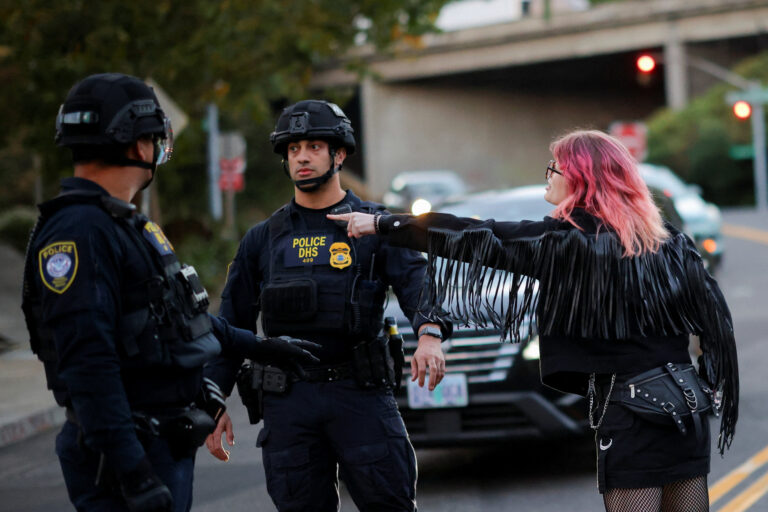
In the United States, large-scale operations to search for and arrest illegal immigrants continue, as does the often violent resistance against federal immigration and customs officials (ICE). In some cases, these officials are protected by members of the National Guard, which has been met with fierce criticism from the opposition.
On August 11, US President Donald Trump took “control” of the District of Columbia, where, with few exceptions, all federal agencies and Congress are based. Even then, he announced that “Chicago would be the next target,” followed by New York.
At the same time, following the murder of conservative activist Charlie Kirk, he described the Antifa movement as a terrorist organization whose unofficial center in Portland, Oregon, became the scene of violent protests. Left-wing extremists protested against the detention of migrants and demonstrated in front of the local ICE headquarters on Saturday.
West Coast
Federal officials used tear gas and non-lethal pepper-based projectiles, known as pepper balls, against the approximately 400 protesters. The demonstrations continued on Tuesday and show no signs of abating.
Oregon Governor Tina Kotek refused to deploy the state's National Guard to protect the “federal” agents, and when Trump wanted to federalize them [place them under the control of the Pentagon, editor's note], Judge Karin Immergut, whom he himself had appointed, prevented him from doing so. She argued that a protest of this small scale posed no danger to ICE officers.
Instead, the White House chief called in 300 soldiers from the California National Guard. This overreach surprised many, even among his supporters. Among his opponents, Governor Gavin Newsom stood out, immediately filing a lawsuit against the federal government.
“This is a breathtaking abuse of law and power. The Trump administration is recklessly attacking the rule of law and putting its dangerous rhetoric into action – ignoring court orders and treating judges, even those appointed by the president himself, as political opponents,” he wrote in the complaint.
California's largest city, Los Angeles, was already the scene of violent clashes between federal officials and coordinated protesters in June. At that time, Trump called in the National Guard and the Marine Corps for help, although he never deployed hundreds of “Marines.”
Chicago had been the target for weeks
Trump took a similar step, namely deploying the National Guard from another state, in the case of the largest city in the state of Illinois. He was criticized for this by Mayor Brandon Johnson and Governor JB Pritzker, who expressed their concern about the militarization of civilian life.
“We have to call it what it is: Trump's invasion,” said the Democratic governor, adding that the president intended to deploy 400 members of the Texas National Guard. He added that “no federal official has called me directly to discuss or coordinate this.”
He called on Texas Governor Greg Abbott to refuse to cooperate with Trump. However, Abbott has long been a supporter of the Republican leader and therefore rejected this request. “The elite of the Texas National Guard. Always ready. Currently on duty,” he wrote in a brief response on the X network.
On Monday, Chicago Mayor Brandon Johnson also joined Governor Pritzker's opposition and signed an ordinance banning ICE operations in certain parts of the city. This was a legally unnecessary step, as state law is subordinate to federal law, although Johnson warned of legal action in the event of a violation.
The purpose of the announced “ICE-free” zones is to prevent federal officials from using municipal facilities to detain migrants. They are therefore prohibited from setting up outposts or holding migrants in municipal jails.
However, Johnson's move slightly missed its mark when, on the same day, Northern Illinois U.S. Attorney Andrew Boutros announced the indictment of Juan Espinoza Martinez, the alleged boss of the Latin Kings criminal organization. The reason was the suspicion that the mobster had ordered the murder of Border Patrol (CBP) Commander Gregory Bovino.
Bovino officially heads Operation Midway Blitz, in which immigration officials track down members of the Venezuelan drug gang Tren de Aragua. Trump classified this gang as a “narco-terrorist” organization on January 20.
Republican governors work together
Representatives from states such as Bill Lee of Tennessee and Jeff Landry of Louisiana announced in late September/early October that they would activate the National Guard to protect federal officials searching for and arresting migrants.
Last week, Attorney General Pam Bondi and White House Deputy Chief of Staff Stephen Miller announced that the Tennessee National Guard would protect ICE officials in the state's second-largest city, Memphis. As recently as 2014, the city ranked sixth among cities with the highest violent crime rates, although it has reached a 25-year low this year.
Against the backdrop of these measures, Miller's star is rising. In addition to his deputy Susie Wiles, he is also Trump's advisor on internal security and chief of staff for speechwriting. He is also known for his harshest statements against illegal immigrants, and an ironic remark is circulating on social media that “no one is anti-Semitic toward him for security reasons.”
Notice how no one’s ever antisemitic toward Stephen Miller. pic.twitter.com/KD2fXU20tu
— Leonarda Jonie (@leonardaisfunE) June 25, 2025
However, it is Miller who is largely responsible for coordinating raids against migrants and tightening border security. His power in high circles thus grows with each successful raid.
At the beginning of the summer, the president attempted to deploy the army within the United States, in open violation of the Posse Comitatus Act (1878). Members of his administration, notably Vice President JD Vance, announced the application of the older Insurrection Act (1807), which allows the use of the army against “internal enemies.”
However, Trump and Secretary of Defense (now Secretary of War) Pete Hegseth withdrew the National Guard and the Marines before legal experts had reached a compromise between these laws.
The next step, however, which already crosses the line, is the deployment of the National Guard in states other than their home states. Here, too, Trump is testing the limits of the expression “politics as the art of the possible,” playing with the units of the de facto reservists of the U.S. Army. According to Chapter 32 of the U.S. Code, National Guard troops are primarily subordinate to the governor of their respective state.
Before the elections, the Republican declared ironically that he would be a dictator on his first day in office. However, it is only after nine months that he is taking steps that could be described as dictatorial.