
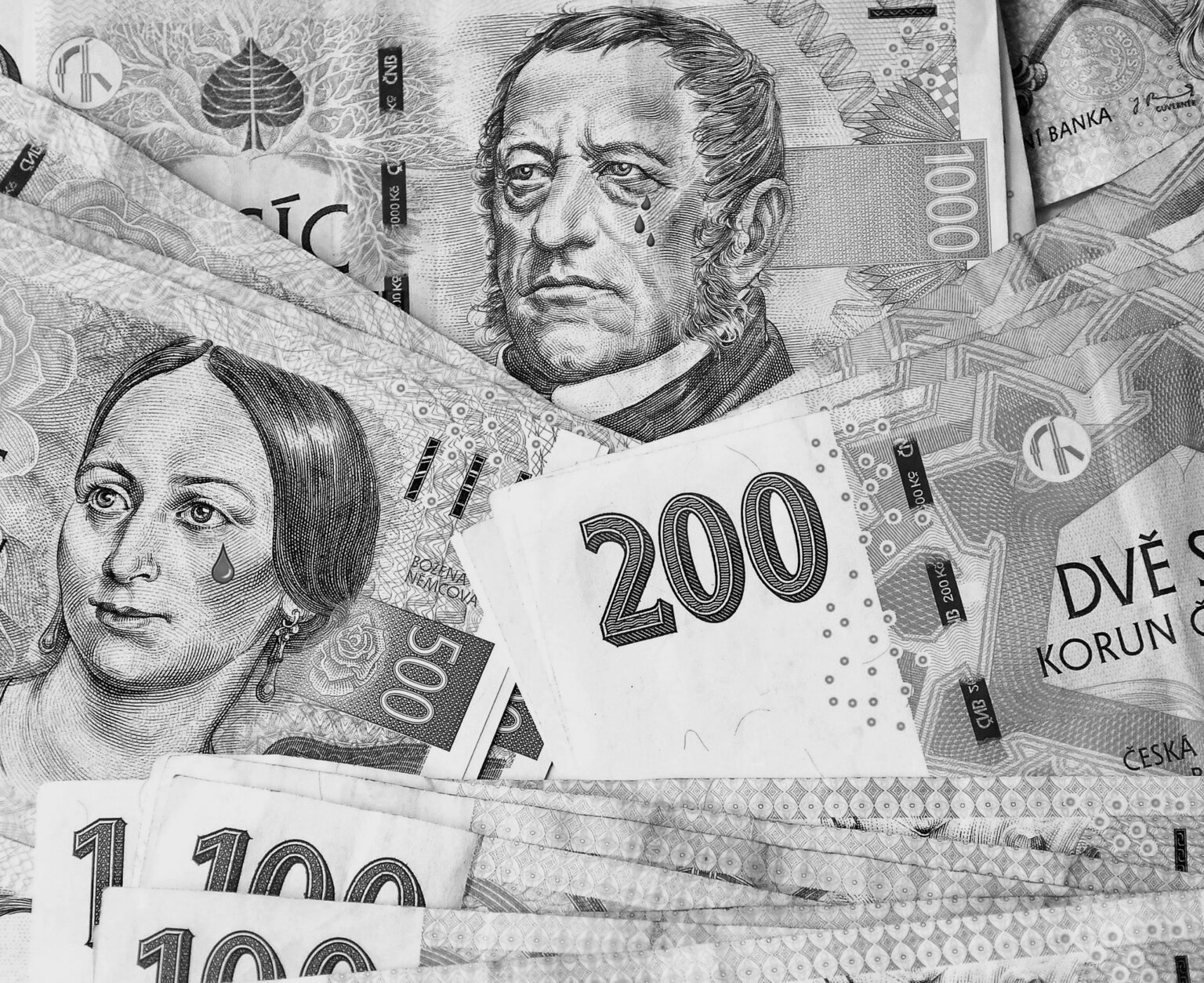
The Covid pandemic caused a deficit of 419 billion Czech crowns (€17.2 billion) in 2021. The Fiala government reduced the deficit, helped in part by the partial recovery of the economy. The outgoing government’s best result was a deficit of 271 billion crowns (€11.1 billion) in 2024.
For 2025, a deficit of 241 billion crowns (€9.9 billion) was planned, but according to election winner Andrej Babiš, it will be higher, as 38 billion crowns (€1.6 billion) are missing for the construction of roads and railways. In addition, the budget includes 10 billion crowns (€0.4 billion) from EU funds, for which it is still unclear how exactly they will be used.
Futile fight against the deficit
The Czech government is resisting, but the deficit for 2025 will reach between 241 and 289 billion crowns (€9.9–11.9 billion). The government is therefore continuing its wasteful policy. High expenditures and high deficits, which were understandable during the pandemic, have now become the norm.
The Czech state has turned into a “greedy entity” unable to bring the deficit back to its original level of around 100 billion crowns (€4.1 billion). The saddest part is that cumulative inflation during the Fiala government’s term reached 30.9 percent. High inflation benefits the state, as price increases lead to higher VAT revenues.
Another worrying factor is that the Fiala government could not resist the temptation to buy voters in the election year. It significantly eased its efforts toward a balanced budget and still failed to win the elections. Ultimately, Czech taxpayers will have to pay for this policy.
The consolidation package did not significantly reduce the deficit. It raised corporate tax from 19 to 21 percent, adjusted the progressive tax rate for individuals, abolished the kindergarten subsidy, and limited the tax allowance for non-working spouses to those with children under three years old. It also increased minimum contributions for the self-employed and raised property tax. Nevertheless, the state deficit remains enormous.
The outgoing government defends itself by citing the energy crisis and the war in Ukraine, which allegedly prevented better economic management. Leading a country is never easy, and the next government will also face crises.
This excuse, however, is not very convincing. Some European countries have managed to return their budgets to pre-pandemic levels. Spain and Portugal, which have even achieved budget surpluses twice in a row, are proof that it is possible. Of course, there are also countries that are doing worse, such as Slovakia or France, but citizens do not expect their government to compare itself to the worst performers.
How to solve a fundamental problem
Politicians are not all-powerful. The Czech budget, like most European budgets, is tied to mandatory expenditures that the state must cover. Finding savings elsewhere is difficult, as shown by the previous government’s consolidation package, which affected almost everyone but did not solve the problem.
The main cause of the massive post-Covid deficit was the abolition of the super-gross wage. This tax included not only the gross salary but also the employer’s mandatory contributions, effectively applying a 15 percent tax on a higher amount. After the super-gross wage was abolished, the tax base was limited to the gross salary, effectively reducing employees’ tax burden.
According to a study by the National Budget Council, this measure caused revenue losses of more than 102 billion crowns (€4.2 billion) in 2021. The increased purchasing power of employees brought the state an additional 15 billion crowns (€0.6 billion) per year through higher VAT and excise tax revenues.
The reform was proposed by the ANO movement during the pandemic and supported by the ODS due to its promise of lower taxes. The problem was that this change was not temporary. The result is a regular loss of revenue for the state budget of 110–130 billion Czech crowns (€4.5–5.4 billion) annually.
Reintroducing the super-gross wage would bring the deficit much closer to normal levels. However, no political party is promising this change, as it would risk losing voter support. Without such a step, it will be very difficult to bring public finances to a sustainable level.
Babiš’s populist plan
We do not yet know what the new Czech government will look like or what its final policy statement will be. What is certain, however, is that it will most likely be led by the ANO movement under the leadership of Andrej Babiš.
His election program was populist, filled with unfulfillable promises. In his view, the state should both save money and spend it at the same time. Babiš did not hold back on grand promises: starting salaries for customs officers should be 50,000 crowns (€2,050), for teachers 75,000 crowns (€3,080), the retirement age should be restored to 65, and taxes should be reduced.
The program also includes promoting financial literacy, which could backfire on the new government since financially literate people cannot take such a program seriously. It may sound attractive but does not correspond to economic reality.
In response to economic objections, Babiš claimed he would raise the necessary funds by combating the shadow economy. The shadow economy in the Czech Republic is significant, accounting for about 14 percent of GDP, meaning the state loses more than one trillion crowns (€40+ billion) in untaxed income.
At first glance, this seems like a promising solution, but fighting the shadow economy is not easy. Some measures, such as mandatory cash registers or simplified income tax administration, can be implemented quickly. Many issues, however, are moral in nature and cannot be changed overnight.
Even if Babiš were successful in combating the shadow economy, tax revenues could increase by 60–100 billion crowns (€2.5–4.1 billion) per year. This would significantly help the Czech state budget, but it is still unclear where Babiš would find the additional tens or even hundreds of billions needed to fulfill his promises.
It can therefore be said that the Czech budget is caught in a structural trap that no political actor wants to escape from. Czech politics, therefore, lives on borrowed time — economically and morally alike.